OTTAWA — Hardly anybody seems interested in subsidy programs to install chargers for electric trucks, Natural Resources Canada warned Minister Jonathan Wilkinson earlier this year, and the federal goal of having all new trucks be zero-emissions vehicles by 2040 is at risk.
Skip to content


News
Feeble interest in heavy chargers puts feds’ goal of zero-emissions trucking at risk: NRCan
Sales of heavier electric vehicles lag passenger cars badly, with 2040 target on horizon
Newly manufactured trucks at the Lion Electric Company assembly plant in Saint-Jerome, Que., in August 2023. Photo: The Canadian Press/Christinne Muschi
OTTAWA — Hardly anybody seems interested in subsidy programs to install chargers for electric trucks, Natural Resources Canada warned Minister Jonathan Wilkinson earlier this year, and the federal goal of having all new trucks be zero-emissions vehicles by 2040 is at risk.
Talking Points
- As many as 275,000 heavy-duty chargers will be needed to meet demand if Canada is to achieve the federal government’s goal to have only zero-emissions trucks and buses sold by 2040
- Natural Resources Canada has seen minimal interest in its subsidies for heavy chargers and officials have been worried about local power grids’ capacity to feed the chargers if anybody wanted them
Sales of electric medium- and heavy-duty vehicles—including school buses, delivery vans and tractor-trailers—are a fraction of sales of electric cars, deputy minister Michael Vandergrift wrote in a briefing note to Wilkinson. Electric versions were 2.1 per cent of new registrations in 2023 for heavier vehicles versus 11.2 per cent of light-duty ones.
The briefing note was dated Feb. 8. The Logic obtained a partly redacted copy through an access-to-information request.
With a target of 100 per cent now only 16 years away, there’s a lot to do. “Failure to deploy sufficient and reliable charging infrastructure would create risks for meeting longer-term sales targets and causing further delays in the EV transition,” the note said.
Moreover, although Natural Resources has a program to subsidize the costs of installing new chargers, just 0.02 per cent of its funded projects have been for the powerful charging systems aimed at heavier vehicles, Vandergrift reported.
Related Articles

The department opened a new round of applications for charger subsidies in July that closed Thursday, spokesperson Michael MacDonald wrote in an email. That could see more chargers for heavier vehicles installed.
Range anxiety is as much a problem in the medium- and heavy-duty zero-emissions vehicle (MHZEV) sector as it is for consumers considering what cars to buy, Vandergrift wrote in the note to Wilkinson: “A 2023 national survey of potential MHZEV owners found the majority feel it is difficult to find credible information on ZEV performance and access to charging and refuelling infrastructure, and that most respondents believe battery-electric vehicles have insufficient range.”
To meet anticipated needs, Canada will need 34,000 public chargers and 205,000 chargers in private truck depots, the briefing note says, citing a Pembina Institute report.
A fresh study the department commissioned concluded the total needed is higher—275,000—if battery power is the only zero-emissions technology used to meet the goal for heavier vehicles, MacDonald wrote.
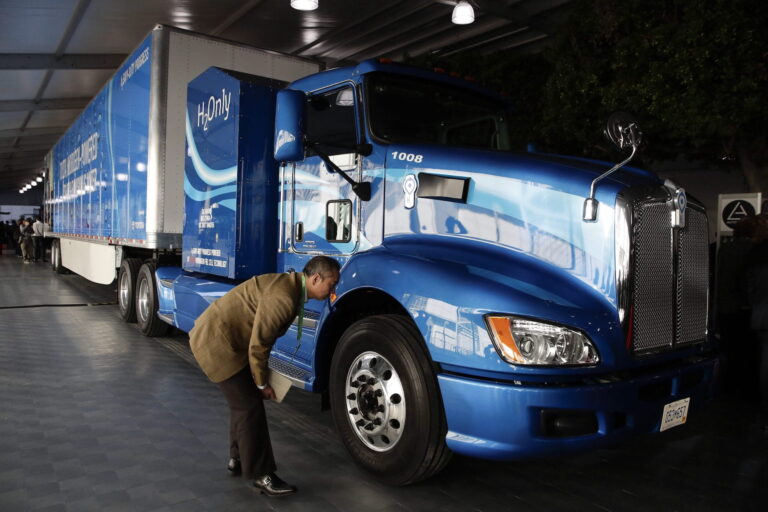
(Batteries aren’t the only possibility. The Canada Infrastructure Bank is backing a commercial project supporting hydrogen-powered trucks; hydrogen can be pumped like diesel and takes less space and weight than batteries to deliver the same energy. But batteries are a more mature technology.)
“If anything happens, truck drivers need to know that they can rely on the infrastructure and that there are charging stations available.”
Heavier vehicles have bigger batteries and need heavier infrastructure to recharge them fast enough to be practical, said Patrick Gervais, vice-president of both trucks and public affairs at Lion Electric. The Quebec company makes school buses and several models of freight trucks.
Even a heavy charger that can push out about 250 kilowatts of electricity will take an hour to charge a Lion truck. That’s fine for most trucking needs under normal circumstances, which see drivers start from a depot in the morning, run a delivery route of up to a few hundred kilometres with several stops, and return at night, Gervais said. Plugging in at the depot overnight will do the job.
“But if anything happens—if they extend a route, or have something [unexpected] come up, they need to know that they could rely on the infrastructure and that there are charging stations available,” Gervais said.
Some heavily used transportation corridors, such as between Toronto and Quebec City, are beginning to get heavy charging stations, Gervais said, but they’re not everywhere, and certainly not as widely available as they would need to be to support long-haul trucking.
“Perception is everything, so it’s important that consumers, customers, people, see them,” he said.
However, Gervais pointed out, if Canada wants to electrify long-haul trucking, it’ll need facilities specifically designed for those big vehicles. It’s rarely practical to pull a truck of any size up to a charger intended for a private car, “next to McDonald’s and Subways and things like that,” he said.
Natural Resources also acknowledged to its minister that heavy chargers, in the numbers it wants to see, will strain local power systems. A heavy charger needs to deliver a lot of electricity at once, going through more power in four hours of charging than a typical Canadian household does in a month.
“The department is coordinating internally to address issues related to grid capacity and technology readiness,” the deputy minister wrote.



Loading...
Thanks for sharing!
You have shared 5 articles this month and reached the maximum amount of shares available.
CloseThis account has reached its share limit.
If you would like to purchase a sharing license please contact The Logic support at [email protected].
CloseGift the full article!
You have gifted 0 article(s) this month and have 5 remaining.
Recipients will be able to read the full text of the article after submitting their email address. They will not have access to other articles or subscriber benefits.
Photo: The Canadian Press/Christinne Muschi
Most Popular This Week




In-depth, agenda-setting reporting
Great journalism delivered straight to your inbox.
Commentary
Carmichael: Being boxed in will help Canada focus on what matters
Briefing
Rio Tinto gets nearly $165M in additional federal funds for Quebec aluminum
U.S. to lift tariffs on some Canadian products crucial to Maine: Collins
Carney warns of tech dependence after Starlink disruptions in Ukraine
Best business newsletter in Canada
Get up to speed in minutes with insights and analysis on the most important stories of the day, every weekday.
Exclusive events
See the bigger picture with reporters and industry experts in subscriber-exclusive events.
Membership in The Logic Council
Membership provides access to our popular Slack channel, participation in subscriber surveys and invitations to exclusive events with our journalists and special guests.






