OTTAWA — With a $337-million loan to B.C.’s HTEC, the Canada Infrastructure Bank hopes to kickstart a hydrogen-fuelled trucking network connecting Vancouver to Prince George, Calgary and Edmonton.
Skip to content
 The Vancouver port authority's container terminal south of the city, where HTEC plans to build the first of its new hydrogen fueling stations. Photo: The Canadian Press/Darryl Dyck

News
Infrastructure bank lends $337M for hydrogen fuel station network in West
B.C. firm HTEC plans to fuel truck fleets serving Vancouver, Prince George, Calgary, Edmonton
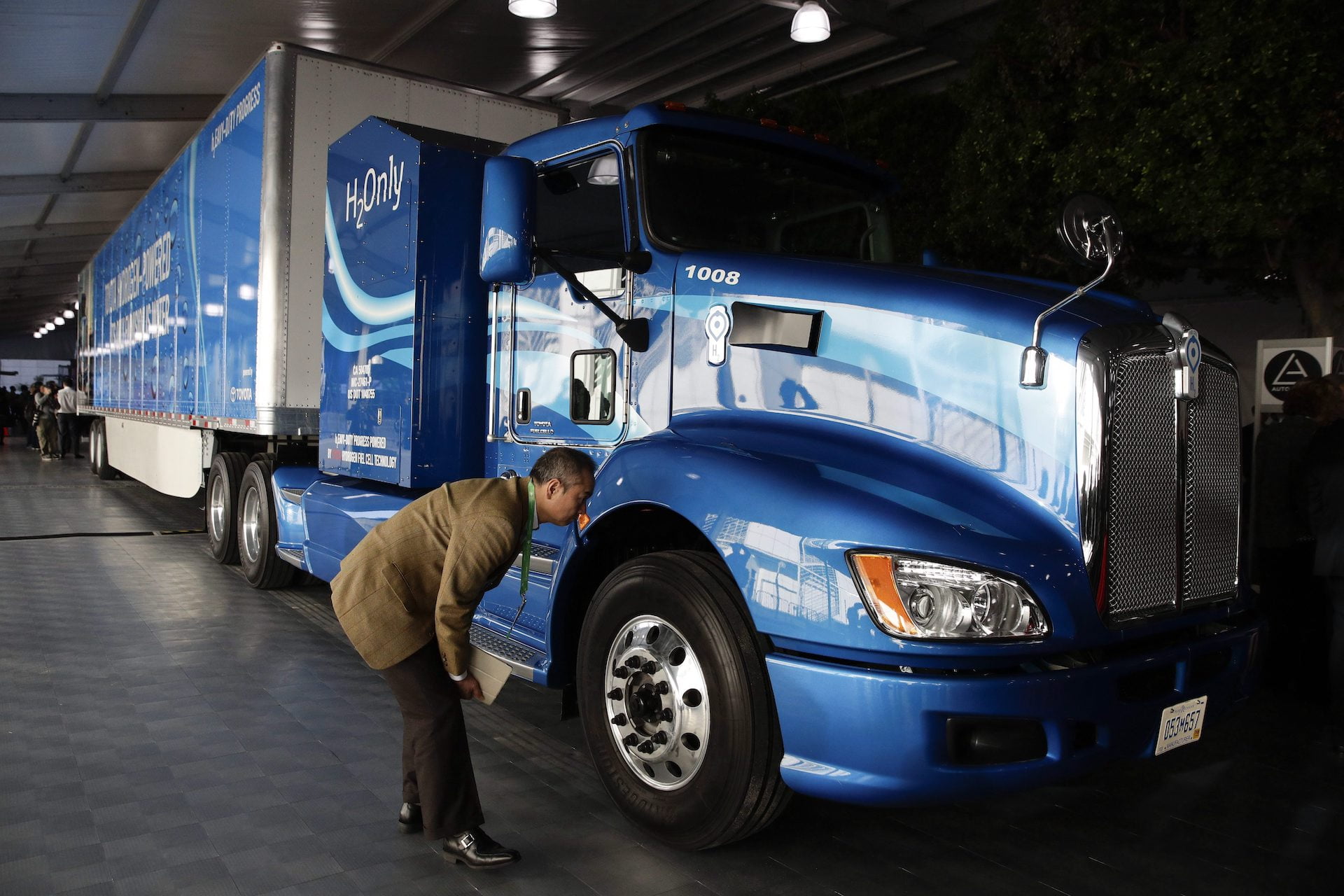
Toyota's hydrogen fuel cell truck at the Los Angeles Auto Show in November 2017. With help from the Canada Infrastructure Bank, the B.C. firm HTEC plans to build a fueling network in Western Canada for hydrogen-powered transport trucks. Photo: The Associated Press/Jae C. Hong
OTTAWA — With a $337-million loan to B.C.’s HTEC, the Canada Infrastructure Bank hopes to kickstart a hydrogen-fuelled trucking network connecting Vancouver to Prince George, Calgary and Edmonton.
The bank announced the deal Friday morning. It’s helping fund the expansion of HTEC’s network of five hydrogen stations to as many as 20, and the construction of hydrogen production facilities to feed them.
Talking Points
- Hydrogen is a nascent fuel technology for heavy trucks, but its fans say its practical similarity to diesel and high energy density make it a strong alternative to batteries
- Lack of fuelling options makes it an unappealing choice for now, which the Canada Infrastructure Bank loan is supposed to solve for western truck fleets
“We’re going to build out a network like this at key transportation nodes across the country,” the bank’s CEO, Ehren Cory, said in an interview.
In 2020 the federal government published a national hydrogen strategy. “Ultimately Canada will need a zero-emission option for long-haul trucking to reach [federal] decarbonization goals,” it declared, implying it hoped hydrogen would be that option.
In April, the federal government published a progress report that listed 14 hydrogen fuelling sites open or in progress across all of Canada, including the five HTEC already has, so the new project is to more than double the national total.
Hydrogen technology and electric batteries are duelling power sources for zero-emission trucks. Batteries are a more mature technology, but they can take a long time to charge. Hydrogen can be pumped like diesel and has more energy density, so it takes up less space and weight for the same oomph.
“Going to a battery-powered heavy truck, you would use half of your cargo space to carry your batteries,” Cory said.
Related Articles

But hydrogen suffers as a vehicle fuel, at least in part, because it’s not widely available. HTEC wants to change that.
It already has three fuelling stations in the Lower Mainland and one each in Kelowna and on Vancouver Island. They serve private fleets, but the customer base is growing, said HTEC CEO Colin Armstrong.
“We see [hydrogen] as complementary to battery-electric in pretty much all segments,” he said.
Uber just announced a deal with Toyota to make hydrogen cars available for Vancouver-area drivers to rent. Hydrogen buses have failed before, but they’re making comebacks here and there. Alberta’s trucking industry association is testing several heavy truck models and major manufacturers are experimenting with the technologies; Volvo announced plans for a heavy hydrogen-powered truck just on Thursday.
Starting with short-haul routes around the Vancouver port authority’s container terminal south of the city, Armstrong hopes that studding the highways to Alberta’s major cities (and to Prince George, B.C.) with fuelling stations will make hydrogen truck fleets viable in the western provinces.
HTEC serves 250 to 275 light vehicles now, he said; the expanded network will be able to fuel about 30,000 light vehicles or 400 heavy ones.
The production facilities are key, he said, and they take longer to build than fuelling stations, let alone vehicles, so they need to be planned first. In B.C., HTEC intends to build electrolyzers (which split water into hydrogen and oxygen) in Burnaby, Nanaimo and Prince George, and a facility that liquifies waste hydrogen from a partner in North Vancouver.
“We’re trying to learn from California. They rolled out a lot of stations and a lot of cars and they ran out of hydrogen and the price went up,” Armstrong said.
Vancouver Island is its own hydrogen ecosystem, he said, and it’s relatively easy to serve because it has one major highway running the length of the island.
“We’re talking to a whole suite of fleets that have routes on Vancouver Island, around greater Vancouver, into the Okanagan, to Calgary and up to Edmonton, and up to Prince George,” Armstrong said.
HTEC is also considering more hydrogen facilities in Alberta and Quebec, he said. Quebec has a slightly more attractive regulatory environment, he said, but “Alberta, once it gets going, does things in a big way.”
The infrastructure bank’s loan is long-term, said Cory, with repayments calibrated to uptake—the more customers want HTEC’s hydrogen, the faster the bank gets paid back.
“That’s the risk we’re trying to help them manage. That’s what makes our loan different than a bank loan,” he said.



Loading...
Thanks for sharing!
You have shared 5 articles this month and reached the maximum amount of shares available.
CloseThis account has reached its share limit.
If you would like to purchase a sharing license please contact The Logic support at [email protected].
CloseGift the full article!
You have gifted 0 article(s) this month and have 5 remaining.
Recipients will be able to read the full text of the article after submitting their email address. They will not have access to other articles or subscriber benefits.
Photo: The Associated Press/Jae C. Hong
The Vancouver port authority's container terminal south of the city, where HTEC plans to build the first of its new hydrogen fueling stations.
Most Popular This Week




In-depth, agenda-setting reporting
Great journalism delivered straight to your inbox.
Commentary
Carmichael: Being boxed in will help Canada focus on what matters
Briefing
Rio Tinto gets nearly $165M in additional federal funds for Quebec aluminum
U.S. to lift tariffs on some Canadian products crucial to Maine: Collins
Carney warns of tech dependence after Starlink disruptions in Ukraine
Best business newsletter in Canada
Get up to speed in minutes with insights and analysis on the most important stories of the day, every weekday.
Exclusive events
See the bigger picture with reporters and industry experts in subscriber-exclusive events.
Membership in The Logic Council
Membership provides access to our popular Slack channel, participation in subscriber surveys and invitations to exclusive events with our journalists and special guests.






