Public trust in business executives dropped last year, according to the latest Edelman Trust Barometer, falling more than any other category including political leaders, journalists and scientists. Citizens’ economic optimism also cratered as inflation and higher interest rates roiled markets and thrusted the global economy into uncertainty.
Skip to content
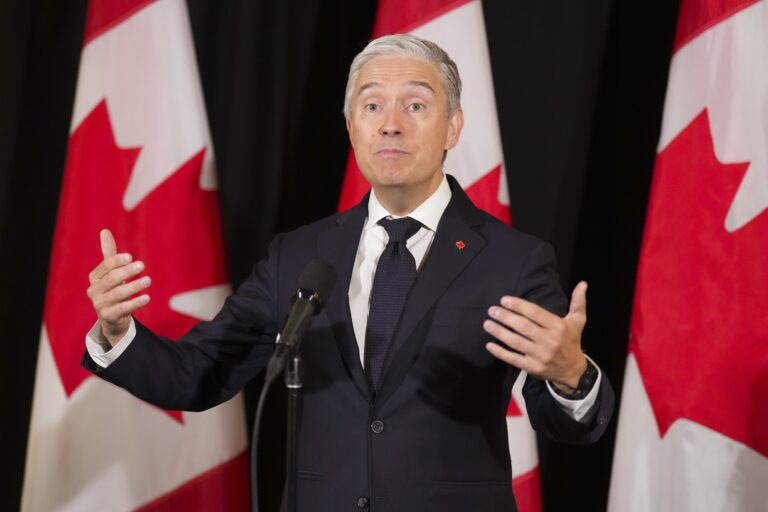
 The public’s trust in CEOs dropped two per cent compared with 2021, with 48 per cent of respondents now saying they had faith in executives. Photo: The Canadian Press/Cole Burston

News
Trust in business leaders falls amid economic uncertainty: Study
Even as distrust in CEOs grew globally, Canadian-headquartered companies registered among the most trustworthy, Edelman Trust Barometer finds
The public’s trust in CEOs dropped two per cent compared with 2021, with 48 per cent of respondents now saying they had faith in executives. Photo: The Canadian Press/Cole Burston
Public trust in business executives dropped last year, according to the latest Edelman Trust Barometer, falling more than any other category including political leaders, journalists and scientists. Citizens’ economic optimism also cratered as inflation and higher interest rates roiled markets and thrusted the global economy into uncertainty.
Those are just a few takeaways from Edelman’s annual global survey, released as the World Economic Forum begins in Davos, Switzerland. It is one of the most extensive indicators of public trust in four core institutions (business, media, government and non-governmental organizations), and this year Edelman surveyed 32,000 respondents in 28 countries.
Here’s what you need to know:
Executives face the brunt of growing distrust: The public’s trust in CEOs dropped two per cent compared with 2021, with 48 per cent of respondents now saying they had faith in executives. Political leaders, co-workers and “people in my local community” dropped by one per cent. Trust in journalists remained unchanged; scientists’ trust increased one per cent, and “citizens of my country” rose two per cent, the most of any category.
Related Articles


Still, overall trust in business was higher than governments by a margin of roughly 11 per cent, according to Edelman. Trust in journalists, while unchanged from 2021, remained lower than that in businesses overall. Forty-two per cent of respondents said the media was a “false or misleading” source of information, compared with 30 per cent for businesses; 46 per cent of respondents said the government was a source of false information.
Canadian businesses highly trusted abroad: Even as overall trust in CEOs fell globally, Canadian-headquartered companies registered among the most trustworthy by foreign respondents. Sixty-seven per cent of foreign respondents said they trusted Canadian companies, compared with Japan (61 per cent), the U.S. (55 per cent) and South Korea (48 per cent). Trust in Chinese companies was 32 per cent.
Economic anxieties and social divisions deepening: The number of people who agreed with the statement “my family and I will be better off in five years” dropped 10 per cent globally in 2022. In Canada, agreement with the statement dropped six per cent, compared with the U.S. (negative four per cent), the U.K. (negative seven per cent) and Australia (negative 11 per cent).
Concerns over job loss was the biggest source of anxiety among respondents (89 per cent), followed by climate change (76 per cent), inflation (74 per cent) and nuclear war (72 per cent).
Most respondents (53 per cent) believe their country is more divided today than in the past. In Canada, 60 per cent of respondents felt the nation is more divided.
Business leaders, NGO leaders and teachers, however, are seen as a “unifying force” amid widening divisions, while journalists, government leaders and hostile foreign governments were seen as dividing forces.



Loading...
Thanks for sharing!
You have shared 5 articles this month and reached the maximum amount of shares available.
CloseThis account has reached its share limit.
If you would like to purchase a sharing license please contact The Logic support at [email protected].
CloseGift the full article!
You have gifted 0 article(s) this month and have 5 remaining.
Recipients will be able to read the full text of the article after submitting their email address. They will not have access to other articles or subscriber benefits.
Photo: The Canadian Press/Cole Burston
Most Popular This Week



In-depth, agenda-setting reporting
Great journalism delivered straight to your inbox.
Commentary
Carmichael: Canadian ignorance about India is a strategic weakness
Briefing
Aritzia shares pop after earnings rise 204%
First Nation in Alberta goes to court over fast-tracked oil pipeline
Chinese EV maker Geely Auto Group to launch in Canadian market in 2027
Best business newsletter in Canada
Get up to speed in minutes with insights and analysis on the most important stories of the day, every weekday.
Exclusive events
See the bigger picture with reporters and industry experts in subscriber-exclusive events.
Membership in The Logic Council
Membership provides access to our popular Slack channel, participation in subscriber surveys and invitations to exclusive events with our journalists and special guests.