Listen Now
0:00
TORONTO — Cohere and its German counterpart Aleph Alpha have finalized terms on their deal to become one company and are now seeking regulatory approval. The development comes as the Toronto-based firm races to secure compute to help it close the gap with Silicon Valley’s AI giants.
“Creating a joint, transatlantic Canadian-European champion will add tons of revenue and growth to the company,” Cohere CEO Aidan Gomez told The Logic. Gomez will lead the combined firm, which will keep the Cohere name.
Talking Points
- Cohere has agreed on final terms and signed its deal to combine with Aleph Alpha, its German counterpart. The merger, announced in April, is designed to create a Canadian-European champion that can sell sovereign AI solutions to clients that want an alternative to U.S. and Chinese technology.
- Cohere is also doing deals to secure more compute as it tries to close the gap between its models and those of Silicon Valley frontier labs like OpenAI and Anthropic
The deal with Aleph Alpha, first announced in April, brings Cohere staff with knowledge of the European market and a client base in the German public and private sectors. While Cohere makes its own AI models, Aleph Alpha now primarily sells sovereign software and services.
Gomez said the technology that the two firms have built is complementary. Aleph Alpha has “domain expertise in these highly-regulated European government and private-sector customers that need a set of guarantees for compliance,” he said. Integrating its technology will allow Cohere to accelerate its business in those industries.
Cohere has touted its AI systems as well-suited to the push for sovereign technology, and an alternative to reliance on the commercially controlled products of U.S. tech giants or the open source tools of Chinese labs.
Gomez said Cohere is trying to be more than just a second option, and is beating the so-called frontier labs OpenAI and Anthropic to certain deals. “Critical industries—that’s a place where our tech stack is just better,” he said, speaking on the sidelines of the Canada Investment Summit in Toronto on Tuesday.
Related Articles

Cohere’s most prominent customers include financial services firm Royal Bank, hospital software developer Ensemble Health Partners, telecom carriers like Bell and STC Group, defence contractors Calian and Thales, as well as federal government departments and intelligence agencies.
Cohere lets clients run its models and North agent-builder platform on their own AI infrastructure. The firm says that means customers have total control, and it can’t use their data for further training. That’s important for firms that, for regulatory or security reasons, can’t store their information in the cloud, or have it leave the country, Gomez said. “Our tech stack serves their purposes better than what anyone else can offer, including OpenAI and Anthropic.”
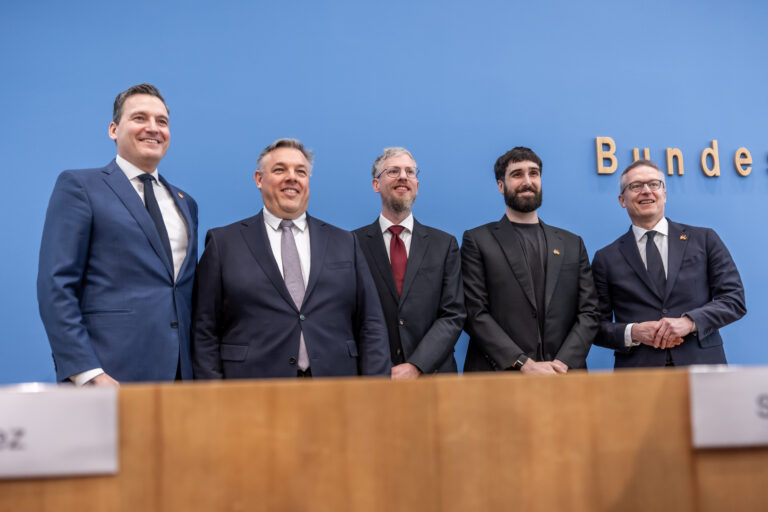
Cohere did not disclose financial terms of the deal with Aleph Alpha. If it closes, Aleph Alpha co-CEO Ilhan Scheer will become COO of the combined firm. Cohere brings “global reach and deployment capabilities that complement our research expertise,” Scheer said in a statement.
Aleph Alpha co-founder Samuel Weinbach will be Cohere’s new chief research officer. Former Cohere president Martin Kon previously held the COO title, before stepping back from his roles last fall.
Gomez acknowledged that Cohere’s models aren’t currently as capable as those of the frontier labs, particularly when it comes to coding ability and cybersecurity capabilities. “There’s a gap today, and we want to work to close that,” he said, citing sensitive applications that are critical to “national security and the defence of our economies.”
Making its technology more competitive in those areas is partly a matter of matching OpenAI and Anthropic on size, according to Gomez. “Cohere is currently scaling up our models dramatically,” he said, adding that the intelligence of the systems should increase accordingly. Cohere had earlier said it could successfully sell smaller systems than its Silicon Valley rivals because it was focused on business applications, and customized its technology for clients. It was a bet that more parameters—pairs of inputs and outputs—didn’t automatically mean better performance.
To close the model-size gap, Cohere needs a lot more processing power. “We’re investing heavily in compute,” Gomez said. “We’re trying to do that as much as we can in Canada and in Germany.” He cited its deals with Bell and StackIt, a subsidiary of Aleph Alpha investor Schwarz Group. Cohere also counts chip giants Nvidia and AMD as investors.
Cohere recently struck an agreement to buy capacity from a seven-megawatt Bell data centre in British Columbia; Buzz HPC, which will generate the compute, said the transaction is worth US$220 million. Cohere has also committed to use processing power from StackIt for its European cloud needs. And Cohere will take 50 megawatts of capacity in Saudi Arabia built by Humain, a state-backed AI firm.
Those numbers pale in comparison to the cloud and AI giants, which have committed to trillions of dollars worth of compute contracts between them. Cohere argues it needs less processing power than other model makers because its clients often bring their own. Still, while the firm’s existing partners can mostly deliver the compute it needs, the supply is very constrained, Gomez said. “We’re feeling the pressure,” he said. “We’re sprinting and trying to lock down compute as quickly as possible.”
At the Canada Investment Summit and in several appearances at related events in Toronto this week, Gomez touted the opportunity for Canada to build more AI data centres, citing the cold climate and availability of clean energy. Anthropic and OpenAI have both recently signalled they’re interested in sourcing compute from Canada.
Earlier this week, The Globe and Mail reported that Cohere was in advanced talks to raise up to US$3 billion. Amanda Taggart, the firm’s vice-president of communications, said in a statement that it doesn’t comment on speculation, but is seeing strong interest in its upcoming Series E financing.
Gomez said he has used the summit and associated events to pitch investors. Visiting financiers from around the world have been receptive to both Cohere and the Canadian AI opportunity as a whole, he said. “They want to invest and support the Canadian mission, because it’s going to be a high-growth, profitable one,” he said.
Cohere’s more recent, larger funding rounds have been led by Canadian investors like Radical Ventures, Inovia Capital and the Public Sector Pension Investment Board. It also counts the Canada Pension Plan Investment Board as a backer. That’s a large proportion of the country’s growth-stage venture funds and pension plans.
Still, most of the money in those financings has come from the U.S., Gomez said at an event Monday, adding that Cohere is looking for more Canadian and European capital.
While the firm has the backing of Canadian institutional investors, their stakes are currently not very large, he said Tuesday. “There’s a ton of room for them to increase their position and support us,” Gomez said. “Decisively, no, Canada is not tapped out.”
Editor’s note: This story has been updated with details of Aleph Alpha executives’ new roles with Cohere.