A reader got in touch to vent her frustrations over the federal government’s tax holiday. She was unimpressed. Something about this being the wrong time for such spending. The word “dumb” came up a few times.
Skip to content

Commentary
Carmichael: Will the FES show Freeland finally means business?
The government may be starting to see that tax policy and regulation are holding us back
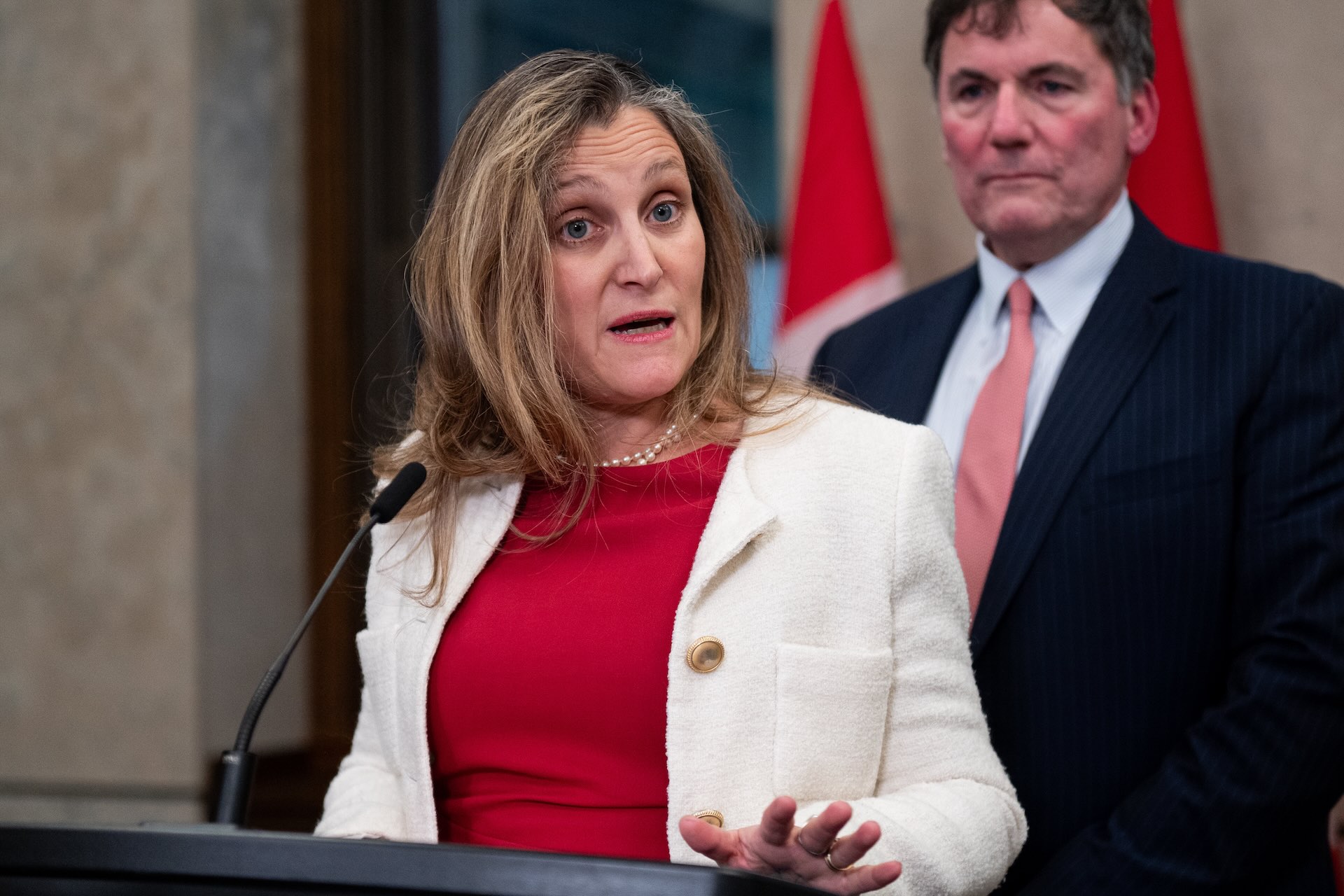
Finance Minister Chrystia Freeland delivers remarks on Parliament Hill in Ottawa, on Wednesday, Dec. 11, 2024. Photo: The Canadian Press/Spencer Colby
A reader got in touch to vent her frustrations over the federal government’s tax holiday. She was unimpressed. Something about this being the wrong time for such spending. The word “dumb” came up a few times.
Nevertheless, this reader admitted the dialogue over Finance Minister Chrystia Freeland’s antidote for the “vibecession” was much different in her chat group with other moms. There, she and others were debating whether it was safe to wait until after Dec. 14 to pull the trigger on buying Christmas toys, given the Canada Post strike.
Why so much negativity over a policy that people nonetheless will exploit to their advantage? My guess is those people see the disconnect between the gravity of the situation in which Canada finds itself, and the feebleness of the response. They wanted help with the cost of living a year ago. The issue now is growth, which everyone can see is weak—and on track to get weaker amid the chaos of Donald Trump’s tariff plans. A flimsy tax gimmick doesn’t match the moment.
Freeland probably knows that. A new round of gossipy stories in The Globe and Mail this week suggest there was tension between Finance and the Prime Minister’s Office over spending priorities ahead of the unveiling of her fall economic statement Monday. Her credibility as a steward of the economy was in jeopardy amid forecasts that she will miss her goal of keeping the deficit under $40 billion.
Related Articles

Those doubts are valid, but they will need to be weighed against what the government proposes to do about the productivity crisis and an antagonistic White House. Business investment was already stagnant in this country, and Bank of Canada governor Tiff Macklem acknowledged this week that the threat of a trade war has given executives another reason to retrench. Things could get bad.
Senator Clément Gignac, a former chief economist at National Bank, thinks Freeland should reset her guardrails and spend heavily on infrastructure as a counterweight to whatever losses come from a trade war. Gignac is onto something. There are always limits, but sometimes you have to judge the quality of the spending, not just the quantity. Helicopter money outside a recession is a poor reason to disregard fiscal guardrails; broadly distributed investment incentives that restore business confidence are a good one.
On Friday, Freeland previewed at least part of her response, announcing a multi-billion-dollar package of investment incentives. Implementation will matter, but the changes suggest the government has begun to recognize that tax policy and regulation have become significant barriers.
“I feel like we’ve been playing on the fringes,” Adrian Rocca, chief executive of Fitzrovia, a Toronto-based housing developer, said earlier this week. “We really need someone to step up and really introduce some policy changes that are actually going to make a difference to drive our economy.”
The tax holiday was a bad sign because it undermined Freeland’s attempts to counter the impression that her government only cares about wealth redistribution.
At an event in Washington, D.C. in October, she praised the U.S.’s “phenomenal” economic and productivity growth, adding that “it’s something we talk about in my office every day, and things we can learn from you.”
Six months earlier, Freeland did a very un-American thing and raised capital gains taxes, even though virtually every investor and entrepreneur told her the measure could only hurt economic and productivity growth. Freeland countered with economic arguments about a fairer tax structure, and political arguments that pit the middle class against wealthier Canadians who she said could afford to pay more. None of those arguments sat right with anyone who pays close attention to what it takes to generate economic growth, including some prominent Liberals.
“What I didn’t like about the capital gains discussion earlier this year was the way it was framed. It was class warfare type language,” former Bank of Canada governor Mark Carney said on Liberal MP Nate Erskine-Smith’s podcast in October.
“We’re entering an era where if we’re going to be successful, we need some people, some companies, Canadians, to be successful,” Carney continued. “That doesn’t mean they’re bad people, that they’ve done the wrong thing. They will have done what we want them to do.”
The best argument Freeland had for raising taxes was the revenue would allow her to contain the deficit and keep the debt under control. Her accounting created space for the Bank of Canada to lower interest rates by reducing the amount of inflationary fiscal stimulus in the economy. The budget also reinforced Canada’s advantage in international bond markets, where Canadian bonds stand out because public debt appears to be under control.
Freeland boasted about both those things in Washington after her host, Michael Froman, head of the Council on Foreign Relations, asked her why Canada’s per capita GDP was now similar to that of Alabama, one of America’s poorest states. She argued that to some extent, U.S. growth was being driven by outsized government spending, an option she didn’t have because she felt compelled to keep the deficit under control. She said her restraint was being rewarded by bond investors, who demand a higher interest rate from the U.S. treasury than they do from Canada.
Blowing through her fiscal guardrails would be embarrassing. It’s also history: the fiscal year ended nine months ago, when many would have put higher odds on Trump ending up in jail than winning the election. What matters is what Freeland does from here. Her new emphasis on business investment is the right place to begin.
Kevin Carmichael is The Logic’s economics columnist and editor-at-large. He has spent more than two decades covering economics, business and finance for outlets including Bloomberg News, The Globe and Mail and the Financial Post, where he also served as editor-in-chief.



Loading...
Thanks for sharing!
You have shared 5 articles this month and reached the maximum amount of shares available.
CloseThis account has reached its share limit.
If you would like to purchase a sharing license please contact The Logic support at [email protected].
CloseGift the full article!
You have gifted 0 article(s) this month and have 5 remaining.
Recipients will be able to read the full text of the article after submitting their email address. They will not have access to other articles or subscriber benefits.
Photo: The Canadian Press/Spencer Colby
Most Popular This Week



In-depth, agenda-setting reporting
Great journalism delivered straight to your inbox.
News
ApplyBoard was the worst-performing Canadian startup in Fidelity’s portfolio in 2026
Briefing
Defence Investment Agency to be a Crown corporation so it can get deeper into Canada’s military industry
Mark Carney says he’ll work with Quebec separatist premier-to-be on housing, infrastructure, big projects
Mistral claims its new AI model closes the gap with leading Chinese developers
Best business newsletter in Canada
Get up to speed in minutes with insights and analysis on the most important stories of the day, every weekday.
Exclusive events
See the bigger picture with reporters and industry experts in subscriber-exclusive events.
Membership in The Logic Council
Membership provides access to our popular Slack channel, participation in subscriber surveys and invitations to exclusive events with our journalists and special guests.