OTTAWA — The Liberals widened their lead over the Conservatives when it comes to which party Canadians most trust to steer the economy, according to a new The Logic poll by Abacus Data, although there was also a small drop in the share of people who plan to vote for them.
Skip to content


News
Carney opens significant lead over Poilievre on economic trust, says new poll
Conservative leader is still seen as best to keep taxes low as election draws closer
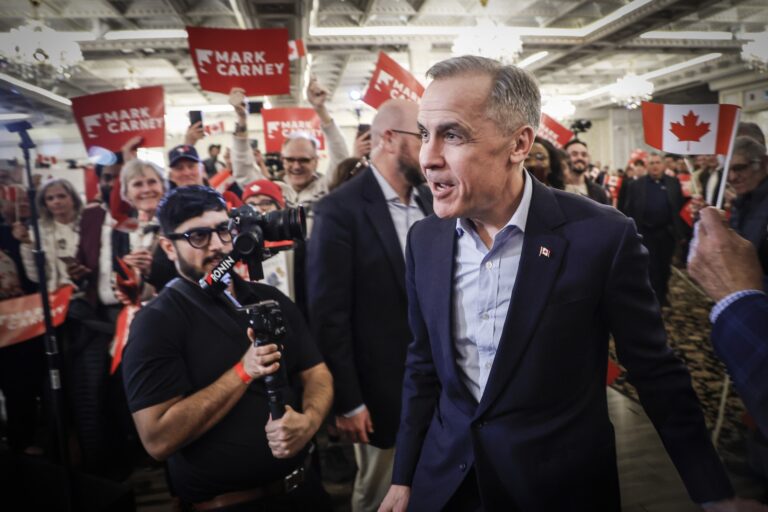
The Liberals under Mark Carney, right, have closed a big polling gap on economic trust and now lead Pierre Poilievre's Conservatives. Photo: The Canadian Press
OTTAWA — The Liberals widened their lead over the Conservatives when it comes to which party Canadians most trust to steer the economy, according to a new The Logic poll by Abacus Data, although there was also a small drop in the share of people who plan to vote for them.
Talking Points
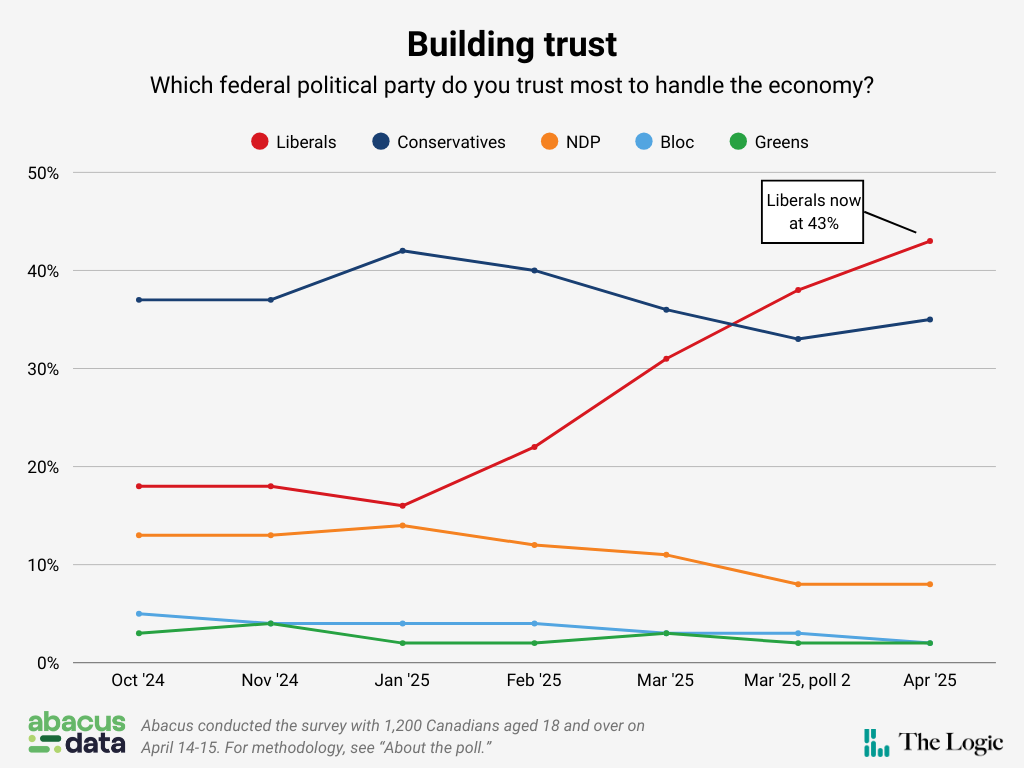
- A new survey by Abacus Data suggests 43 per cent of Canadians believe the Liberals are most trusted to handle the economy, compared to 35 per cent for the Conservatives
- Mark Carney is seen as the party leader best able to protect Canada’s interests in the U.S. trade war, while Pierre Poilievre still considered best able to keep taxes low
Forty-three per cent of survey respondents said they most trust the Liberals led by Mark Carney, who replaced Justin Trudeau as prime minister on March 14, to handle the economy. Thirty-five per cent chose Pierre Poilievre and the Conservatives. That marks a two-point increase for the Conservatives on this question since last month, but it was not enough to overtake the five-point jump in the share of respondents who picked the Liberals. The survey was conducted Monday and Tuesday.
Eight per cent of respondents chose the New Democrats as the best party to manage the economy, while the Bloc Québécois and the Green Party of Canada each had two per cent.
The Liberals first took the lead on this question last month, having trailed the Conservatives since Abacus Data began its polling for The Logic in October. In January, after Trudeau announced his resignation but well before Carney won the leadership race, the Liberals were the choice for 16 per cent of respondents—barely more than the NDP and well behind the 42 per cent for the Conservatives.
Getting to know them
Related Articles

The proportion of respondents who said they did not know who is most trusted to handle the economy is now at nine per cent—a significant drop from 15 per cent last month and 21 per cent when Abacus began tracking the question.
“More people across the country are getting a better sense of how they would answer that question,” said David Coletto, CEO of Abacus. The latest survey took place before four of the federal party leaders faced off this week in the French- and English-language debates. The Liberals and Conservatives have not yet published their platforms.
Micro vs. macro
The Conservatives held their advantage when it came to which leader respondents believe is best able to keep taxes as low as possible (Poilievre at 40 per cent and Carney at 29 per cent); ensure the immigration system supports economic growth (Poilievre at 35 per cent and Carney at 34 per cent); and create well-paying, stable jobs (Poilievre at 37 per cent and Carney at 34 per cent).
About the poll
The Logic and Abacus Data have partnered to poll Canadians on key economic issues in advance of the April 28 federal election. The surveys take stock of voters’ priorities and their views of the parties’ policies on matters ranging from affordability to making Canada more competitive. On questions of economic stewardship, we are tracking attitudes over time. We are seeking responses on other issues as they emerge in the public conversation. For today’s story, Abacus surveyed 1,200 Canadians aged 18 and over from April 14 to 15 through an online panel. The margin of error for a comparable probability-based random sample of the same size would be 2.82 percentage points, 19 times out of 20.
But Carney is now at 38 per cent on managing inflation and affordability—one point ahead of Poilievre on an issue that had fuelled skyrocketing support for the Conservatives over the past couple of years. “That gap has closed enough that it’s not an overwhelming advantage,” Coletto said.
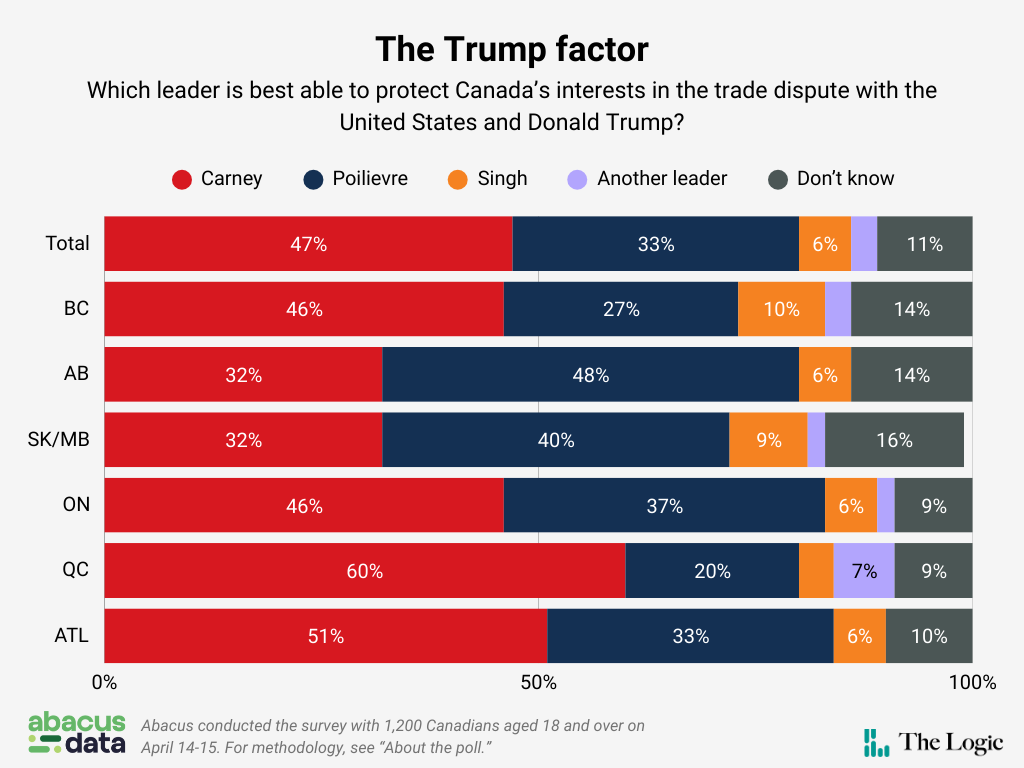
Meanwhile, the Liberals are leading on many of the bigger-picture economic issues. That includes the presumptive ballot-box question in this campaign: who is best able to protect Canadian interests in the trade war launched by U.S. President Donald Trump? Forty-seven per cent of respondents picked Carney, while 33 per cent chose Poilievre. Six per cent said it was NDP Leader Jagmeet Singh.
The Liberals beat the Conservatives on that question in every region except Alberta, Saskatchewan and Manitoba. The choice of Carney on that question was especially strong in Quebec (60 per cent), Atlantic Canada (51 per cent) and Ontario (46 per cent).
“That macro versus micro has been a distinguishing feature of this election and the macro seems to be winning the fight right now,” Coletto said.
Narrowing race
The economy is not the only issue voters care about in this election, which is not yet over. On Wednesday, Abacus published a poll using the same data that put the Liberals at 40 per cent nationally in voter intentions, which is two points down from April 10. The Conservatives held steady at 38 per cent. The NDP are at 11 per cent and the Bloc at seven per cent, which were small increases over last week. The Greens and People’s Party both stayed at two per cent.
Still, Coletto said being trusted on the economy is a key indicator. “I don’t think you can win this election in this context without leading on who is best to handle the economy,” he said.



Loading...
Thanks for sharing!
You have shared 5 articles this month and reached the maximum amount of shares available.
CloseThis account has reached its share limit.
If you would like to purchase a sharing license please contact The Logic support at [email protected].
CloseGift the full article!
You have gifted 0 article(s) this month and have 5 remaining.
Recipients will be able to read the full text of the article after submitting their email address. They will not have access to other articles or subscriber benefits.
Photo: The Canadian Press
Most Popular This Week




In-depth, agenda-setting reporting
Great journalism delivered straight to your inbox.
Commentary
Carmichael: Canadian ignorance about India is a strategic weakness
Briefing
Aritzia shares pop after earnings rise 204%
First Nation in Alberta goes to court over fast-tracked oil pipeline
Chinese EV maker Geely Auto Group to launch in Canadian market in 2027
Best business newsletter in Canada
Get up to speed in minutes with insights and analysis on the most important stories of the day, every weekday.
Exclusive events
See the bigger picture with reporters and industry experts in subscriber-exclusive events.
Membership in The Logic Council
Membership provides access to our popular Slack channel, participation in subscriber surveys and invitations to exclusive events with our journalists and special guests.





