TORONTO — U.S. President Donald Trump’s use of the National Emergencies Act to impose tariffs on Canada and Mexico could violate trade laws and be open to challenge, legal experts have told The Logic.
Skip to content



News
Canada has ‘strong case’ to launch legal challenge against Trump’s tariffs
The U.S. has used fentanyl as an excuse to declare a trade war with Canada and ‘blatantly violated’ trade laws
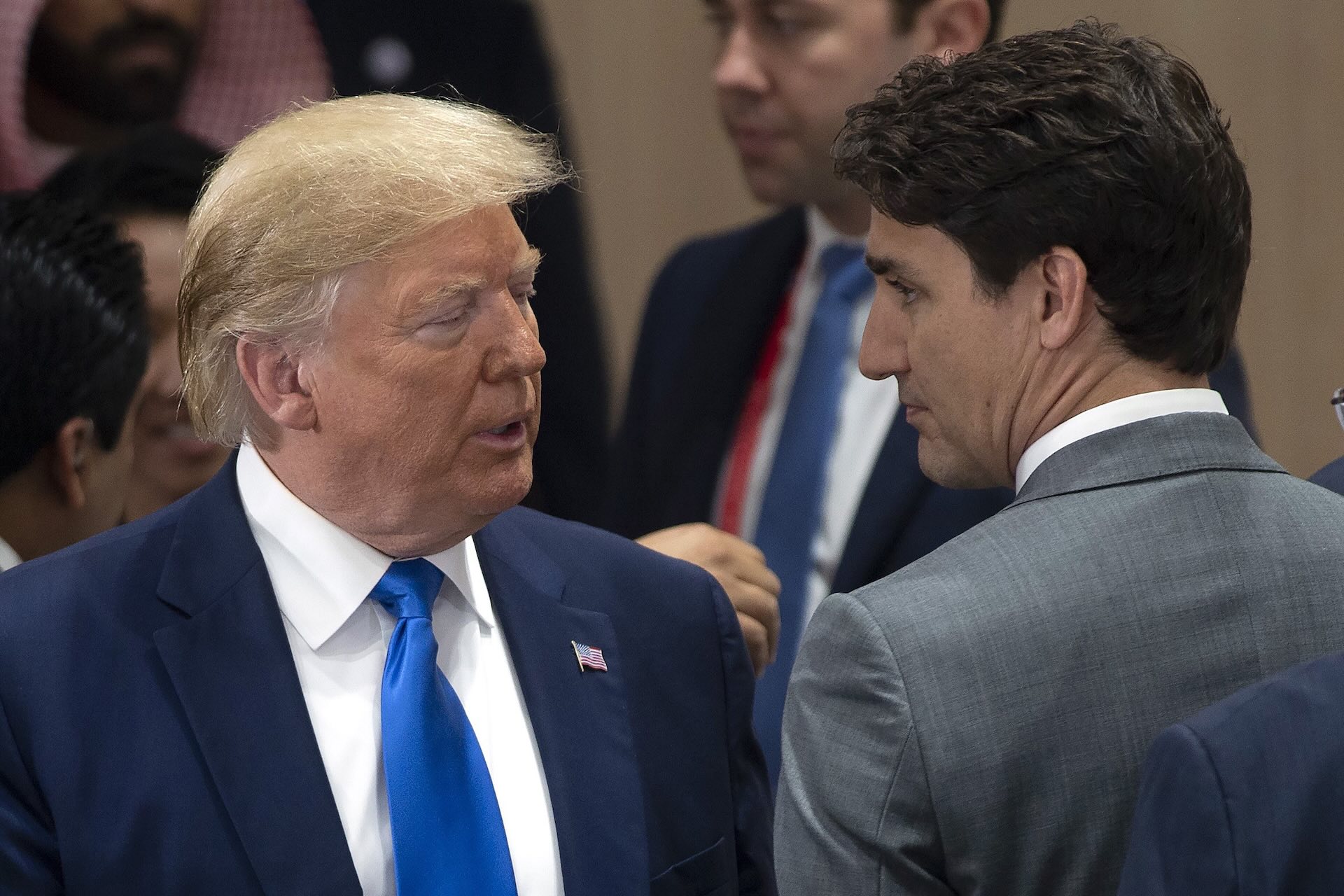
"We don't want to be here, we didn't ask for this," Prime Minister Justin Trudeau said Saturday in response to Trump’s tariff announcement. Photo: The Canadian Press/Adrian Wyld
TORONTO — U.S. President Donald Trump’s use of the National Emergencies Act to impose tariffs on Canada and Mexico could violate trade laws and be open to challenge, legal experts have told The Logic.
Talking Points
- U.S. President Donald Trump’s tariffs could be challenged in U.S. courts, and by Canada and Mexico
- There is no clear link between the imposition of tariffs and the national emergency Trump has declared over border security and fentanyl, legal experts say
The move, experts say, raises questions about the legitimacy of the U.S. president’s ability to impose tariffs to secure America’s borders and clamp down on the flow of illegal drugs. It also makes it difficult to see what Canada could do to address Trump’s apparent concerns.
Trump’s approach to imposing tariffs “blatantly violates” both the United States-Mexico-Canada Agreement (USMCA) and World Trade Organization agreements, said Gus Van Harten, professor at Osgoode Hall Law School of York University. If Canada and Mexico pursue the U.S. in international courts, they’ll most likely win—and then “watch the U.S. disrespect the arbitral award,” Van Harten claimed. Canada might win legally, but lose economically, he said.
The lack of a “clear connection between the national emergency and the trade restrictions raises serious concerns—both legal and diplomatic,” said Barry Appleton, co-director and senior fellow of the Center for International Law at New York Law School.
Related Articles


The “key legal vulnerability” of the tariffs is the weak link between illegal immigration, drug trafficking and trade barriers, Appleton said. “These emergency tariffs appear loosely connected to the stated emergency.”
On the international level, Canada and Mexico could challenge the tariffs through the dispute resolution in the USMCA, which would require proof of a clear connection between the tariffs and the emergency. Though there would be a “strong case for Canada,” it would likely be a lengthy process and be damaging to the Canadian economy, Appleton added.
Jacques Shore, a partner at law firm Gowling WLG, said it would be “hard to imagine why” Canada wouldn’t legally challenge the tariffs.
The emergency legislation being used by Trump has typically been used for countries that the U.S. has a “hostile” relationship with or for terrorist threats, says Andrea Bjorklund, law professor at McGill University. “Using it against allies seems to depart from the purpose of the bill and arguably exceeds the authority that Congress delegated to the president,” Bjorklund said.
The president is granted discretion to decide what constitutes an emergency, but it should be an “unusual and extraordinary threat,” Bjorklund said.
“It is hard to believe that the relatively small amounts of fentanyl coming over the northern border qualify as unusual or extraordinary.” The president is also supposed to consult with Congress prior to taking such action, Bjorklund added.
International state-to-state tribunals are another option for Canada or Mexico, but are dependent on how much evidence the U.S. has on drugs or illegal migration, Appleton said. Such evidence might be hard for the U.S. to produce, according to official data.
Trump’s executive order claims Canada plays a key role in the inflow of illicit drugs into the U.S. through gangs, human trafficking and drugs “pouring across” the border. While 21,148 pounds of fentanyl came into the U.S. through the Mexican border in the 2024 fiscal year, just 43 pounds came into the U.S. from Canada.
The executive order cited a report from Canada’s Financial Transactions and Reports Analysis Centre (FINTRAC) to highlight the increase in domestic production of synthetic opioids in Canada, specifically British Columbia.
The report details the shift from a reliance on China by consumers and dealers, to domestic and international distribution in the U.S., Mexico and Canada. It does not single out Canada’s production of fentanyl, but rather details how the three countries are producing more fentanyl internally.
“Organized crime groups within Canada, the United States and Mexico are working to entice consumers in markets outside of North America to use opioids as a means of increasing their illicit profits,” the report explains.
Seizures of precursory chemicals, which could be used to make fentanyl, increased more than ninefold between 2021 and 2022 in Canada, according to a report from the Canadian government. It also identified China or Hong Kong as a major source of precursory chemicals.
Despite this, very little Canadian-made fentanyl makes it to the U.S. “There is little to no evidence from either Canadian or U.S. law enforcement that Canadian-produced fentanyl is an increasing threat to the United States,” the report states.
Most of the organized criminal groups in Canada either import drugs or create them within the country, according to a 2018 report from the Criminal Intelligence Service Canada (CISC). Only five per cent of the drugs made in Canada or trafficked through the country are exported elsewhere. What is exported is mostly cocaine, cannabis and MDMA.
A 2024 report from CISC highlighted how the production of fentanyl has grown in Canada, with organized crime groups moving drugs around North America, Asia, Europe and Latin America.
Australia and New Zealand have become popular markets for Canadian drug exporters, with the CISC report saying crime groups are attracted to the high demand and prices. In recent years, customs officials in both New Zealand and Australia have intercepted major drug shipments from Canada. In 2022, for example, 24 pounds of Canadian fentanyl was intercepted at the Port of Melbourne. A large amount of finished fentanyl that enters Canada also comes from Mexican crime groups, FINTRAC said in its report.
U.S. Customs and Border Protection services have various operations targeting inbound fentanyl into the U.S., including on the Mexican border, in Southern California, and Arizona. The U.S. does not list any operations specifically targeting the northern border.
In his executive order, Trump also claimed Canada doesn’t “devote sufficient attention and resources” to coordinating with U.S. enforcement.
In response to the initial threat of tariffs, Canadian Prime Minister Justin Trudeau recently announced a $1.3 billion border protection and immigration. The plan includes new around-the-clock surveillance on Canada’s U.S. border, addresses the need for “increased information sharing” between the U.S. and Canada, and proposes a “strike force” between the two countries. U.S. Customs and Border Protection data shows nearly 199,000 people were apprehended at their northern border in 2024, compared to 2.1 million people coming from Mexico.
While the evidence against the basis for Trump’s tariffs might seem compelling, legal experts argue any legal challenge against the move would be unprecedented. The U.S. Supreme Court typically doesn’t question presidential authority to declare a national emergency. If it were to look at the issue, Appleton said, it would likely focus on how connected the tariffs are to the national emergency being declared. Simply put, it is unclear if 25 per cent tariffs on Canada and Mexico will help the U.S. crack down on illegal drugs and secure its borders.
Under U.S. trade remedy law, there needs to be sufficient evidence of unfair economic actions to impose tariffs, such as dumping, where a country significantly underprices an item to boost sales. It’s unlikely that there’s a reasonable basis for starting a trade war, Appleton said, hence the use of fentanyl and border security to trigger a national emergency. Another way to enact tariffs is Section 232 of the Trade Act, which would require evidence and a report.
Trade associations or industries in the U.S. could sue the Trump administration for imposing the tariffs, Vivek Astvansh, a business professor at McGill University, told The Logic. However, the tariffs are “not a data-driven or factual exercise,” he said. “This is an emotion-driven decision by both countries.”
“Repeatedly, you will see that we are not given evidence on what exactly is the issue in terms of immigration or fentanyl,” Astvansh said.
It’s the first time a U.S. president has used the National Emergencies Act to invoke the International Emergency Economic Powers Act and, subsequently, impose tariffs. “The drug crisis was very important for the overall ability of the president to declare an emergency and then invoke the emergency powers,” Appleton said.
The U.S. courts tend to be “reluctant to question what constitutes an emergency,” Appleton added, as it’s really up to how the president evaluates the situation.
“The amount of the drugs seems to be irrelevant,” Appleton said. “If there are any drugs, it is possible for the president to issue a declaration of emergency and invoke emergency powers.”



Loading...
Thanks for sharing!
You have shared 5 articles this month and reached the maximum amount of shares available.
CloseThis account has reached its share limit.
If you would like to purchase a sharing license please contact The Logic support at [email protected].
CloseGift the full article!
You have gifted 0 article(s) this month and have 5 remaining.
Recipients will be able to read the full text of the article after submitting their email address. They will not have access to other articles or subscriber benefits.
Photo: The Canadian Press/Adrian Wyld
Most Popular This Week




In-depth, agenda-setting reporting
Great journalism delivered straight to your inbox.
News
Canada faces a satellite-launch crunch as SpaceX retires its workhorse rocket
Briefing
North Vector Dynamics raises over US$20M for anti-drone missile development
Rio Tinto gets nearly $165M in additional federal funds for Quebec aluminum
U.S. to lift tariffs on some Canadian products crucial to Maine: Collins
Best business newsletter in Canada
Get up to speed in minutes with insights and analysis on the most important stories of the day, every weekday.
Exclusive events
See the bigger picture with reporters and industry experts in subscriber-exclusive events.
Membership in The Logic Council
Membership provides access to our popular Slack channel, participation in subscriber surveys and invitations to exclusive events with our journalists and special guests.