Conservative advocacy group Canada Proud is dominating the discussion of the federal election on Facebook and Instagram as the Meta-owned platforms continue to block the sharing of all news content in Canada.
Skip to content


News
Canada Proud is dominating Facebook ahead of the election
The conservative group’s posts about the election are finding a huge audience in the vacuum created by Meta’s ongoing ban on all news in Canada
Meta’s news ban in Canada has led to a proliferation of accounts that repackage actual news content and add their own commentary Photo: The Canadian Press/Frank Gunn
Conservative advocacy group Canada Proud is dominating the discussion of the federal election on Facebook and Instagram as the Meta-owned platforms continue to block the sharing of all news content in Canada.
The group’s Facebook page, which has 593,000 followers, is behind 31 of the top 50 most-viewed posts mentioning Liberal Leader Mark Carney on Facebook in the past seven days. Collectively, posts mentioning Carney from Canada Proud have been viewed more than 1.58 million times on Facebook in the past seven days worldwide. Numbers specific to Facebook use in Canada are not available.
Talking Points
- Posts about the election by Canada Proud are getting millions of views on Facebook as Meta continues to block news from being shared on its platforms in Canada
- This is the first federal election since Meta started blocking all news in Canada. The ban makes it impossible for Canadians to share and discuss news articles about the upcoming election on Facebook and Instagram.
Canada Proud, which is run by former Conservative Party staffer Jeff Ballingall’s Mobilize Media Group, was also responsible for 36 of the top 50 Instagram posts mentioning Carney worldwide in the past seven days. The group’s Instagram posts have been viewed more than 532,000 times.
The popularity of Canada Proud’s posts on Facebook and Instagram is in part the result of Meta’s ongoing news ban, said Aengus Bridgman, director of the Media Ecosystem Observatory, a research group at McGill University. While Canada Proud, and other groups like it, were successful before, they now have virtually no competition in the sharing of news coverage on Meta platforms. The Logic’s analysis was unable to find similar, or any traction, from equivalent groups on the opposite side of the political spectrum.
Bridgman said the news ban in Canada had led to a “proliferation” of Facebook and Instagram accounts that repackage news through screenshots and video clips without directly linking to specific articles. Canada Proud isn’t the only organization in Canada that does this, but it is one of the biggest and most successful, Bridgman said. “News is still available to a certain extent on these platforms, but often it’s in the way Canada Proud does it, which is commentary on the news,” Bridgman said. Asked about Canada Proud’s success on social media, Ballingall pointed to major moderation changes Meta founder Mark Zuckerberg announced in January, but did not elaborate on their impact.
Related Articles


This is the first federal election in Canada since Meta banned all news on its platforms in the country in the summer of 2023. The move, made in response to the Online News Act—which makes the biggest tech companies pay news publishers for journalism shared on their platforms—blocks anyone in Canada from sharing or seeing posts from media organizations. As a result of Meta’s news ban, popular posts about the federal election in Canada are mostly from third-party groups such as Canada Proud, or from politicians, obscure meme accounts and influencers.
Posts from Canada Proud often reference or quote from reporting by media organizations, including CTV, CBC News, the Toronto Star and Juno News, all of which are blocked on Meta platforms in Canada. Despite Canada Proud regularly sharing repackaged content from news organizations, Meta classifies it as a “nonprofit organization.”
Meta did not respond to questions about why Canada Proud was not categorized as a media organization. Bridgman suggested that its repackaging of news content as commentary, and not using direct links, had effectively allowed it to slip through a loophole in the news ban.
A lengthy announcement from Meta about how it is preparing for the federal election in Canada made no reference to its continued blocking of news content from its platforms in the country.
Outside of Canada, popular Facebook posts about Carney and Poilievre have come from accounts belonging to ABC News, CNN, CBS News, Reuters, and The Wall Street Journal. Facebook users in Canada are unable to share or see these posts. According to a Meta report, news websites made up 10 of the top 20 most popular domains on Facebook in the U.S. during Q4 2024. Meta does not publish this data for any other country.
The news ban has been to “the enormous detriment of Canadians and Canadian news organizations,” Bridgman said, and created a space where organizations like Canada Proud have fewer competitors and are able to dominate the sharing of news on Facebook. “Blocking reliable, accurate information on two of the platforms most used by Canadians, creates an information space that doesn’t support a rich democratic conversation during an election.”
Facebook is by far the most popular social media platform in Canada, with 77 per cent of Canadian adults using it at least once a month according to research by Toronto Metropolitan University. YouTube is the second most popular, with 70 per cent of Canadians using it at least once a month. Instagram is third with 60 per cent.
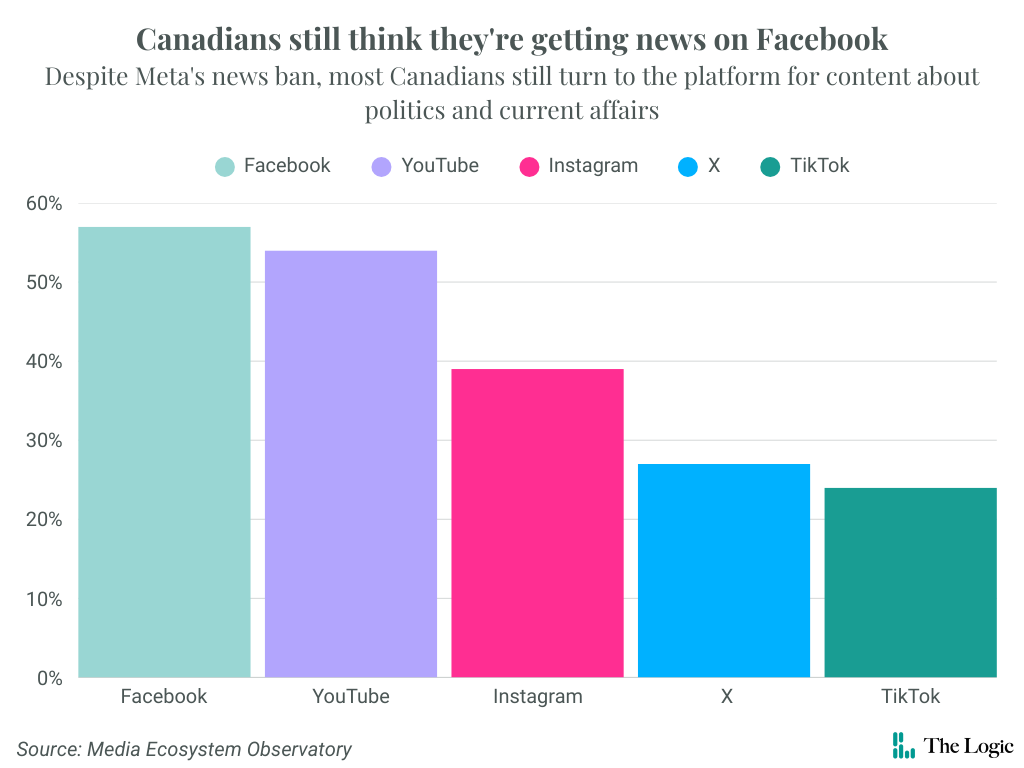
Despite the news ban, a huge number of Canadians still think they are getting news from Facebook and Instagram. A survey of 1,100 people conducted by the Media Ecosystem Observatory last week showed that 57 per cent of Canadians use Facebook as a source of politics and current affairs content, despite news being blocked on the platform. Google-owned YouTube is second at 54 per cent with Instagram used by 39 per cent of Canadians for politics and current affairs content.
Brent Jolly, president of the Canadian Association of Journalists, said people likely aren’t aware that what they are seeing on Meta platforms in Canada isn’t journalism. “Social platforms are becoming cesspools of mis- and disinformation in the wake of the Meta news ban,” he said. Jolly added there was a big difference between the election-related content that’s going viral on Facebook and Instagram and the work of “a bona fide news organization.”
Before Carney announced a snap election for April 28, Canada Proud spent tens of thousands of dollars in March alone on around 200 adverts on Facebook and Instagram mentioning the new Liberal party leader. A number of the ads alluded to Carney’s alleged ties with American financier and child sex offender Jeffrey Epstein, on which Canada Proud spent around $15,000.
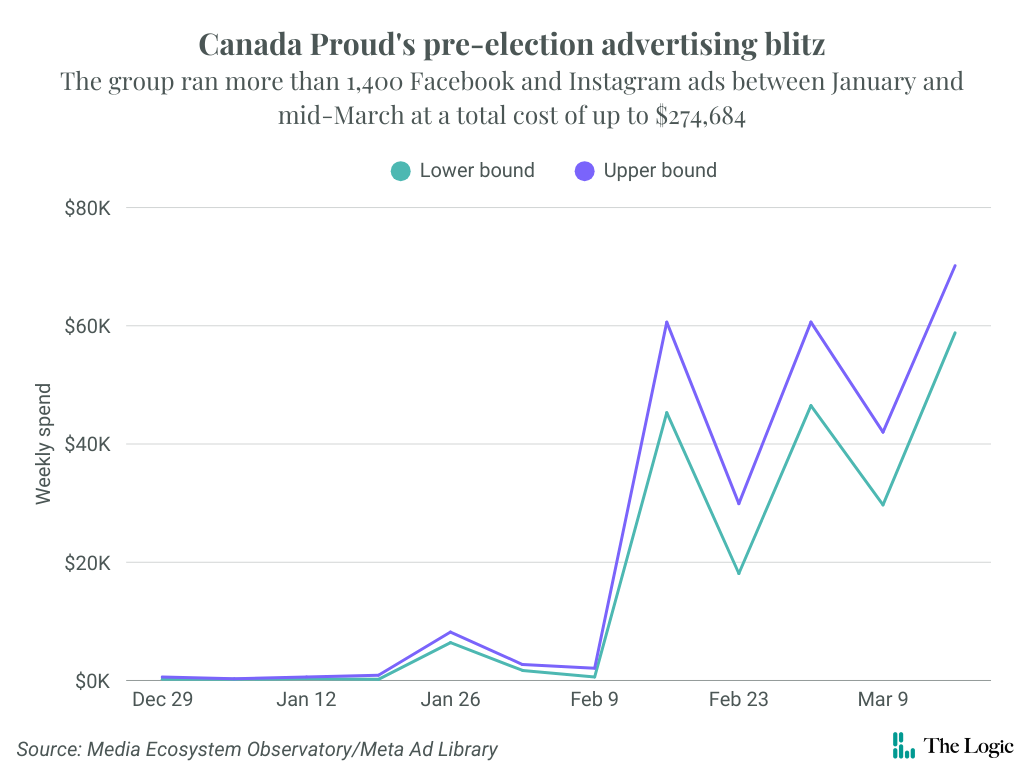
The Epstein ads, which were viewed more than two million times, were just a small part of an advertising blitz launched by Canada Proud on Facebook and Instagram shortly before the election was called. Canada Proud ran more than 1,400 Facebook and Instagram ads between January and mid-March at a cost of between $208,000 and $278,684, according to Meta’s Ad Library. The organization is no longer running adverts due to strict rules around third-party advertising once an election has been called.
Canada Proud’s history on Facebook can be traced back to the creation of the Share This Canada page in June 2017. The page changed its name to Canada Proud in October 2018.
Page transparency details show that six of the 10 people who currently manage the group’s Facebook page are primarily based in Canada, while the other four primarily based in the United States. Ballingall said the four people listed as being based in the U.S. “are consultants who have provided analytical support with backend access.”
Correction: News is available on Threads in Canada. This story has been updated.



Loading...
Thanks for sharing!
You have shared 5 articles this month and reached the maximum amount of shares available.
CloseThis account has reached its share limit.
If you would like to purchase a sharing license please contact The Logic support at [email protected].
CloseGift the full article!
You have gifted 0 article(s) this month and have 5 remaining.
Recipients will be able to read the full text of the article after submitting their email address. They will not have access to other articles or subscriber benefits.
Photo: The Canadian Press/Frank Gunn
Most Popular This Week




In-depth, agenda-setting reporting
Great journalism delivered straight to your inbox.
News
Panel decries Canada’s chaotic way of funding world-class science
Briefing
AI is pushing insurers to become asset managers, Canadian CEOs say
Trump administration faces lawsuit over 50% tariffs on Canadian goods
Canada-U.S. trade war to reduce real GDP by 1.4% over 2024 levels after five years: PBO
Best business newsletter in Canada
Get up to speed in minutes with insights and analysis on the most important stories of the day, every weekday.
Exclusive events
See the bigger picture with reporters and industry experts in subscriber-exclusive events.
Membership in The Logic Council
Membership provides access to our popular Slack channel, participation in subscriber surveys and invitations to exclusive events with our journalists and special guests.





