U.S. deals for Canadian companies hit a 22-year low in January as President Donald Trump’s economic threats cast a pall over mergers and acquisitions.
Skip to content


News
M&A craters in Canada as Trump’s threats loom
January featured the fewest U.S. deals for Canadian companies in 22 years
January saw only 19 mergers or acquisitions of Canadian companies with a U.S. acquirer involved, a 22-year low. Photo: The Canadian Press/Nathan Denette
U.S. deals for Canadian companies hit a 22-year low in January as President Donald Trump’s economic threats cast a pall over mergers and acquisitions.
Deal makers say Trump’s mooted 25 per cent tariffs have prospective buyers worried about the impact on Canadian companies’ profit margins.
Talking Points
- This January was the weakest in 22 years for M&A activity in Canada involving U.S. buyers, as deal makers wait to see how U.S. President Donald Trump’s economic threats will play out
- Many international buyers used to see Canada as a test bed for the North American market, but now are turning directly to the U.S. to acquire, analysts say
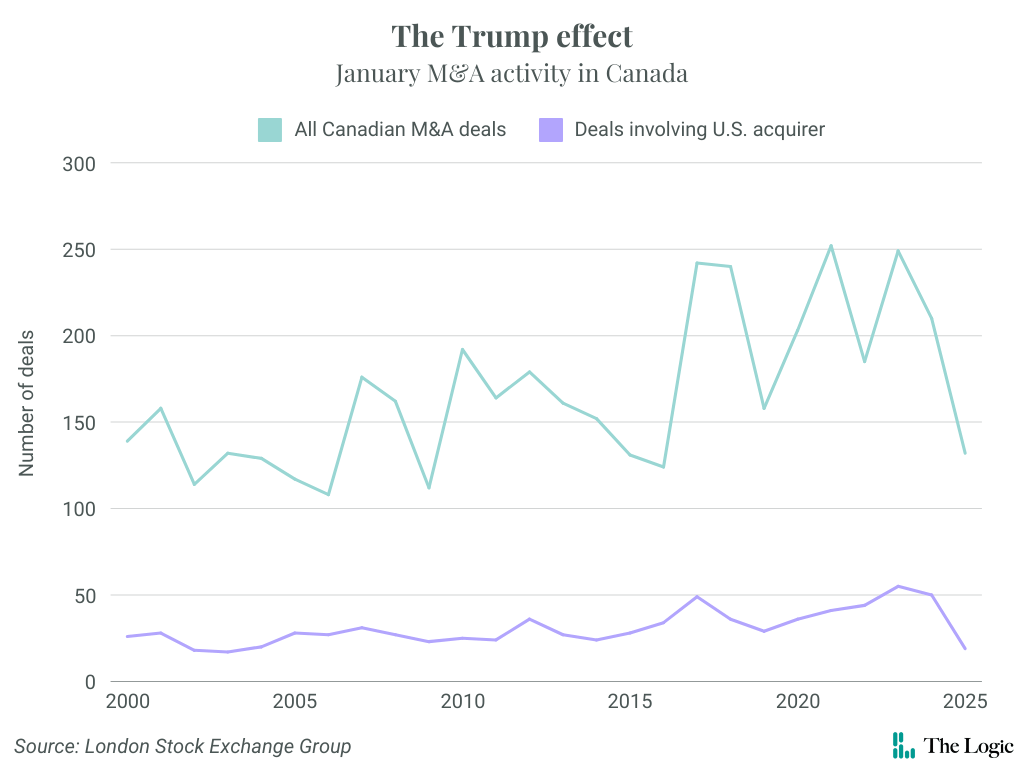
January saw only 19 mergers or acquisitions of Canadian companies with a U.S. acquirer involved, a 22-year low for January, according to data from the London Stock Exchange Group (LSEG). The number of U.S. buyers’ acquisitions in Canada had risen 72.4 per cent over the past five Januaries, with 50 acquisitions in January 2024.
Overall M&A activity in Canada also fell in January, according to LSEG, reaching a nine-year low for the month. It dropped 37 per cent from January 2024, which saw 210 deals.
The overall deal value for M&A in Canada in January dropped to roughly US$6.1 billion, down from roughly US$10.1 billion in deals in January 2024 but still ahead of the roughly US$4.6 billion and US$5 billion in January 2022 and 2023, respectively. Deal value for Canadian M&A activity involving a U.S. acquirer followed a similar trend.
Deal makers had been optimistic about the outlook for Canada in 2025. Analysts believed stabilizing interest rates would reassure buyers, giving them a clearer picture of what companies were worth, and global private equity looked ready to deploy the record capital on their books.
Were it not for the tariff threat, the conditions would be ideal for deal making, said Marco Tomassetti, corporate finance lead at KPMG. Banks have strong balance sheets and are in a good position to lend. Falling interest rates are positioning companies for better returns, which should make them attractive takeover targets.
But short-term corporate confidence is dwindling, Tomassetti said. A KPMG survey of 250 business leaders in Canada found 58 per cent plan to delay M&A plans for at least the next six months. Almost two-thirds said they would consider acquisitions in the U.S. if tariffs were enacted.
Related Articles


“It’s just hard to trigger a buy right now,” Tomassetti said. “You need to wait to see how it settles.”
It’s more difficult to value a business for a transaction when it’s not clear what impact tariffs will have on its cash flow, said Tomassetti. Prospective buyers don’t know what the effect of tariffs or other economic measures will be on individual businesses.
Brock McMillan, engineering lead at EY Canada, said though he’s working on a few deals that are near closing, it’s likely they’ll be delayed. Prospective buyers are particularly concerned about the prospects for Canadian businesses that rely on sales to the U.S. “We’ve definitely seen road bumps in our transactions,” said McMillan. “When you have uncertainty, the deal market freezes up.”
It’s particularly true for international buyers who might be in the market for Canadian deals, said Tim Caulfield, managing director at Franklin Templeton’s ClearBridge Investments. “It’s really hard for international businesses to commit capital to Canada when they don’t know how Canada is going to be treated on the world stage.”
European buyers used to see Canada as an important entry point into the North American market, a small, multicultural market from which they could later expand to the U.S., says Aimé Toumelin, co-founder of Hadaly, a startup that uses AI to facilitate M&A for small companies.
Quebec companies are especially attractive for buyers in France, he added. As the tariff threat looms, prospective buyers who would typically look to the Canadian market may prefer to skip over it, he said, especially if Trump’s policies significantly improve the business climate in the U.S. “Short term, those people are worried because they usually use Canada as a platform to enter the American market,” Toumelin said.
Whether Canada retaliates, and how, may have the biggest impact on what costs companies and consumers face in the country, said Daniel Nowlan, a managing director at National Bank. “We’re in a bit of a stasis until the Liberals get their leadership sorted out.”
A weak loonie could help offset the deal freeze in the medium term, especially for prospective U.S. buyers, said Caulfield. “The weakness in the Canadian dollar can be very enticing for U.S. companies to take advantage of,” Caulfield said.
However, a weak loonie could also make the profits of Canadian companies less valuable, potentially dissuading U.S. acquirers, Tomassetti at KPMG countered. If the tariffs are in place for a while, it may start disrupting valuations of Canadian companies over the longer term, EY’s McMillan said.



Loading...
Thanks for sharing!
You have shared 5 articles this month and reached the maximum amount of shares available.
CloseThis account has reached its share limit.
If you would like to purchase a sharing license please contact The Logic support at [email protected].
CloseGift the full article!
You have gifted 0 article(s) this month and have 5 remaining.
Recipients will be able to read the full text of the article after submitting their email address. They will not have access to other articles or subscriber benefits.
Photo: The Canadian Press/Nathan Denette
Most Popular This Week




In-depth, agenda-setting reporting
Great journalism delivered straight to your inbox.
The Big Read
Beacon is building an AI empire by fixing Main Street’s software
Briefing
Inovia raises US$200M for new VC fund as it eyes AI’s impact
43% of eligible Albertans voted ahead of Monday’s referendum
AI chip company Tenstorrent raises US$1.5B, valuing it at US$6.2B
Best business newsletter in Canada
Get up to speed in minutes with insights and analysis on the most important stories of the day, every weekday.
Exclusive events
See the bigger picture with reporters and industry experts in subscriber-exclusive events.
Membership in The Logic Council
Membership provides access to our popular Slack channel, participation in subscriber surveys and invitations to exclusive events with our journalists and special guests.







