Skip to content

Canada's Business and Tech Newsroom

  • Professional Subscription
  • Partnerships & Advertising
  • Licensing & Syndication
Log In Subscribe
Welcome,
  • My Account
  • Log Out
  • Business
  • Tech
  • National
  • The Big Read
  • Briefings
  • Commentary
Search
Log In Subscribe
Welcome,
  • My Account
  • Log Out
News

Canada’s housing crisis shows signs of easing as rental vacancies surge

Listen Now
0:00
News

Canada’s housing crisis shows signs of easing as rental vacancies surge

Rental vacancy rates across Canada are soaring. That’s good news for tenants and a major headache for developers.

By Martin Patriquin
Rental supply across Canada has increased just as immigration levels have decreased. In October 2025, the national rental vacancy rate was 3.1 per cent, up 41 per cent year-over-year. Photo: The Canadian Press/Darryl Dyck
May 8, 2026
A A
A Small A Medium A Large
Share

Gift

Share

Listen Now
0:00

Rental vacancies have increased dramatically across Canada in the last year, providing relief in a tight housing market but sparking concerns of a slowdown in construction as developers struggle to cover costs.

The national rental vacancy rate was 3.1 per cent in October 2025, a 41 per cent year-over-year increase, with the figure rising in every province, according to Canada Housing and Mortgage Corporation (CMHC) data.

Talking Points

  • A rapid increase in rental unit development and falling immigration levels have sent vacancy rates soaring in every Canadian province, according to Canada Mortgage and Home Corporation data
  • The result will likely translate to lower rent increases or even falling prices, but the imbalance has caused fears that developers will balk at building more in the long term

Increased construction is one factor behind the spike, according to housing economist Mike Moffatt, who said government initiatives, including the Apartment Construction Loan Program, “work as well, if not better than anticipated” in getting developers building.

The result has been a rapid uptick in the number of rental units hitting the market, with 2025 construction starts in the sector nearly double than 2020 levels. By comparison, starts on condos intended for sale were actually lower in 2025 than in 2020.
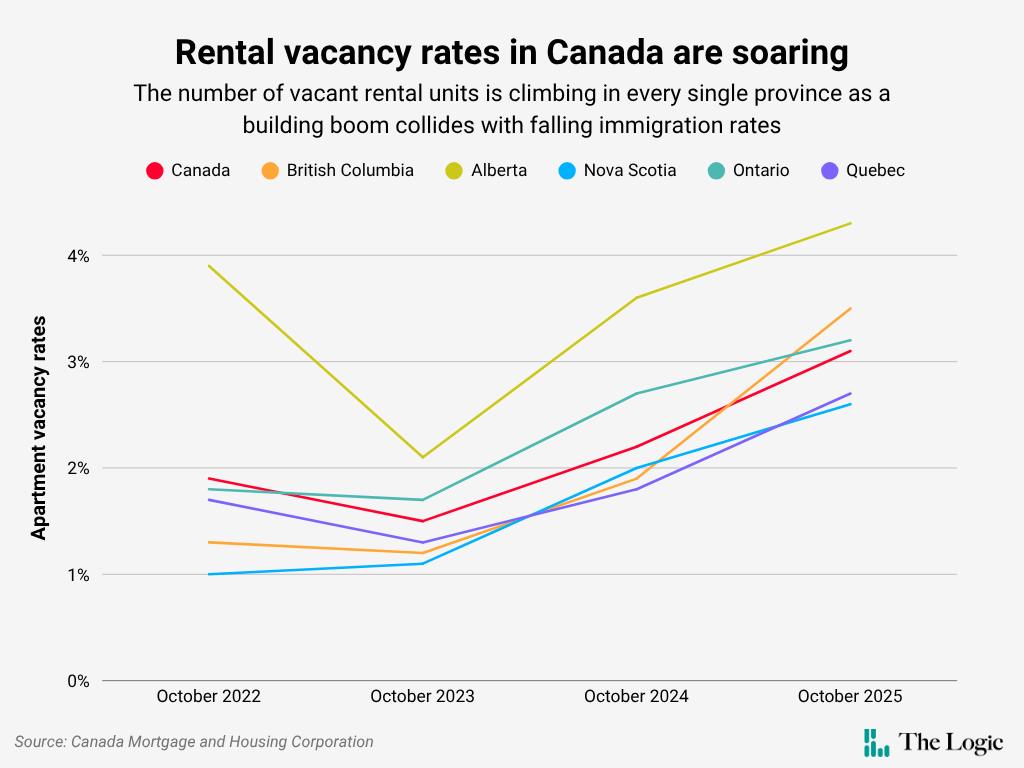
A line chart headlined "Rental vacancy rates in Canada are soaring" with the subhead "The number of vacant rental units is climbing in every single province as a building boom collides with falling immigration rates." The Canada-wide average apartment vacancy rate from 2022 to 2025 goes from under 2% to over 3%, with a slight dip in 2023. The chart shows province-specific numbers, with B.C., Nova Scotia, Ontario and Quebec following similar trajectories. Alberta is an outlier, starting just under 4% in 2022, dipping to just over 2% in 2023, then climbing back above 4% by 2025.

Just as rental supply has gone up, immigration levels have also gone down, further reducing competition for housing. In 2024, the federal government began limiting study and work permits, as well as the number of temporary foreign workers allowed into Canada, causing the first back-to-back population decreases ever recorded, according to a March 2026 National Bank report.

Related Articles
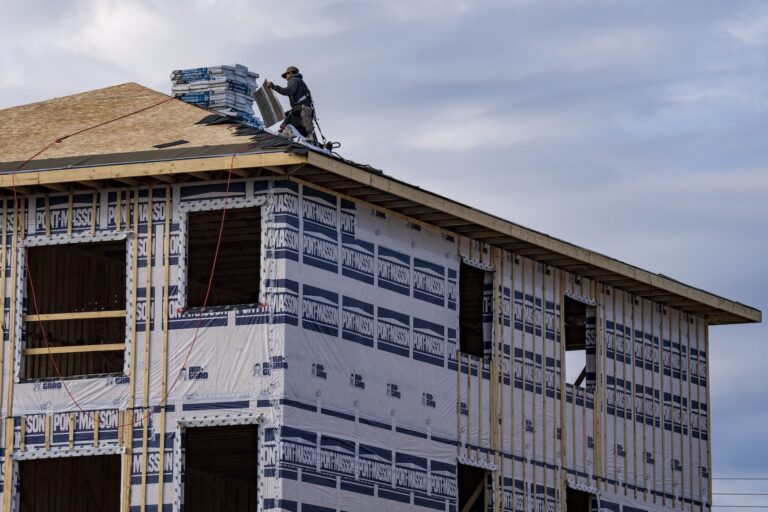
An image of a home under construction. A construction worker is seen on the roof of the house.

Ottawa announces $6B plan to train 100,000 tradespeople

By Laura Osman
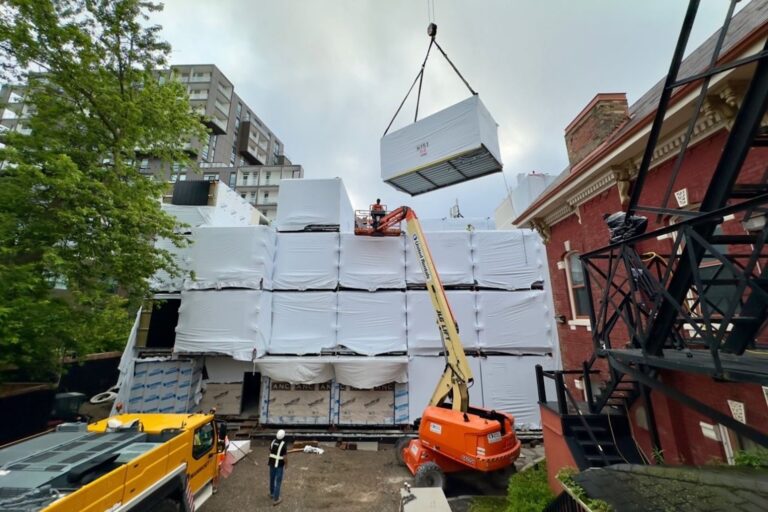
Construction site with a crane lifting a large, wrapped module onto a stacked structure. Workers with safety gear, buildings, and trees in the background. Urban development scene.

Canada’s modular housing industry may not be able to meet Carney’s ambitions

By Martin Patriquin

The Quebec government also cancelled a fast-track immigration program in 2025, though it recently reinstated it for a two-year period. The combined decrease may cause Montreal’s population to contract, according to the CMHC housing market outlook for 2026. 

“It’s a perfect storm,” said Anthony O’Brien, executive director of Jesta Group, a Montreal-based real estate investment and management firm. One of the company’s rental properties, a 321-unit building in Old Montreal, has been almost full since opening in 2023—until this spring, when 140 residents didn’t renew their leases. Many condo owners, bedeviled by a collapse in condo sales, have converted their properties to rental, further saturating the market, O’Brien said.

Growing vacancy rates could be a sign that Canada’s long-running housing crisis, which has been particularly keenly felt in and around Toronto and Vancouver, is easing. 

Montreal, for example, has been comparatively successful in building new housing stock in recent years, with rental units accounting for 88 per cent of housing starts in 2025. In Vancouver, where rental construction starts are nearly half the level of Montreal, the rental vacancy rate has nonetheless shot up more than 130 per cent, to 3.7 percent, between October 2024 and 2025.

A line chart headlined "Rentals dominate Canada's construction boom" with the subheading "While condos have crashed and home construction numbers have barely budged, rental units have flooded the market." It shows the number of units under construction for three types of housing (homes, rentals, and condos) from 2000 to 2026. Rentals were the smallest of the three until about 2016, when they hit 50,000 and sharply accelerated to a 2026 total of over 200,000. Homes started under 50,000 in 2000 and slowly grew to around 78,000 in 2024 before falling to 56,000 in 2026. Condos started with around 28,000 units under construction in 2000, trended upward to over 170,000 in late 2023, then dropped to 133,000 by 2026.

The sudden increase in properties available will inevitably drive down rental prices, said Moffatt. “Vacancy rates were way too low for a long time, rents and prices are way too high, so they need to come down in order to get affordability,” he said. “In the long run, most high-rise developers, both condos and rental, recognize that investing in new projects is basically making a bet on the future of immigration policy. And since we have no idea what the federal government will do after 2027 on immigration, there’s a lot of wait-and-see going on.”

Gift the full article

The throttling of immigration levels upended the housing market just as developers were putting shovels in the ground, according to Andrew Lutfy, the CEO of Groupe Dynamite and real estate developer behind Montreal’s Royalmount shopping mall. “It was violent,” said Lutfy of the cuts to immigration. “The development cycle from the time you say ‘Let’s do it’ to the time it actually takes to stabilize tenant occupancy to 90 per cent or more is between three to seven years,” he said. 

“Because the wheels were set in motion at a time when immigration was really high, you were able to make the numbers work,” Lutfy added. “But now the landscape has completely changed just as these projects are coming online.”


#Business #economy #housing

Sponsored Content

The real-world economic offshoots of sovereign AI

By Deborah Aarts
Illustration of a plane flying above a mailbox

Increasing healthcare access across Canada

By Deborah Aarts

What it takes to lead a frontier firm

By Deborah Aarts
Paid promotional content

Loading...

Thanks for sharing!

You have shared 5 articles this month and reached the maximum amount of shares available.

Close
This account has reached its share limit.

If you would like to purchase a sharing license please contact The Logic support at [email protected].

Close
Want to share this article?

Upgrade to all-access now

Close
Gift the full article!

You have gifted 0 article(s) this month and have 5 remaining.

Copy link and gift
Copy Link
Email to a friend
Send Email
Gift on Social Media

Recipients will be able to read the full text of the article after submitting their email address. They will not have access to other articles or subscriber benefits.

Photo: The Canadian Press/Darryl Dyck

A line chart headlined "Rental vacancy rates in Canada are soaring" with the subhead "The number of vacant rental units is climbing in every single province as a building boom collides with falling immigration rates." The Canada-wide average apartment vacancy rate from 2022 to 2025 goes from under 2% to over 3%, with a slight dip in 2023. The chart shows province-specific numbers, with B.C., Nova Scotia, Ontario and Quebec following similar trajectories. Alberta is an outlier, starting just under 4% in 2022, dipping to just over 2% in 2023, then climbing back above 4% by 2025.

A line chart headlined "Rentals dominate Canada's construction boom" with the subheading "While condos have crashed and home construction numbers have barely budged, rental units have flooded the market." It shows the number of units under construction for three types of housing (homes, rentals, and condos) from 2000 to 2026. Rentals were the smallest of the three until about 2016, when they hit 50,000 and sharply accelerated to a 2026 total of over 200,000. Homes started under 50,000 in 2000 and slowly grew to around 78,000 in 2024 before falling to 56,000 in 2026. Condos started with around 28,000 units under construction in 2000, trended upward to over 170,000 in late 2023, then dropped to 133,000 by 2026.

Most Popular This Week

Janice Charette and Dominic LeBlanc walking toward the camera next to a white pavilion that bears the logo of the 2026 G7 meeting in France.
News

Canada ‘can’t even talk about anything else’ if Trump makes good on latest tariff threat

By Joanna Smith
A man walks across a large greenhouse with large glass ceilings. He is walking on a white path through rows of green lettuce growing on the ground.
News

Canadian businesses were bracing for a wave of retirees. Then along came AI

By Anita Balakrishnan
An image of a man wearing a dark suit jacket and tie. He is wearing a mic and looking slightly away from the camera.
News

Brookfield and Cohere execs among high-profile guests at CVCA summit

By Catherine McIntyre
In this photo illustration the Moneris logo is seen displayed on a smartphone.
News

U.S. private equity is buying Canada’s biggest payments processor. Some people are worried about sovereignty

By Claire Brownell

In-depth, agenda-setting reporting

Great journalism delivered straight to your inbox.

An aerial image of rows of data-centre buildings under construction.
News

Neocloud Iren goes big on U.S. data centres as Canadian expansion slows

By Murad Hemmadi

Briefing

Space raises US$2.4M to get users’ files faster

By Murad Hemmadi   |   Aug 18, 2026 | 8:00 AM ET

US$120M preliminary settlement reached in Pornhub class action

By Anita Balakrishnan   |   Aug 17, 2026 | 6:00 PM ET

Peripheral raises US$8.7M for AI replay tools

By Murad Hemmadi   |   Aug 17, 2026

Best business newsletter in Canada

Get up to speed in minutes with insights and analysis on the most important stories of the day, every weekday.

Exclusive events

See the bigger picture with reporters and industry experts in subscriber-exclusive events.

Membership in The Logic Council

Membership provides access to our popular Slack channel, participation in subscriber surveys and invitations to exclusive events with our journalists and special guests.

Recent Popular Stories

News

U.S. private equity is buying Canada’s biggest payments processor. Some people are worried about sovereignty

By Claire Brownell   |   Aug 12, 2026
In this photo illustration the Moneris logo is seen displayed on a smartphone.
News

Brookfield and Cohere execs among high-profile guests at CVCA summit

By Catherine McIntyre   |   Aug 13, 2026
An image of a man wearing a dark suit jacket and tie. He is wearing a mic and looking slightly away from the camera.
News

Canadian businesses were bracing for a wave of retirees. Then along came AI

By Anita Balakrishnan   |   Aug 13, 2026
A man walks across a large greenhouse with large glass ceilings. He is walking on a white path through rows of green lettuce growing on the ground.
Special Report

Meet Canada’s leading innovators from the Class of 2026

By Sara Harowitz   |   Jul 29, 2026
A multimedia illustration showing images of six smiling individuals, on a dark background with blue shapes.
Commentary

Carmichael: Canada’s biggest companies aren’t wired for growth. That’s a problem for us all

By Kevin Carmichael   |   Aug 15, 2026
News

The Fisheries Department is losing its ability to back maritime innovations, documents warn

By David Reevely   |   Aug 11, 2026
A wide-lens aerial shot of a red Canadian Coast Guard ship amid a sea of white ice pans. The effect of the lens exaggerates the curvature of the horizon.

Canada's most influential executives and policymakers are reading The Logic

  • CPP Investments
  • Sun Life Financial
  • C100
  • Amazon
  • Telus
  • Mastercard
  • bdc
  • Shopify
  • Rogers
  • RBC
  • General Motors
  • MaRS
  • Government of Canada
  • Uber
  • Loblaw Companies Limited
logic-logo

Canada's Business and Tech Newsroom

100% human-crafted journalism

Newsroom

  • News Tips
  • AI Policy
  • Editorial Disclosures
  • Story Pitches

Company

  • About Us
  • Terms of Service
  • Privacy Statement
  • Corporate Information

Contact

  • Contact Us
  • Advertise
  • FAQs
  • Work at The Logic

© 2026 The Logic Inc. All Rights Reserved.

Trusted by leaders

Error

Account creation failed.

Please email us at [email protected].

Create Account

[wppb-register form_name=”cozmo-registration-form-for-modal”]

I do have an account
Login
or

[wppb-login]

I don’t have an account