MONTREAL — Montreal Mayor Valérie Plante advocates for things like bike paths and pedestrian-only streets. As such, she is a scapegoat for those who believe Canadian cities have become expensive hellscapes of leftist whimsy. Pierre Poilievre indulged earlier this year, when the Conservative leader called Plante (along with Bruno Marchand, Quebec City’s liberal mayor) “incompetent” on X for allegedly throttling housing construction.
Skip to content


Commentary: Quebec Ink
Lessons from Quebec on getting houses built
Declining interest rates and one sensible law are flipping stereotypes about progressive city governments
A residential construction site in Montreal in May 2023. Photo: The Canadian Press/Christinne Muschi
MONTREAL — Montreal Mayor Valérie Plante advocates for things like bike paths and pedestrian-only streets. As such, she is a scapegoat for those who believe Canadian cities have become expensive hellscapes of leftist whimsy. Pierre Poilievre indulged earlier this year, when the Conservative leader called Plante (along with Bruno Marchand, Quebec City’s liberal mayor) “incompetent” on X for allegedly throttling housing construction.
The ad hominem attack was customary, for both the medium and the man. But it hasn’t aged well. In May, housing starts in Montreal were up 200 per cent year over year. By June, the city had registered a 23 per cent month-over-month increase—while Toronto and Vancouver saw declines, according to Canadian Mortgage and Home Corporation (CMHC) data. (With its own 44 per cent year-over-year increase, Marchand’s Quebec City was no slouch, either.)
Overall, Montreal is just one of the driving forces behind Quebec’s suddenly boffo ability to get shovels into dirt. In June, the province provided a rare bit of good news on the housing front, with a 72 per cent year-over-year gain in centres with more than 10,000 people. The country’s average over the same period was down 13 per cent.
Related Articles


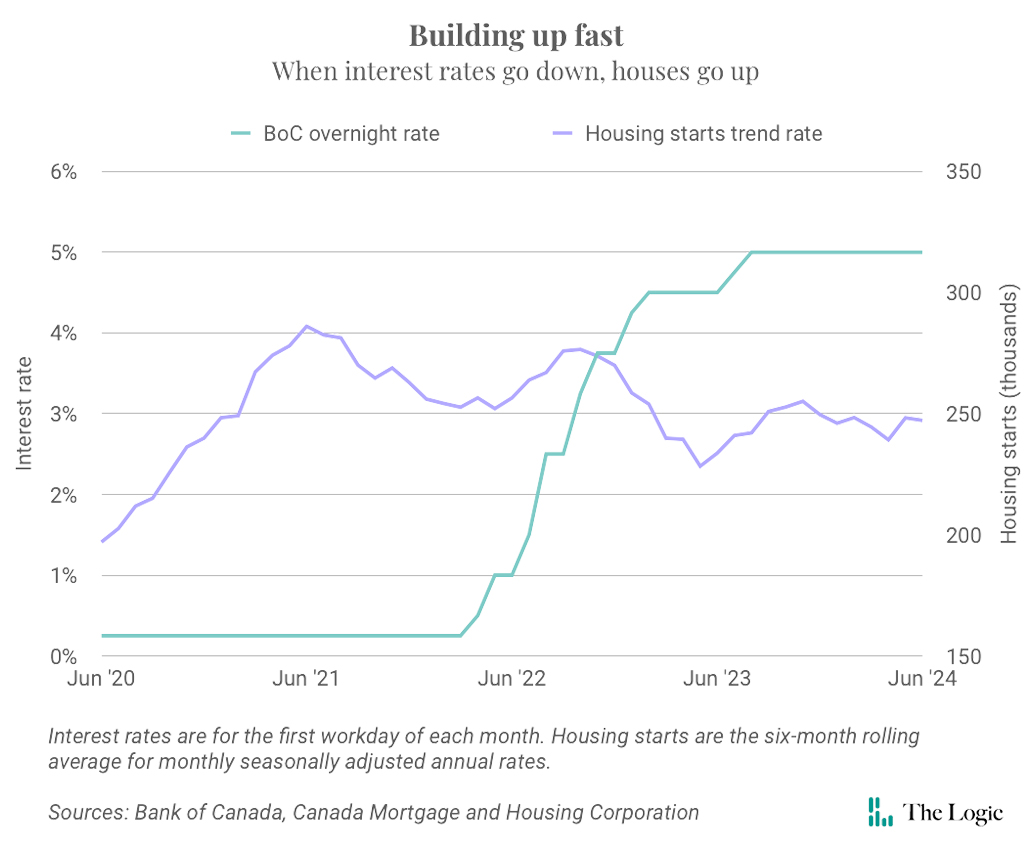
The question is why, because it’s not as if Poilievre’s tweeted bon mots provided some unique insight, spurring the Plante administration into a building mania. The simplest explanation behind the boom has less to do with politics than a basic tenet of modern-day capitalism: people will build more capital-intensive stuff when money is cheap, and less when it isn’t.
If you chart housing starts across the country over the last four years, you’ll see the trend line hit a peak in the late summer of 2022 before cratering just under a year later. These dates aren’t random. The decline began not long after the Bank of Canada, faced with constricting global supply chains, increased interest rates to curb consumer demand.
The ensuing downward trend and eventual plunge, which took place in summer 2023, corresponds with successive interest rate hikes aimed at stifling stubborn inflation. On Jan. 18, 2024, the day Poilievre called Plante incompetent, interest rates were at a 23-year high. They have since come down, and housing starts have risen as a result. “What caused a slowdown in housing starts in Montreal and Quebec wasn’t our regulations, it was access to capital,” Plante spokesperson Catherine Cadotte told me.
Still, Montreal’s rebound has been bigger and quicker than those of other cities. For this, the Plante administration credits a Quebec law, passed in February, giving cities the ability to stray from zoning limits imposed by the province. “Montreal is building a lot because our measures are bearing fruit,” Quebec government spokesperson Alice Bergeron told me.
Montreal’s bump belies another hoary stereotype. Critics have long assailed Quebec’s rent control system, saying it is a drag on new development. In fact, it has created a thriving demand for rented accommodation, and that market has responded in kind. In June, construction began on just over 4,000 rental units in the province—about 800 more than in Ontario, which is home to nearly seven million more people.
Unlike selling condominiums, renting out apartments is a long-term proposition, which is why many investors don’t like it. Yet the end result speaks for itself. It might not feel like it for many of its citizens, but Montreal remains comparatively cheap and renter-friendly. In Toronto, the condo market is in danger of entering a death spiral while the average home costs well over a million bucks.
I reached out to Poilievre’s party, and didn’t hear back. But he isn’t the only leader politicizing home prices. Justin Trudeau’s Liberal Party has paid lip service to affordable housing since forming government in 2015, when the average home in Canada went for roughly $430,000. It has since nearly doubled. One reason: the Liberal government increased immigration rates without a corresponding housing strategy to accommodate the new arrivals.
Nor did Poilievre invent the logic-defying argument that incompetence, not market forces, is solely responsible for the country’s housing crisis. The rationale, if there is any, is strictly and cynically political. He has an election to win, and cities are juicy prey when one’s path to power runs through the surrounding suburbs and hinterland. In leading the province and much of the country in housing starts, Montreal has demonstrated the limits to this opportunism.
Martin Patriquin is The Logic’s Quebec correspondent. He joined in 2019 after 10 years as Quebec bureau chief for Maclean’s. A National Magazine Award and SABEW winner, he has written for The New York Times, The Guardian, The Walrus, Vice, BuzzFeed and The Globe and Mail, among others. He is also a panelist on CBC’s “Power & Politics.”



Loading...
Thanks for sharing!
You have shared 5 articles this month and reached the maximum amount of shares available.
CloseThis account has reached its share limit.
If you would like to purchase a sharing license please contact The Logic support at [email protected].
CloseGift the full article!
You have gifted 0 article(s) this month and have 5 remaining.
Recipients will be able to read the full text of the article after submitting their email address. They will not have access to other articles or subscriber benefits.
Photo: The Canadian Press/Christinne Muschi
Most Popular This Week




In-depth, agenda-setting reporting
Great journalism delivered straight to your inbox.
The Big Read
Beacon is building an AI empire by fixing Main Street’s software
Briefing
EverWind plans $10B data centre and wind development in Nova Scotia
Canada ready to force Stelco to sell its Canadian operations, Joly says
Feds plan a 60 MW defence-oriented data centre for Ottawa
Best business newsletter in Canada
Get up to speed in minutes with insights and analysis on the most important stories of the day, every weekday.
Exclusive events
See the bigger picture with reporters and industry experts in subscriber-exclusive events.
Membership in The Logic Council
Membership provides access to our popular Slack channel, participation in subscriber surveys and invitations to exclusive events with our journalists and special guests.






