With its angular design, brightly coloured accents and jet-black facade, the 56-unit apartment building at 150 Eighth St. in the Toronto neighbourhood of Etobicoke looks much like many new housing complexes in the country’s biggest city. Yet because much of it was manufactured off-site then Lego’ed together with cranes, its roughly 62,000 square feet will be built as much as six months faster than a traditional build. “We’re very, very happy with the finished product,” said Philip Corke, chair of the Canadian Helen Keller Centre, which owns the building.
Skip to content


News
Canada’s modular housing industry may not be able to meet Carney’s ambitions
The government hopes it will help solve the housing crisis, but the industry faces financing issues and supply chain constraints, among other challenges
ANC Group’s modular housing being installed on the St. Felix Centre site in Toronto in June 2024. Photo: ANC Group/Handout
With its angular design, brightly coloured accents and jet-black facade, the 56-unit apartment building at 150 Eighth St. in the Toronto neighbourhood of Etobicoke looks much like many new housing complexes in the country’s biggest city. Yet because much of it was manufactured off-site then Lego’ed together with cranes, its roughly 62,000 square feet will be built as much as six months faster than a traditional build. “We’re very, very happy with the finished product,” said Philip Corke, chair of the Canadian Helen Keller Centre, which owns the building.
Modular housing units like 150 Eighth St. are increasingly seen as the solution to the country’s chronic shortage of places to live. Build Canada Homes, the new $13-billion federal agency the government has tasked with increasing the country’s housing stock, is relying heavily on prefabricated construction methods to fulfill the anticipated need for nearly 5 million new homes over the next decade to restore affordability to 2019 levels. The reasoning is simple: its proponents argue that modular housing can be delivered to market comparatively quickly and cost-effectively.
Talking Points
- The Canadian government says it will “place an intense focus” on modular housing in order to address Canada’s chronic housing shortage, but some say industry can’t meet the resulting demand
- The modular housing industry has many of the same productivity-related challenges as traditional construction
Yet many in the sector say Canada’s modular and prefabricated home industry is ill-prepared to do what the government is asking of it. In a recent report, the Real Estate Institute of Canada (REIC) said that with about 40 mostly small-scale modular manufacturers, the industry has nowhere near the production capacity to deliver the volume and type of housing the country needs.
It also faces a sizable manufacturing gap, along with daunting financing issues, supply chain constraints and a countrywide patchwork of differing zoning regulations. The industry is basically stagnant as a result, said REIC analyst Allwyn Dsouza.
The country has relied on modular housing to solve housing shortages before. From 1910 to 1932, the Eaton’s department store sold “kit houses” to its customers in the western provinces, where there was often a dearth of lumber. Wartime Housing Limited, a federal Crown corporation, built some 30,000 prefabricated “Victory Homes” for returning Second World War veterans.
Related Articles
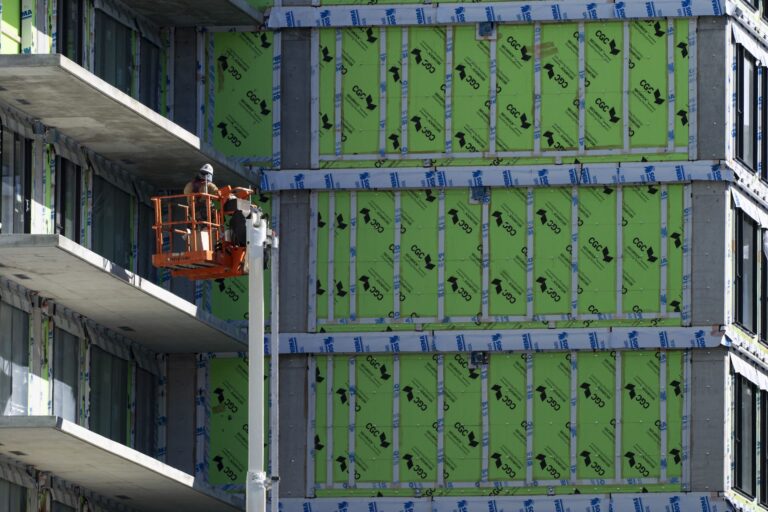
The trouble is the industry hasn’t evolved much since then, according to Ramtin Attar, CEO of Promise Robotics, which develops AI-powered controls for modular housing manufacturing equipment. “Globally, the fundamentals of the modular industry haven’t changed in a half-century. Countries like Sweden and Germany may have streamlined modular building techniques, but without seriously investing in automation, AI and digitization, or training our labour force to use these tools, modular homebuilding is going to experience the same issues that have led to the productivity crisis we’re seeing in the sector today,” Attar said.
Modular construction represents 7.5 per cent of the overall construction market and is valued at $5.1 billion, according to the Modular Building Institute (MBI), the U.S.-based trade association that has represented Canada’s modular construction sector since the early 1990s. The MBI has lobbied over a dozen government ministries, institutions and committees, advocating for standardized building codes, better access to financing and the mass adoption of modular technology in public procurement. “The modular industry offers proven advantages in speed, quality control, and cost-efficiency, and with sustained policy support and investment, our capacity can grow to become a critical part of the national housing solution,” MBI executive director Tom Hardiman said of Canada in an email.
For a government burdened with a housing crisis, the appeal of modular construction is undeniable. Building modular housing is as much as 50 per cent faster than through traditional construction methods, according to a 2023 McKinsey report. “You’re never losing a day to rain or high winds, because that doesn’t happen in a factory,” said Kevin Stewart, director of operations at ANC Group, the Brantford, Ont.-based company building the 150 Eighth St. project.
The modular method also requires less labour, a further advantage in a tight construction job market, and generates as much as 45 per cent less carbon emissions, according to a 2022 report from the University of Cambridge and Edinburgh Napier University.
Modular housing isn’t necessarily cheaper, however. The 150 Eighth St. project in Toronto cost $29 million, or about $464 a square foot—significantly higher than the $320 a square-foot industry standard, said Corke. A lack of training is behind these higher costs, according to Brandon Searle, a director at the Off-site Construction Research Centre at the University of New Brunswick. “Modular is often more expensive right now, but it will come down in price as the subcontractors and owners gain a deeper understanding of how to install and fit out the modules when they arrive at site,” Searle said.
There is also the matter of zoning regulations. The MBI has lobbied for a countrywide adoption of the Canadian Standards Association’s modular construction standard, or CSA A277. Currently, only Alberta, Quebec and Yukon require CSA A277, and the modular industry faces a patchwork of often-differing regulations as a result, said REIC’s Dsouza. At least one company has voted with its feet. In 2024, Illinois-based Z Modular closed its Canadian modular housing factory, saying “systematic headwinds,” “public sector inefficiencies” and financing issues had rendered their operations unsustainable.
Others still have brought the factories to them. Leith Moore, the co-founder of Toronto-based Assembly Corp., said cobbling together a supply chain is akin to watching the various pieces of an aged Canadian military helicopter “flying in loose formation.” Earlier this year, the company, which manufactures homes from engineered wood, bought and shipped a robotics factory from Sweden that will enable it to build its own prefabricated walls and floors. Assembly will be able to increase its production to 1,200 units from 150 when the new factory comes online in summer 2026.
Moore said the Build Canada Home $13-billion initial spend on things like bulk financing and public procurement are “foundational” in generating private sector demand and getting the prefabricated housing industry on its feet. “We’ve been spending a billion dollars in rapid housing to support modular construction without it necessarily being tied to creating or scaling a new business,” Moore said. “Let’s help businesses become sophisticated. Take the learnings from Europe and jump ahead.”



Loading...
Thanks for sharing!
You have shared 5 articles this month and reached the maximum amount of shares available.
CloseThis account has reached its share limit.
If you would like to purchase a sharing license please contact The Logic support at [email protected].
CloseGift the full article!
You have gifted 0 article(s) this month and have 5 remaining.
Recipients will be able to read the full text of the article after submitting their email address. They will not have access to other articles or subscriber benefits.
Photo: ANC Group/Handout
Most Popular This Week




In-depth, agenda-setting reporting
Great journalism delivered straight to your inbox.
The Big Read
Alberta’s referendum is just the start of the turmoil
Briefing
EverWind plans $10B data centre and wind development in Nova Scotia
Canada ready to force Stelco to sell its Canadian operations, Joly says
Feds plan a 60 MW defence-oriented data centre for Ottawa
Best business newsletter in Canada
Get up to speed in minutes with insights and analysis on the most important stories of the day, every weekday.
Exclusive events
See the bigger picture with reporters and industry experts in subscriber-exclusive events.
Membership in The Logic Council
Membership provides access to our popular Slack channel, participation in subscriber surveys and invitations to exclusive events with our journalists and special guests.