OTTAWA — David Cape wants shoppers trying to shift their spending to homegrown goods during the trade war to know that buying made-in-Canada products does not have to mean searching far and wide for something artisanal, unfamiliar or small.
Skip to content


News
This Canadian cosmetics company isn’t scared of a trade war
Head of Groupe Marcelle urges Canadians to rally around powerful companies like his, not just the small ones
Groupe Marcelle brands share space on the shelves of major Canadian retailers like Shoppers Drug Mart with the largest U.S.-based cosmetics companies. Photo: Charlie Gillis for The Logic
OTTAWA — David Cape wants shoppers trying to shift their spending to homegrown goods during the trade war to know that buying made-in-Canada products does not have to mean searching far and wide for something artisanal, unfamiliar or small.
“Canadians may feel that buying local means that it has to be a cottage industry, but Canada has produced some incredibly large companies that operate and compete at international scale,” Cape, the president of Montreal-based cosmetics company Groupe Marcelle, told The Logic in a recent interview.
Talking Points
- Head of Montreal-based cosmetics company Groupe Marcelle says consumers should think holistically about what it means to be a Canadian company
- BDC chief economist estimates a 0.7 per cent boost to GDP if every Canadian household diverted $100 worth of monthly spending from U.S. to Canadian products
The family-owned business, which says it is the largest cosmetics manufacturer with headquarters in Canada, has its skincare, makeup and fragrance products sold at more than 3,500 locations across Canada under its own name, and through acquired brands Watier and Annabelle, as well as CW Beggs and Sons, a skincare line for men. Its products line pharmacy shelves alongside American beauty-aisle giants Maybelline, Revlon and Cover Girl. Yet more than 90 per cent of its sales are within Canada.
That could insulate the company from the effects of U.S. President Donald Trump’s steep universal tariffs on Canadian goods—set to resume in full on April 2—although it is examining its supply chain for potential disruptions to the flow of ingredients it sources from the U.S.
Groupe Marcelle traces its history to 1870s Chicago, but in 1949 Montreal pharmacist Victor Cape, David’s grandfather, began distributing its products in Canada. Victor later secured global rights and opened the headquarters in Montreal in 1973.
The company has trademarked the phrase “A Canadian company proudly made in Quebec.” Groupe Marcelle is using some version of that messaging in its domestic marketing—such as the “audaciously Canadian” phrase featured above Annabelle products. Still, those slogans do not yet appear on all of its packaging, so consumers looking to buy Canadian would likely need to read the fine print on its labels.
Related Articles
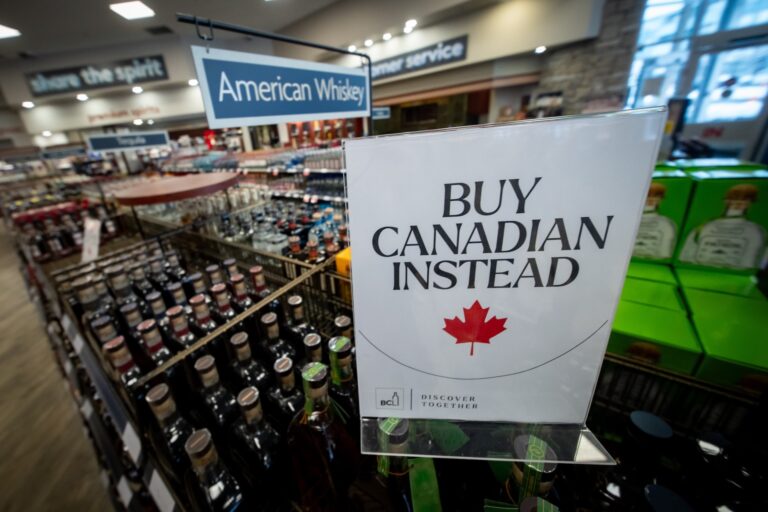

“We had no idea that this was coming, but we’re certainly trying to highlight that and make it clear as consumers are out there shopping and making choices,” Cape said.
Isabelle Hudon, president and CEO of the Business Development Bank of Canada (BDC), said too few companies based in Canada have foregrounded that fact in marketing their pitches. “When I see the wave of support for Buy Canadian, I think that any label that is 100 per cent made in Canada should make this highly visible,” she said. (Hudon used to be on the board at Groupe Marcelle, but she was not speaking about that company in particular.)
The federal Crown corporation believes a robust Buy Canadian movement could make a big difference as U.S. trade barriers threaten to slow economic growth. Hudon pointed to a key finding in analysis by BDC chief economist Pierre Cléroux: if every Canadian household replaced $100 worth of American products with Canadian ones every month, it would add 0.7 per cent to Canada’s GDP.
“Let that sink in,” Hudon said in a follow-up statement. “We have the ability to almost completely offset the impacts of 25 per cent U.S. tariffs (you know, the on-again, off-again tariffs). We take all their power away.”
Groupe Marcelle does include some quintessentially Canadian ingredients in its formulations, such as a Labrador tea extract that it actually sources from northern Quebec, and uses in the Watier skincare line for its anti-aging properties. But Cape would like consumers, and the federal government, to take a broader view of what it means to be a Canadian company.
Groupe Marcelle is owned by Canadians, financed by its banks, employs 350 people across the country and puts money into the economy through real estate, engineering consultants involved in the manufacturing process and marketing agencies that promote its business, Cape said. “Some of that doesn’t directly end up on every product label of every single product.”
That integration is also why Cape does not want anyone to think Groupe Marcelle is cheering on a trade war, even if it boosts sales. “I want to make sure that all Canadians are doing well,” he said. “There’s lemonade coming out of lemons, but certainly we need less lemons.”



Loading...
Thanks for sharing!
You have shared 5 articles this month and reached the maximum amount of shares available.
CloseThis account has reached its share limit.
If you would like to purchase a sharing license please contact The Logic support at [email protected].
CloseGift the full article!
You have gifted 0 article(s) this month and have 5 remaining.
Recipients will be able to read the full text of the article after submitting their email address. They will not have access to other articles or subscriber benefits.
Photo: Charlie Gillis for The Logic
Most Popular This Week




In-depth, agenda-setting reporting
Great journalism delivered straight to your inbox.
News
National Bank CEO warns AI alone won’t give banks a lasting edge
Briefing
Canada and Ontario commit over $5B to support tariff-hit steel sector
Hackers will see cars as major targets in next 3 years, 83% of car-tech workers say
EA shutting down Edmonton studio BioWare
Best business newsletter in Canada
Get up to speed in minutes with insights and analysis on the most important stories of the day, every weekday.
Exclusive events
See the bigger picture with reporters and industry experts in subscriber-exclusive events.
Membership in The Logic Council
Membership provides access to our popular Slack channel, participation in subscriber surveys and invitations to exclusive events with our journalists and special guests.





