Sue Ennis had some important questions for her boss after he participated in the first meeting of a council, featuring Elon Musk, to discuss the Bitcoin-mining industry’s energy use.
Skip to content
News
Can Elon Musk’s mining council rehab Bitcoin’s polluting image?
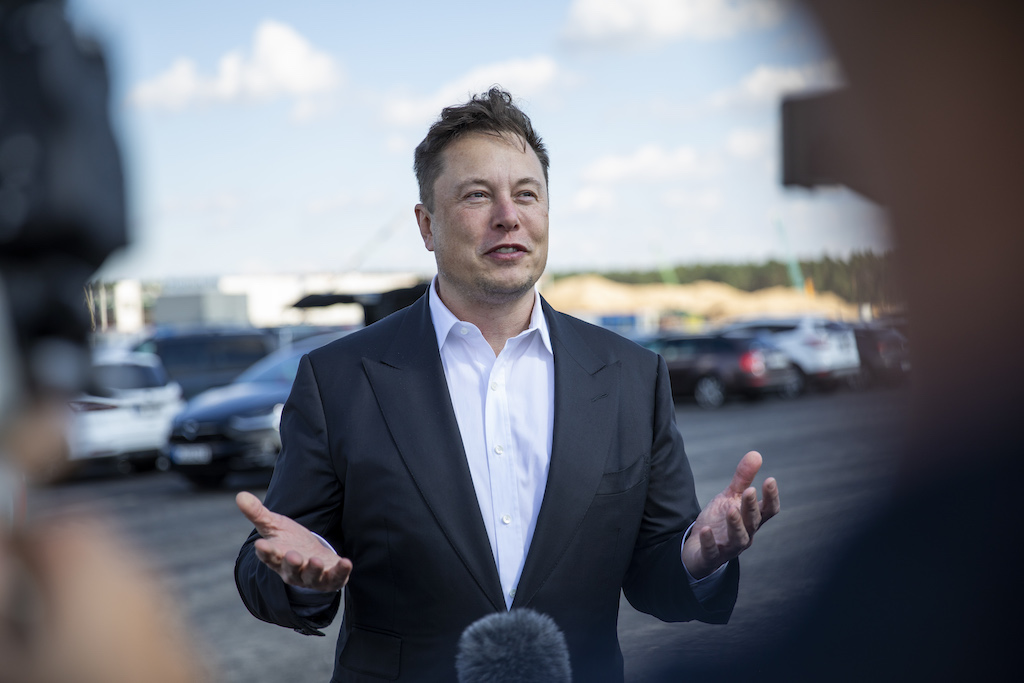
Tesla CEO Elon Musk in Germany in September 2020. Photo: Maja Hitij/Getty Images
Sue Ennis had some important questions for her boss after he participated in the first meeting of a council, featuring Elon Musk, to discuss the Bitcoin-mining industry’s energy use.
“I was like, ‘Oh my God, did you see Grimes or the baby?’” said Ennis, head of corporate development and investor relations for Canadian Bitcoin mining company Hut 8, referring to Musk’s partner—Vancouver-born musician Claire Boucher—and their one-year-old. “This industry is now trying to collaborate with one of the largest, most influential guys in technology. It’s great.”
Talking Point
Concerns about Bitcoin’s environmental impact are coming to a head, with Elon Musk convening a council of miners, including three Canadian-headquartered and -listed companies, to address the industry’s biggest public relations problem. Controversy over the council is revealing the ways two of the biggest trends in investing—cryptocurrency and ESG—are colliding.
Ennis could be forgiven if she were less enthusiastic about the invitation to collaborate with a man who had recently wiped billions in value from cryptocurrency markets with a single tweet. Since the Tesla CEO said on May 12 that his company was suspending vehicle purchases in Bitcoin out of concerns over the cryptocurrency’s environmental impact, the market has been in a free fall, with the price of Bitcoin dropping from more than US$50,000 to a low of about US$33,000 in late May.
There’s more at play in the recent cryptocurrency downturn than Musk’s Twitter use, including a call from China to ban Bitcoin mining and signs pointing to a coming regulatory crackdown in the U.S. But the formation of the Bitcoin Mining Council—which includes Musk, Microstrategy CEO and outspoken Bitcoin proponent Michael Saylor, and a group of North American miners including three that are headquartered or listed in Canada—highlights how big a problem Bitcoin’s carbon footprint has become for the currency.
Cryptocurrency and ESG—or environmental, social and corporate governance factors—are two of the biggest trends in investing. But with Bitcoin consuming more energy per year than all of Argentina, and facing longstanding criticisms over its role in facilitating crime and its limited utility for other forms of payments, both fans and critics of the cryptocurrency are questioning whether the two trends are at odds with each other.
Andrew Kiguel, chief executive of the Canadian cryptocurrency company Tokens.com and a co-founder of Hut 8, said the recent attention Musk has brought to Bitcoin’s environmental impact is a major problem for the sector.
“This is a huge blow,” Kiguel said. “People don’t want to support things that they think might be damaging.”
Concern around Bitcoin’s energy use had been growing steadily before Musk’s tweet brought it to a fever pitch. Cryptocurrencies require the participants who validate transactions to prove they have skin in the game in order to disincentivize fraud, with the two best-known and most valuable ones—Bitcoin and Ethereum—using energy consumption as the form of proof.
Bitcoin miners are essentially playing the lottery, competing for a reward of newly created bitcoins to generate a random winning result that the network accepts as a valid addition to the blockchain, a shared digital record of transactions. By design, it takes a lot of computing power—and racks up some big electricity bills—to make enough guesses to be statistically likely to win, which makes it profitable to be a good actor and extremely expensive to attempt to sneak inaccurate transaction records into the blockchain.
Miners turn a profit mainly on the difference between the price of Bitcoin and the cost of electricity. Canada’s cool temperatures and affordable power make it an attractive destination for Bitcoin miners, particularly in Quebec, thanks to cheap and abundant hydro.
On May 24, Musk and Saylor announced the Bitcoin Mining Council, which includes Canadian companies Hut 8 and Hive Blockchain, as well as TSX-listed Galaxy Digital. The council had met and agreed to be more transparent about energy use and promote ESG goals, they said, with Musk calling the development “potentially promising.”
The council faced immediate backlash from Bitcoiners, however. Some took issue with a group of executives making decisions about the protocol, which is designed to be leaderless, behind closed doors. Others raised concerns that increased transparency around energy use might lead to investors considering certain bitcoins to be “greener” and therefore more valuable than others, making it harder to use the digital asset as a currency.
Adam Back, chief executive of the Victoria-based Bitcoin company Blockstream—as well as the inventor of the system used to limit email spam that inspired Bitcoin mining, and an early correspondent with Bitcoin’s pseudonymous creator Satoshi Nakamoto—said the members of the Bitcoin Mining Council don’t have as much power as many people think. Previous Bitcoin controversies have shown miners tend to follow the forces of the free market as the system was designed rather than colluding to push a certain outcome, Back said.
“People are sensitive to things that sound centralizing, and ‘council’ was maybe a bit of an unfortunate word,” he said. “Miners are actually not that influential. They’re just service providers.”
Marty Bent, a co-founder of the Bitcoin mining company Great American Mining and author of a popular Bitcoin newsletter, argued ESG goals themselves may be the real threat to the cryptocurrency.
“The ESG movement is nothing more than an empty virtue signal,” he wrote. “Bitcoin is good. It consumes a lot of energy. This is okay. The illogical moralization of electricity use is anti-human and anti-capitalistic.”
The Bitcoin protocol is based on open source software, and code doesn’t have politics. But the people who write that code do. The values that inspired Bitcoin—privacy, censorship-resistant financial transactions, property rights independent of the state—tend to resonate with the libertarian right of the political spectrum, which might be an uncomfortable fit for a typical ESG investor primarily concerned about climate change and communal social good.
Greg Taylor, chief investment officer at Purpose Investments, said he thinks ESG and cryptocurrency investing can coexist. Taylor said ESG is “a core principle” across Purpose’s funds—including its Bitcoin ETF.
Taylor said Purpose is considering a carbon-neutral class of cryptocurrency funds, something competitor Ninepoint has already introduced by allocating a portion of its Bitcoin ETF’s management fee to support forest-conservation projects in the Amazon in an effort to make the fund carbon neutral. “We’re not taking the stance that some people have of just completely avoiding sectors,” Taylor said.
Kiguel, the CEO of Tokens.com, said investors should be wary of greenwashing. He said he thinks the Bitcoin Mining Council is unlikely to achieve much beyond helping some public mining companies get on the good side of Musk and his market-moving tweets.
“This is done for optics,” Kiguel said. “These are public companies who need to protect their image with investors.”
Ennis, Hut 8’s head of investor relations, readily agreed that improving Bitcoin’s public image is one of the goals of the council. Ennis argued the benefits of the cryptocurrency are worth its carbon footprint.
“Bitcoin enables people to escape tyranny, censorship, financial violence [and] redlining, and improves access to financial sovereignty,” she said. “This [fear, uncertainty and doubt] around, ‘Oh, it’s the devil, it’s so bad for the environment’ is a little bit misguided.”
Hut 8’s mining operations are based in Medicine Hat and Drumheller, Alta., where Ennis said most of the electricity comes from natural gas and wind. She said the company welcomes more transparency and conversations about how to make the industry sustainable.
“It’s more debates, more conversation. And it is more opportunity for collaboration,” she said. “We look at it as a good thing.”



Loading...
Thanks for sharing!
You have shared 5 articles this month and reached the maximum amount of shares available.
CloseThis account has reached its share limit.
If you would like to purchase a sharing license please contact The Logic support at [email protected].
CloseGift the full article!
You have gifted 0 article(s) this month and have 5 remaining.
Recipients will be able to read the full text of the article after submitting their email address. They will not have access to other articles or subscriber benefits.
Photo: Maja Hitij/Getty Images
Most Popular This Week




In-depth, agenda-setting reporting
Great journalism delivered straight to your inbox.
News
Ottawa is softening its ban on stablecoin yield
Briefing
Rio Tinto gets nearly $165M in additional federal funds for Quebec aluminum
U.S. to lift tariffs on some Canadian products crucial to Maine: Collins
Carney warns of tech dependence after Starlink disruptions in Ukraine
Best business newsletter in Canada
Get up to speed in minutes with insights and analysis on the most important stories of the day, every weekday.
Exclusive events
See the bigger picture with reporters and industry experts in subscriber-exclusive events.
Membership in The Logic Council
Membership provides access to our popular Slack channel, participation in subscriber surveys and invitations to exclusive events with our journalists and special guests.






