Skip to content

Canada's Business and Tech Newsroom

  • Professional Subscription
  • Partnerships & Advertising
  • Licensing & Syndication
Log In Subscribe
Welcome,
  • My Account
  • Log Out
  • Business
  • Tech
  • National
  • The Big Read
  • Briefings
  • Commentary
Search
Log In Subscribe
Welcome,
  • My Account
  • Log Out
News

Canada’s closest trading partners are pushing back against Carney’s Buy Canadian policy

Listen Now
0:00
News

Canada’s closest trading partners are pushing back against Carney’s Buy Canadian policy

The U.S, the EU and others have complained at the WTO about the policy that favours Canadian firms bidding for federal government contracts

By Laura Osman
A shot of Mark Carney and Ursula von der Leyen in front of an abstract painting with Canadian and EU flags on either side of it. Von der Leyen is speaking, and Carney appears to be shrugging at the camera with a sly smile on his face.
Prime Minister Mark Carney meeting European Commission President Ursula von der Leyen last May in Rome; the EU says Carney's Buy Canadian policy violates trade commitments. Photo: The Canadian Press/Adrian Wyld
Apr 9, 2026
A A
A Small A Medium A Large
Share

Gift

Share

Listen Now
0:00

OTTAWA – A growing chorus of Canada’s closest trade partners are calling out Prime Minister Mark Carney’s new Buy Canadian procurement policy, saying it flouts promises Ottawa made in trade pacts to give them access to government contracts.

A U.S. representative raised the issue with the World Trade Organization’s procurement committee in March, according to the organization’s account of the closed meeting. The Americans aren’t the only ones complaining. The European Union, Japan, New Zealand, Norway, Switzerland and the United Kingdom have all spoken against the policy at the WTO. 

“According to these parties, the recent developments raised concerns regarding whether Canada was acting in accordance with its commitment… to guarantee non-discriminatory access to other parties,” the WTO Secretariat said in a public meeting summary.

Talking Points

  • At least seven countries have raised concerns at the WTO about whether the federal government’s Buy Canadian procurement policy abides by Canada’s international trade pacts 
  • Canada has been called out at the World Trade Organization by the U.S., New Zealand, the EU and Japan, among other countries

Australia has also flagged the program as a concern, The Logic has confirmed.

The WTO declined to provide more context about the complaints, and U.S. Trade Representative Jamieson Greer’s office did not respond to a request for comment, though he flagged the Buy Canadian policy as an irritant in a recent report to U.S. Congress and President Donald Trump. 

“U.S. companies have reported concerns regarding additional barriers to compete for federal contracts in Canada, including being forced to share information about their boards of directors and prove their Canadian subsidiary’s independence from the U.S. parent company,” Greer said in the annual report on foreign trade barriers.

Related Articles

A shot of Joël Lightbound among reporters in a corridor of Parliament. He is wearing a dark peacoat and a khaki scarf.

Buy Canadian policy lets foreign-owned firms qualify as Canadian, Lightbound says

By Laura Osman
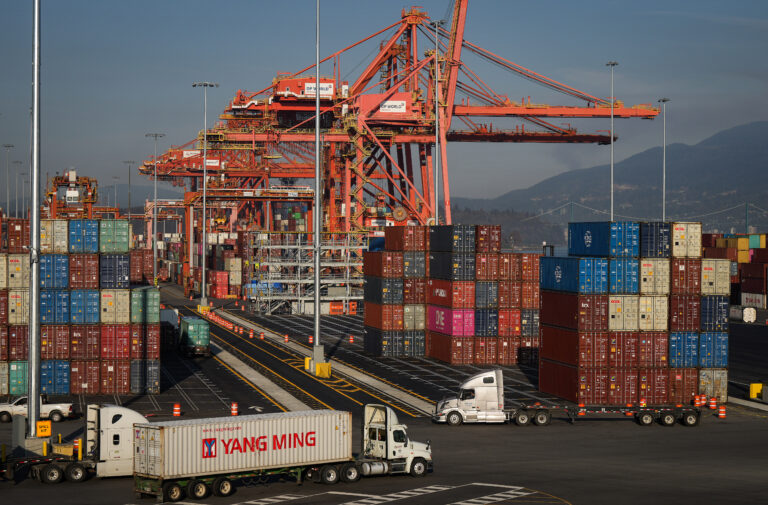
A truck carries a cargo container at the Port of Vancouver Centerm container terminal as others are stacked under gantry cranes.

Canada’s push for new export markets is starting to pay off

By Joanna Smith

The objections of countries other than the U.S. may be of greater concern for Canada, however, as the country looks to diversify its trade and reduce its economic reliance on its southern neighbour. The Liberals pitched the policy during the last election in response to trade aggression from the Trump administration as a way to shore up domestic demand for Canadian businesses dented by tariffs put on exports to the U.S. 

Carney and Procurement Minister Joël Lightbound announced details of the protectionist procurement policy in December. It gives preference to companies with a presence in Canada when awarding federal contracts worth more than $25 million, and requires firms that do business with the government to use Canadian-produced steel, aluminum and wood products for large federal construction and defence projects. 

The government plans to extend the Buy Canadian policy this spring to contracts valued over $5 million sometime this spring.

A few weeks before the announcement, it changed Canadian International Trade Tribunal rules to prevent companies abroad from challenging the preferential treatment given to Canadian firms. That means it will be up to other governments to advocate for their businesses’ access to Canadian contracts through the mechanisms in their trade agreements. 

“You wouldn’t need to create these sorts of protections for yourself if what you were doing was totally consistent with the trade rules,” said Timothy Cullen, a public procurement lawyer with McMillan LLP, of the trade tribunal amendments.

Some countries have a greater right to their grievance than others, he said. Canada’s agreement with the EU, for example, has clear restrictions on giving preferential treatment to domestic procurement partners, he said. “This is not something that is allowed under the agreement,” said Cullen, who co‑leads McMillan’s government and public policy group. 

The U.S. doesn’t have the same kind of procurement pact with Canada, but is covered by the WTO’s procurement agreement, which has a more limited scope.

The federal Procurement Department didn’t immediately respond to a request for comment. However, Canada’s representative at the WTO told the procurement committee on March 4 that Canada is “among the countries most exposed to the restructuring of global trade,” and that the policy responds to “exceptional challenges” for trade-dependent sectors with highly integrated supply chains. The Buy Canadian policy still allows foreign firms to bid on government contracts, it noted. 

Those trading partners’ concerns may be overblown, said Nicolas Lamp, director of Queen’s University’s Institute on Trade Policy. “When you announce a Buy Canadian policy, it always kind of strikes fear in your trading partners, and it sets a particular tone,” he said. 

Canada’s obligations boil down to providing reciprocal access to contracts that trading partners afford Canadian firms, Lamp said. Because other countries have protectionist procurement policies of their own, there’s room for flexibility for the government to prioritize Canadian bidders without running afoul of the rules, he added. The U.S. has had its Buy American regulations since the 1930s, for example, and the EU recently introduced something similar called the Industrial Accelerator Act to boost demand for low-carbon technologies and products made in Europe. 

Gift the full article

The European program lets Canadian firms bid on contracts, but only to the extent that the Canadian government does the same for EU businesses, Lamp said. That means Canada has an incentive to keep its procurement market open. 

Cullen, the procurement lawyer, noted that the government can also be exempted from its trade obligations on national security grounds, which would give Ottawa the ability to waive the rules on national defence contracts.


#Buy Canadian #economy #National #procurement #WTO

Sponsored Content

The real-world economic offshoots of sovereign AI

By Deborah Aarts
Illustration of a plane flying above a mailbox

Increasing healthcare access across Canada

By Deborah Aarts

What it takes to lead a frontier firm

By Deborah Aarts
Paid promotional content

Loading...

Thanks for sharing!

You have shared 5 articles this month and reached the maximum amount of shares available.

Close
This account has reached its share limit.

If you would like to purchase a sharing license please contact The Logic support at [email protected].

Close
Want to share this article?

Upgrade to all-access now

Close
Gift the full article!

You have gifted 0 article(s) this month and have 5 remaining.

Copy link and gift
Copy Link
Email to a friend
Send Email
Gift on Social Media

Recipients will be able to read the full text of the article after submitting their email address. They will not have access to other articles or subscriber benefits.

A shot of Mark Carney and Ursula von der Leyen in front of an abstract painting with Canadian and EU flags on either side of it. Von der Leyen is speaking, and Carney appears to be shrugging at the camera with a sly smile on his face.

Photo: The Canadian Press/Adrian Wyld

Most Popular This Week

An image of a man in a dark suit and purple tie standing and speaking at a microphone. The man has a serious facial expression. A blue banner that reads "Milken Institute" is in the background.
News

Investor demand is what’s bringing the Milken Institute to Canada

By Chaimae Chouiekh
Janice Charette and Dominic LeBlanc walking toward the camera next to a white pavilion that bears the logo of the 2026 G7 meeting in France.
News

Canada ‘can’t even talk about anything else’ if Trump makes good on latest tariff threat

By Joanna Smith
A man walks across a large greenhouse with large glass ceilings. He is walking on a white path through rows of green lettuce growing on the ground.
News

Canadian businesses were bracing for a wave of retirees. Then along came AI

By Anita Balakrishnan
An image of a man wearing a dark suit jacket and tie. He is wearing a mic and looking slightly away from the camera.
News

Brookfield and Cohere execs among high-profile guests at CVCA summit

By Catherine McIntyre

In-depth, agenda-setting reporting

Great journalism delivered straight to your inbox.

A head-on shot of Mark Carney at a lectern embossed with a maple leaf carved from wood. There is a row of Canadian flags behind him, and he's looking at the camera with a serious expression.
News

How Mark Carney plans to wage trade war against the United States

By Laura Osman and Murad Hemmadi

Briefing

Roots to go private in deal led by Marquee Brands

By Catherine McIntyre   |   Aug 21, 2026

Negotiations once again down to the wire as tariff countdown ticks toward midnight

By Laura Osman   |   Aug 21, 2026

Domtar shutters B.C. pulp mill over reduced demand and poor prices

By Laura Osman   |   Aug 21, 2026

Best business newsletter in Canada

Get up to speed in minutes with insights and analysis on the most important stories of the day, every weekday.

Exclusive events

See the bigger picture with reporters and industry experts in subscriber-exclusive events.

Membership in The Logic Council

Membership provides access to our popular Slack channel, participation in subscriber surveys and invitations to exclusive events with our journalists and special guests.

Recent Popular Stories

Commentary

Carmichael: Canada’s biggest companies aren’t wired for growth. That’s a problem for us all

By Kevin Carmichael   |   Aug 15, 2026
An image of the Canadian flag against two tall buildings with glass windows in the background.
Exclusive

Star researcher Sanja Fidler raises over US$90M for world model startup

By Murad Hemmadi   |   Aug 19, 2026
A woman wearing a ponytail and a black leather jacket stands on a stage. She looks slightly away from the camera. She wears a microphone and appears to be speaking to an audience.
News

Canada ‘can’t even talk about anything else’ if Trump makes good on latest tariff threat

By Joanna Smith   |   Aug 14, 2026
Janice Charette and Dominic LeBlanc walking toward the camera next to a white pavilion that bears the logo of the 2026 G7 meeting in France.
News

Anthropic wants to add ‘gigawatts’ of AI compute in Canada

By Murad Hemmadi   |   Aug 19, 2026
An image of a man with glasses, wearing a dark blue suit and light blue collared shirt. The man looks slightly away from the camera and a microphone is visible in the foreground. A blue background that reads World Economic Forum is visible in the background.
News

Negotiators work on fine print of deal that would spare Canada new U.S. tariffs

By Joanna Smith   |   Aug 19, 2026
A shot taken through a crowd of reporters and boom mics showing Mark Carney seated beside Donald Trump in yellow chairs in the Oval Office. Seated before them on sofas are senior members of the leaders' respecting cabinets.
News

U.S. private equity is buying Canada’s biggest payments processor. Some people are worried about sovereignty

By Claire Brownell   |   Aug 12, 2026
In this photo illustration the Moneris logo is seen displayed on a smartphone.

Canada's most influential executives and policymakers are reading The Logic

  • CPP Investments
  • Sun Life Financial
  • C100
  • Amazon
  • Telus
  • Mastercard
  • bdc
  • Shopify
  • Rogers
  • RBC
  • General Motors
  • MaRS
  • Government of Canada
  • Uber
  • Loblaw Companies Limited
logic-logo

Canada's Business and Tech Newsroom

100% human-crafted journalism

Newsroom

  • News Tips
  • AI Policy
  • Editorial Disclosures
  • Story Pitches

Company

  • About Us
  • Terms of Service
  • Privacy Statement
  • Corporate Information

Contact

  • Contact Us
  • Advertise
  • FAQs
  • Work at The Logic

© 2026 The Logic Inc. All Rights Reserved.

Trusted by leaders

Error

Account creation failed.

Please email us at [email protected].

Create Account

[wppb-register form_name=”cozmo-registration-form-for-modal”]

I do have an account
Login
or

[wppb-login]

I don’t have an account