BlackBerry announced Monday it is providing the “foundation” of a new electric-vehicle platform under a consortium launched by Foxconn, the world’s largest maker of electronic components.
Skip to content


News
BlackBerry’s software to power Foxconn-founded EV effort
Ivy, QNX to serve as ‘plumbing’ for customizable car platform Project X
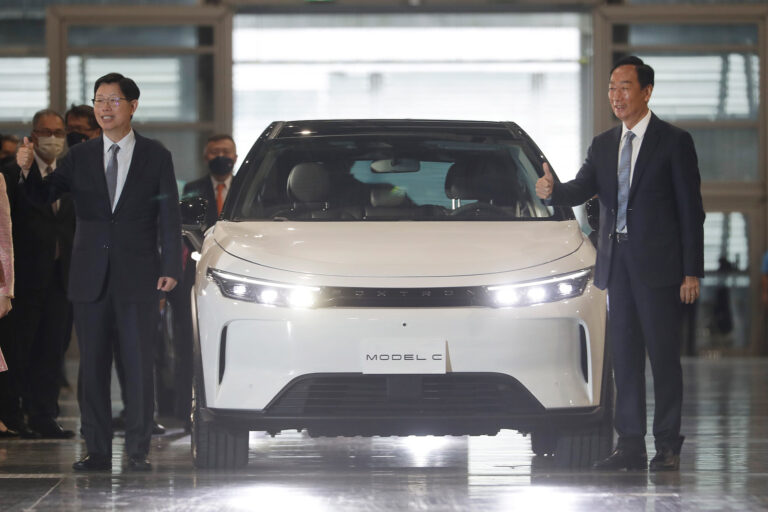
Jack Cheng at MIH Demo Day in November 2022. Photo: MIH/Handout
BlackBerry announced Monday it is providing the “foundation” of a new electric-vehicle platform under a consortium launched by Foxconn, the world’s largest maker of electronic components.
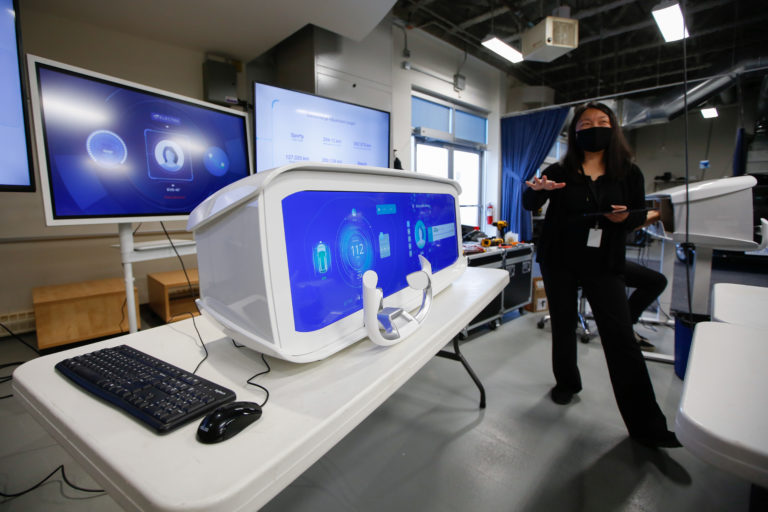
Mattias Eriksson, president of BlackBerry’s Internet-of-Things division, said the company’s software, including its Ivy and QNX systems, will be the “plumbing” behind the user experience for Project X, an open platform which any EV company can use to introduce vehicles faster and at lower cost. The first Project X vehicle will be a three-seater geared toward Asian consumers that will debut later this year in Japan.
Talking Points
- BlackBerry is working with Mobility in Harmony, a group founded by Taipei-based electronics giant Foxconn, on a new customizable electric-vehicle platform
- The Ontario software maker’s new customer will give it global exposure as Foxconn launches ambitious plans to make half the world’s EVs and become the equivalent of Google’s Android for the automotive sector
Why it matters: Adding MIH as a customer could mean huge exposure for BlackBerry. The group behind Project X is the Mobility in Harmony (MIH) consortium, initiated by Hon Hai Precision—better known as Foxconn. Taipei-based Foxconn ranks in the top 20 in the Fortune Global 500, and has vast ambitions to supply almost half the world’s EVs. While the company initiated MIH, the group extends beyond it, with 2,675 members from LG to Microsoft to Taiwanese semiconductor giant TSMC, MIH’s CEO Jack Cheng said in an email. About 70 per cent of members are hardware companies and 30 per cent are in software or services.
It’s one of the highest-profile deals yet for BlackBerry’s Ivy platform, a cloud and AI system co-developed with Amazon Web Services. It follows the January announcement of a deal to design software with China’s Dongfeng Motor—the first for Ivy, which became widely available earlier this summer.
It also deepens ties between Canada’s tech ecosystem and Foxconn, a company with which the Canadian government has met about a potential expansion of its footprint here, as The Logic first reported. Canadian diplomats in Taipei “received unofficial confirmation” last year that Foxconn was establishing a Toronto centre for automotive technologies.
Related Articles

Cheng declined to speak on Foxconn’s behalf, but said MIH’s consortium “is actively engaging with the Automotive Parts Manufacturers’ Association” and is “deeply connected with supply-chain vendors in Canada” on EV development.
The backdrop: The marriage of two legendary smartphone makers—Foxconn runs the world’s largest iPhone factory—comes as companies are trying to turn vehicles into “smartphones on wheels” and encourage drivers to cut the cord on intermediary services like Apple CarPlay and Android Auto.
A new report released by Wards Intelligence last week said that “lack of competencies in software and processing data” is one of the top challenges in the automotive supply chain, according to their survey of automakers, suppliers and industry players from various regions.
With the Ivy operating system, BlackBerry has sought to change that, helping connect automakers with software developers. Foxconn, similarly, wants to become the Android of electric vehicles—the automotive equivalent of the open source, affordable platform that non-iPhone makers quickly adopted.
The challenges: Consumers haven’t loved automakers’ attempts to build software, and have reported declining satisfaction with their vehicles because of it. Even the majority of automakers, suppliers and consultants told Wards they expect 30 per cent or less of vehicles to be sold with at least two subscription packages by 2030.
Cheng said that consumers in Asia highly value “emotional design and digital experiences,” particularly voice-activated features, something he sees catching on in North America amid the growing influence of AI. MIH is also investigating features “to cater to the preferences and needs of Generation Z,” as well as B2B applications for delivery vans, shuttle services and robotaxis.
While data access seems to be a big draw of many vehicle software developers, MIH said its goal is to “return data ownership and control back to vehicle owners.”
“In the current landscape, vehicle owners’ data and information are mainly controlled by vehicle manufacturers,” Cheng said. “As awareness around data collection and privacy grows, this approach is no longer satisfying to many vehicle owners.”



Loading...
Thanks for sharing!
You have shared 5 articles this month and reached the maximum amount of shares available.
CloseThis account has reached its share limit.
If you would like to purchase a sharing license please contact The Logic support at [email protected].
CloseGift the full article!
You have gifted 0 article(s) this month and have 5 remaining.
Recipients will be able to read the full text of the article after submitting their email address. They will not have access to other articles or subscriber benefits.
Photo: MIH/Handout
Most Popular This Week




In-depth, agenda-setting reporting
Great journalism delivered straight to your inbox.
Commentary
Carmichael: Being boxed in will help Canada focus on what matters
Briefing
Rio Tinto gets nearly $165M in additional federal funds for Quebec aluminum
U.S. to lift tariffs on some Canadian products crucial to Maine: Collins
Carney warns of tech dependence after Starlink disruptions in Ukraine
Best business newsletter in Canada
Get up to speed in minutes with insights and analysis on the most important stories of the day, every weekday.
Exclusive events
See the bigger picture with reporters and industry experts in subscriber-exclusive events.
Membership in The Logic Council
Membership provides access to our popular Slack channel, participation in subscriber surveys and invitations to exclusive events with our journalists and special guests.






