BlackBerry is shipping its Ivy software platform for vehicles this month, beginning a major test for its collaboration with Amazon—one in which it will increasingly face competition from the automakers it hopes to win over as clients.
Skip to content

News
With Ivy’s launch, BlackBerry aims to return to the cutting edge of apps
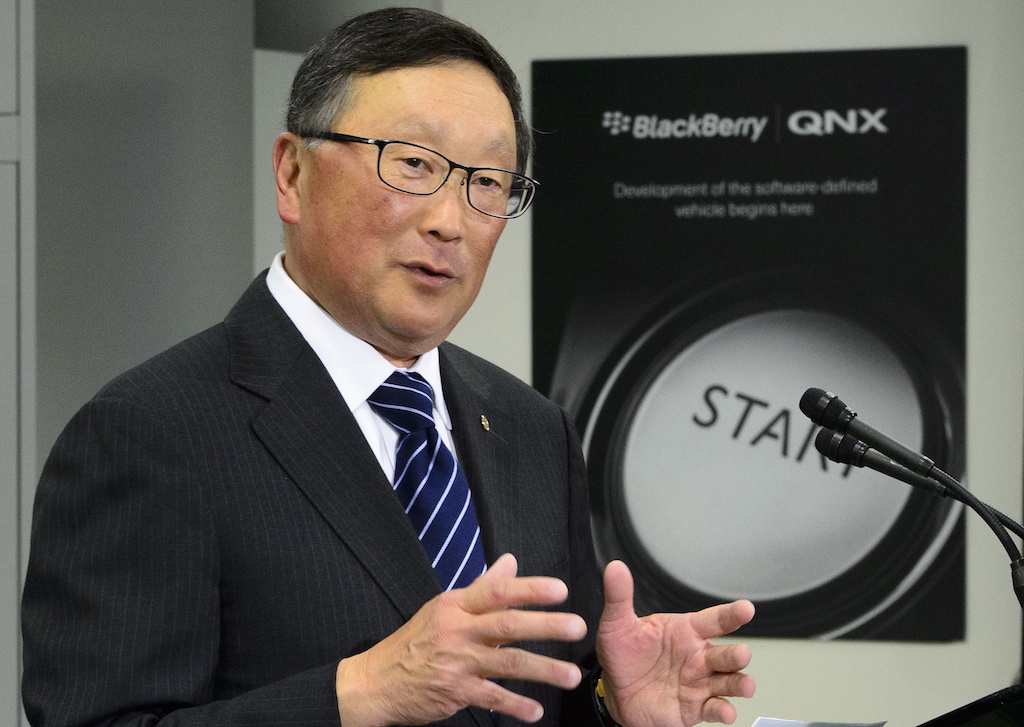
BlackBerry CEO John Chen takes part in an event at BlackBerry QNX headquarters in Ottawa in February 2019. Photo: The Canadian Press/Sean Kilpatrick
BlackBerry is shipping its Ivy software platform for vehicles this month, beginning a major test for its collaboration with Amazon—one in which it will increasingly face competition from the automakers it hopes to win over as clients.
“What you’re seeing in automakers is, ‘Oh, look at this mobile-phone trend. Let’s do that in the vehicle,’” said Peter Virk, vice-president of BlackBerry’s Ivy ecosystem, in an interview with The Logic.
Talking Point
As BlackBerry sends its Amazon-powered auto platform out into the world, it has a chance to regain the visibility it once had as an innovator of consumer electronics—just of the four-wheeled variety. BlackBerry and Amazon may have tech prowess that automakers may lack, but the competition to own the auto operating system could be just as fierce as BlackBerry versus iPhone.
In the early days of mobile phones, most software development focused on the programs that operated the phone. But as iOS and Android grew to dominate the market, focus shifted to developing programs that could harness the same type of content and functions available on a computer.
Technology kept changing, and now smartphone developers build apps that harness the features of the phones themselves, like cameras sensors or location tracking, rather than just mimicking what was available on a desktop or browser.
In the same way, vehicles are moving into an era where instead of operating systems and basic entertainment consoles, companies are hoping to sell subscription software that uses a car’s sensors to handle toll-booth payments or more personalized car insurance.
At least, that’s what BlackBerry is betting on.
“You’ve got iOS and you’ve got Android, because they are two big communities of devices. If there were 100 different devices out there, that would be fragmented. And that’s what happened in the past with the Nokias and the Motorolas—it became very bespoke. The car is no different. And that’s what Ivy is trying to drive, is standardization.”
At a BlackBerry-hosted security summit Wednesday, Amazon Web Services principal business lead Nick Lefler argued consumers have become hesitant to trust digital systems in vehicles, like EV fuel gauges that drop dramatically when the air conditioning turns on and trigger range anxiety. Lefler said the automotive software sector needs “trusted developers” from consumers’ digital lives, who understand the safety risks of automobile technology. As automakers are forced to differentiate their cars through software, “instead of just bending metal, and horsepower and leather seats,” they will need to work on attracting high-quality developers, he said.
At the time of publication, Amazon had 72 job postings that mentioned QNX, BlackBerry’s operating system for running critical systems in cars and other devices— including several for Lab126, the web giant’s experimental-device division. In Toronto, Amazon was looking for a senior engineer to create “cutting-edge voice control in the automotive market.”
Lefler said if automakers open up to the best developers, it might let them build features related to privacy or object detection that they couldn’t build on their own. “Not all algorithms are created equal. You’ve got some people who are really good at it, and some people who aren’t,” Lefler told the audience Wednesday.
BlackBerry and Amazon are hoping the early-access version of the Ivy system will show up in automakers’ and app developers’ presentations at CES in January before a wider launch in February. Ivy’s partnerships—like one announced this week with Qualcomm and Google, which puts Android’s automotive and infotainment systems onto a single-chip system with QNX—suggest BlackBerry’s tech and telecom roots may come in handy. But it’s not the only one with that advantage. Apple is said to be working on a connected-vehicle system, and Chinese automaker Geely is launching a smartphone.
The Las Vegas electronics show is something like home turf for BlackBerry, an event where it has a history of going toe to toe with other tech giants in casino conference rooms. Now, though, it will also be rubbing shoulders with automakers—whether as customers or as competitors. Toyota is building a software platform called Arene that will gather data and be offered to rival automakers. GM is looking to software and apps for recurring revenue beyond vehicles.
The smartphone model has struggled to catch on in cars because phones have historically had a shelf life of two to three years, compared with automobile lives of 10 or even 15 years, Virk said in an interview. Imagine using a 2007 mobile phone in 2017, and you can see why the technology was moving too fast to translate to a car.
Now, technology like 5G could allow cars to get continuous updates like other electronic devices, Virk said. That allows not only for consumer-facing perks like entertainment and EV charging apps, but a business-to-business opportunity for BlackBerry.
The company has so far publicly announced three services for Ivy: payments, EV-battery tracking and driver assistance for fleets. Virk said these use cases make sense for customers like rental car companies, letting them track maintenance on multiple vehicles. CEO John Chen said last month Ivy could be used in Amazon delivery trucks and other cargo trucks.
“If you can get data sets on the car around how they’re being used, the frequency or where they’re going, you can then offload that risk,” Virk told The Logic. “Insurance is always based on risks. But if you can get insights and data, then you can get real factual information.”
Automakers have another motivation to mind their data: the law. The National Highway Traffic Safety Administration has sought automaker data around crashes and driver assistance. In China, where BlackBerry has automotive customers, there has been a crackdown on automotive data security.
Virk said Ivy is designed to work in any jurisdiction, including China. Stateside, an Ivy partner called Ridecell will let automakers provide crash analytics to NHTSA by automatically generating accident reports.
“[Automakers] have to meet regulations, or else they can’t sell or ship vehicles,” said Virk. “If Ivy can support it, it solves it for everybody.”
Correction: Ridecell is an Ivy partner. This story has been updated.



Loading...
Thanks for sharing!
You have shared 5 articles this month and reached the maximum amount of shares available.
CloseThis account has reached its share limit.
If you would like to purchase a sharing license please contact The Logic support at [email protected].
CloseGift the full article!
You have gifted 0 article(s) this month and have 5 remaining.
Recipients will be able to read the full text of the article after submitting their email address. They will not have access to other articles or subscriber benefits.
Photo: The Canadian Press/Sean Kilpatrick
Most Popular This Week




In-depth, agenda-setting reporting
Great journalism delivered straight to your inbox.
News
Cohere plans to acquire cyber startup Aisle and set up a new security division
Briefing
Banks should have kill switches, IDs for AI agents, says global finance watchdog
B.C. First Nations decry rushed consultations as Major Projects Office CEO promises to do better
Feds pledge $100M to back Nova Scotia’s plans for offshore wind farms
Best business newsletter in Canada
Get up to speed in minutes with insights and analysis on the most important stories of the day, every weekday.
Exclusive events
See the bigger picture with reporters and industry experts in subscriber-exclusive events.
Membership in The Logic Council
Membership provides access to our popular Slack channel, participation in subscriber surveys and invitations to exclusive events with our journalists and special guests.