As policymakers everywhere consider what to do about AI, the world’s highest-stakes literature review concluded that the field is moving very fast—but it’s not clear where it’s going. Université de Montréal professor Yoshua Bengio’s expert panel on Friday delivered a first, landmark scientific report on the safety of advanced AI. Here’s what you need to know.
Skip to content
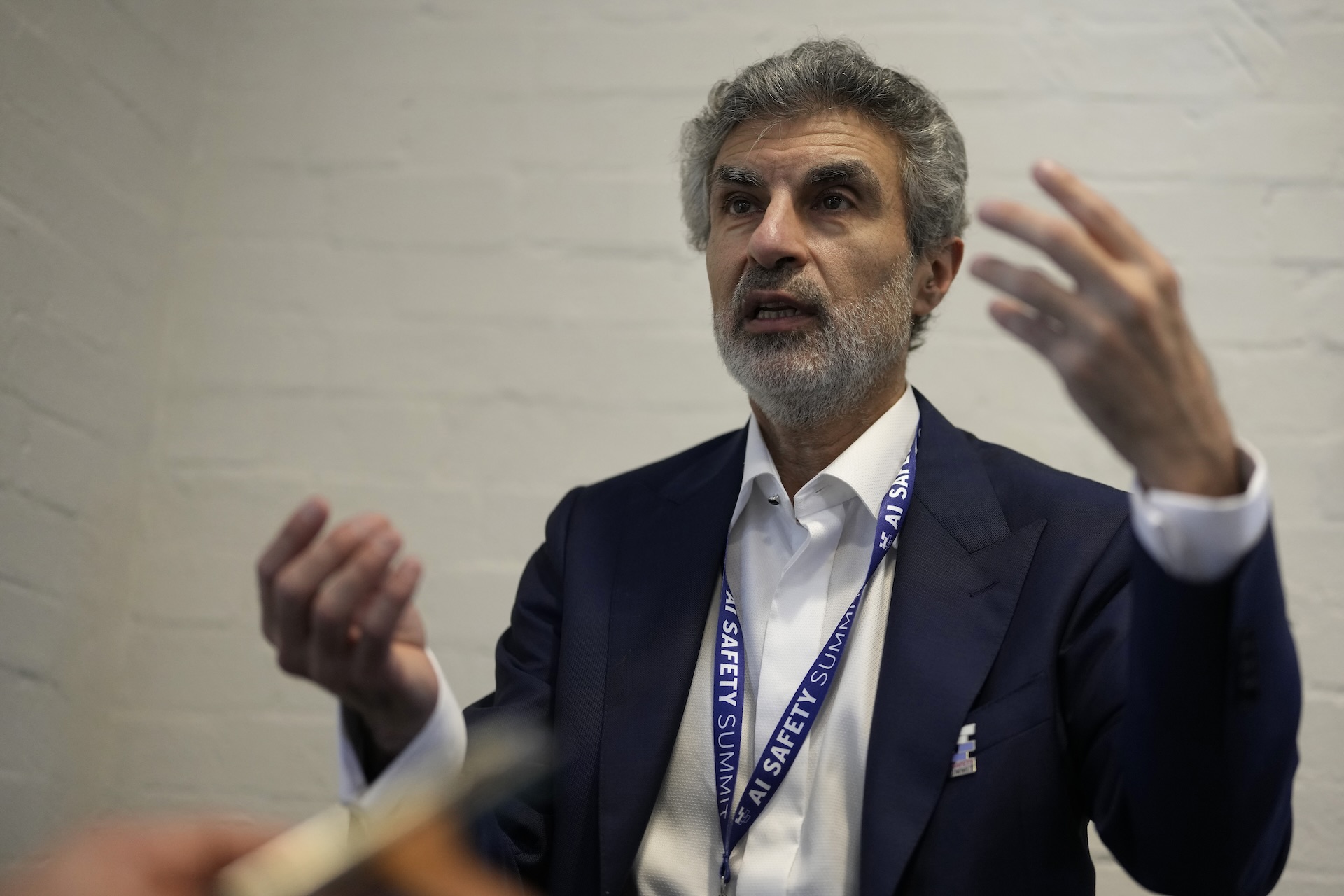 Université de Montréal professor Yoshua Bengio speaks at the AI Safety Summit in Bletchley Park, Milton Keynes, England, in November 2023. Photo: AP Photo/Alastair Grant

News
Bengio’s landmark report clocks pace of AI advances, potential risks
Expert panel commissioned at U.K. AI Safety Summit delivers first findings
Université de Montréal professor Yoshua Bengio speaks at the AI Safety Summit in Bletchley Park, Milton Keynes, England, in November 2023. Photo: AP Photo/Alastair Grant
As policymakers everywhere consider what to do about AI, the world’s highest-stakes literature review concluded that the field is moving very fast—but it’s not clear where it’s going. Université de Montréal professor Yoshua Bengio’s expert panel on Friday delivered a first, landmark scientific report on the safety of advanced AI. Here’s what you need to know.
The backstory: At the U.K. AI Safety Summit in November, countries promised closer cooperation to ensure the technology is developed and used responsibly. The U.K. commissioned Bengio, an advisor to both the Canadian and U.K. governments, to lead work on a “state of the science” report focused on general-purpose systems, the multi-use models that underpin tools like ChatGPT.
The group—which included government-nominated officials as well as researchers and policy analysts—assessed hundreds of sources, combining peer-reviewed papers with other influential literature.
The pace of AI progress: It’s been fast, the report says, noting that five years ago the best AI models “could rarely produce a coherent paragraph of text.” Ordinary users who’ve conversed with ChatGPT or used Stable Diffusion to produce realistic images can see the improvements for themselves.
Related Articles

That progress has come from bigger, increasingly efficient but also more resource-intensive models. The report estimates that each year’s leading systems need about two-and-a-half times as much data and four times as much compute, although they’re squeezing up to three times as much performance out of that processing power. All that extra data-centre-use is a risk, raising energy and water consumption, and therefore the field’s emissions, the panel said.
The group is less certain on what comes next. Many of the tech giants and startups leading the space are trying to scale and optimize existing methods, feeding models more data and compute. But the report notes that developers may eventually run out of information, servers, chips or just the cash to keep going that way. And it says experts are split on whether that approach has brought AI systems closer to the ability to reason, a key goal of many in the field.
The black box: The panel agrees on what we don’t know, which is much about what’s happening under the hood of general-purpose AI. Models are typically tested by inserting an input and seeing what comes out, but that approach doesn’t offer “quantitative safety guarantees,” the report says. It also claims developers don’t always give independent auditors enough access or information to be effective.
Several leading tech firms have agreed to let some government AI safety institutes test their models, although initial efforts have reportedly been challenging. Ottawa has promised to establish its own such organization.
While the report doesn’t make explicit recommendations—it’s meant to inform, not direct, policymakers—it says general-purpose systems need to be better understood.
The risks: AI could pay economic and social dividends, but the report purposely focuses on its potential liabilities. The technology could:
- Be used to generate fake content to scam people, or disinformation to sway public opinion.
- Be used in high-stakes decisions in health care, hiring or lending, and discriminate against people of certain races, gender, ages or with disabilities.
- Automate so many tasks that it costs workers their jobs.
- Misbehave in ways we can’t yet predict.
All those concerns are well-worn, and the report acknowledges the work underway to mitigate AI risks. But that has “not reliably prevented even overtly harmful general-purpose AI outputs in real-world contexts,” it says.
What’s next: Tech leaders and ministers will meet in Seoul next week, a follow up to the U.K. summit. The panel’s report, billed as an “interim” document, is on the agenda. Bengio wrote that he hopes the next edition will cover even more of the scientific literature, as well as submissions from companies and civil society organizations working in the field. The panel has until the next AI summit in Paris, for which a date has not yet been announced.
Meanwhile: OpenAI is dissolving its superalignment team, charged with ensuring the safety of future AI models. That follows the exit of the group’s leaders, Ilya Sutskever and Jan Leike, earlier this week. The ChatGPT developer’s CEO Sam Altman promised details of a new approach shortly.



Loading...
Thanks for sharing!
You have shared 5 articles this month and reached the maximum amount of shares available.
CloseThis account has reached its share limit.
If you would like to purchase a sharing license please contact The Logic support at [email protected].
CloseGift the full article!
You have gifted 0 article(s) this month and have 5 remaining.
Recipients will be able to read the full text of the article after submitting their email address. They will not have access to other articles or subscriber benefits.
Photo: AP Photo/Alastair Grant
Most Popular This Week




In-depth, agenda-setting reporting
Great journalism delivered straight to your inbox.
Commentary
Carmichael: Canadian ignorance about India is a strategic weakness
Briefing
Aritzia shares pop after earnings rise 204%
First Nation in Alberta goes to court over fast-tracked oil pipeline
Chinese EV maker Geely Auto Group to launch in Canadian market in 2027
Best business newsletter in Canada
Get up to speed in minutes with insights and analysis on the most important stories of the day, every weekday.
Exclusive events
See the bigger picture with reporters and industry experts in subscriber-exclusive events.
Membership in The Logic Council
Membership provides access to our popular Slack channel, participation in subscriber surveys and invitations to exclusive events with our journalists and special guests.