
Listen Now
0:00
OTTAWA — The government has set aside less support for the auto sector in its new Strategic Response Fund than the flagship innovation program it replaces, an analysis by The Logic shows.
Last fall, Prime Minister Mark Carney announced the $5-billion Strategic Response Fund (SRF) would replace the Strategic Innovation Fund (SIF), a long-standing Trudeau-era program that offered financial support to companies for research and development, expansion projects and large foreign investments.
Talking Points
- Prime Minister Mark Carney said the government planned to “accelerate” funding for the auto industry by replacing the Strategic Innovation Fund with a new program for tariff-hit industries, but an analysis by The Logic suggests the government has actually taken its foot off the gas
- The Logic found the $3 billion Carney set aside for the auto industry under the new Strategic Response Fund is actually $400 million less than the industry got from the program’s predecessor over the same period
Then, earlier this month, Carney said Ottawa would reserve $3 billion from the fund for the auto industry over six years as part of a larger strategy to help automakers withstand U.S. tariffs.
But over the previous six years, the SIF awarded auto-related companies more than $3.4 billion, The Logic’s ongoing analysis of the fund shows. That doesn’t include a deal Ottawa struck with Volta Energy Solutions in 2023 to back its battery copper foil production facility in Granby, Que., since the government has yet to release how much it is committing to the project. The analysis also leaves out Ottawa’s planned investment in Northvolt’s EV battery manufacturing facility just outside of Montreal, which fell apart when the company collapsed in 2024.
Of the money awarded to the auto industry in those years, 94 per cent went to foreign-headquartered firms or their subsidiaries. The Logic relied on available government records to compile the data.
Related Articles

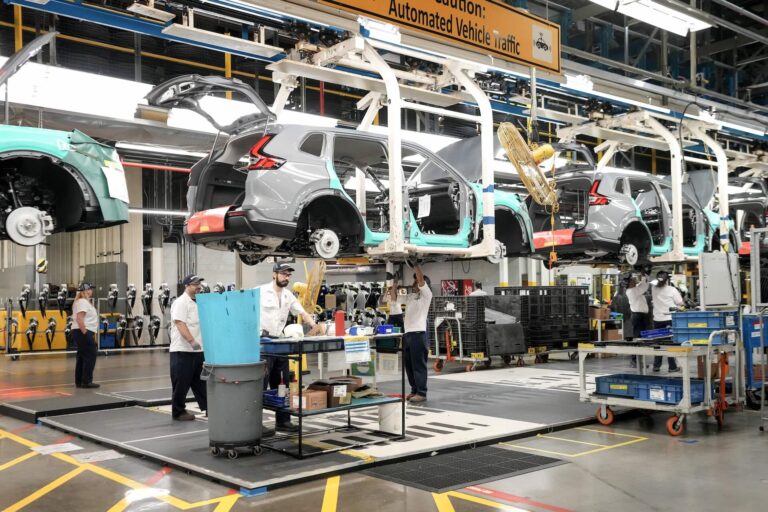
The projects include expanding a Goodyear Tire plant in Napanee, Ont., a cathode active materials facility in Quebec backed by General Motors and, most recently, the Innovation Driving Green Technology Project run by autoparts giant Linamar in Guelph, Ont.
The new funding may not be the boon the government’s long-anticipated auto strategy made it seem, but Global Automakers of Canada president David Adams said he’s happy to see support still coming. “I’m not sure that it’s ideally a sufficient amount, but certainly better than nothing,” said Adams, whose organization represents Toyota and Honda, both of which benefited from the SIF.
Adams noted that, not long ago, he heard people suggesting Canadian governments should let the auto sector go, as U.S. tariffs made the industry unsustainable in this country. “It’s at least good to see that the government recognizes the importance of the sector and is continuing to commit funding to support it in these challenging times,” he said.
The Canadian Vehicle Manufacturers’ Association, which represents Ford, General Motors Stellantis, did not respond to The Logic’s request for an interview.
A spokesperson for Innovation, Science and Economic Development Canada said the auto investments it made through the old version of the fund were largely aimed at electric vehicle production and establishing an EV battery supply chain. “This was part of a whole-of-government response to highly competitive international incentives such as the United States’ Inflation Reduction Act,” Riyadh Nazerally said in the statement.
The new program will add protecting domestic jobs to that list of goals, he said.
Like the SIF, the SRF will focus on large projects with federal contributions of at least $10 million, he added.
Over the last six years, SIF awarded $10.4 billion, which includes repayable and non-repayable grants. Because the fund reimburses companies for their spending, there is a delay in the distribution of the money: during that same period, the amount the government actually paid out from the fund was $5.8 billion.
Roughly 32 per cent of funds awarded under the innovation program went to auto-sector projects over that period. Carney’s new response fund will up that to 60 per cent of the new funds he’s allocated to the program.
All aspects of the sector will require “large investment,” Carney said earlier this month at a press conference in Vaughan, Ont., where he announced the government’s auto strategy. “We’re accelerating investment across the auto value chain to support strategic investments by our companies,” he said.
The rebranded SRF is supposed to help firms in sectors hit by U.S. President Donald Trump’s tariffs, from autos to lumber to aluminum. In July, the government set aside $1 billion from the fund for Canada’s steel industry. And last month, as part of an affordability announcement, Carney earmarked $500 million to address rising grocery prices by backing private-sector projects that respond to supply chain disruptions.
The SRF is also available to companies looking to expand Canada’s AI compute capacity and other large-scale innovation projects.
The fact that most of the allotted $5 billion is reserved for the automotive industry, though, brings the program full circle. Former prime minister Justin Trudeau launched it in 2017 by rolling together four existing programs for the automotive and aerospace sectors.
Since then, the biggest complaint Adams has heard from automakers is that accessing the fund is difficult and administratively complex. Even if the government isn’t offering more money through the SRF, he said, it could help the industry by fixing that.
Nazerally said the government hopes to make the process faster and more agile, but “rigorous due diligence remains critical.”
“My hope would be that the government has heard some of the issues with the previous iteration, and it will address those with the rebranded fund,” Adams said. “As with everything, the proof will be in the pudding.”













