Skip to content

Canada's Business and Tech Newsroom

  • Professional Subscription
  • Partnerships & Advertising
  • Licensing & Syndication
Log In Subscribe
Welcome,
  • My Account
  • Log Out
  • Business
  • Tech
  • National
  • The Big Read
  • Briefings
  • Commentary
Search
Log In Subscribe
Welcome,
  • My Account
  • Log Out
Analysis

Canada’s private equity boom is leaving the weakest borrowers exposed

Listen Now
0:00
Analysis

Canada’s private equity boom is leaving the weakest borrowers exposed

The share of borrowers rated as risky or worse has reached nearly 20 per cent, according to Moody’s, driven in part by a surge in private equity ownership

By Chaimae Chouiekh
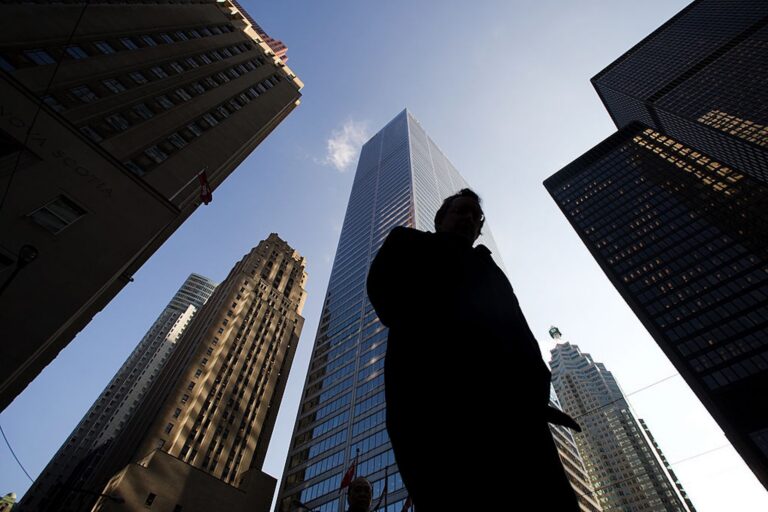
A shaft of light illuminates a man crossing a street within a canyon of dark office towers in downtown Toronto.
Canada’s speculative-grade issuers are seeing faster deterioration in credit quality than those in other major advanced economies, as default risks continue to rise. Photo: The Canadian Press/Nathan Denette
Jun 2, 2026
A A
A Small A Medium A Large
Share

Gift

Share

Listen Now
0:00

Canada’s riskiest corporate borrowers are deteriorating faster than those in other major economies, according to a Moody’s report that links the trend in part to the country’s high concentration of private equity ownership. Yet despite losses across some of the Maple 8’s private equity portfolios last year, some argue the downturn is creating new opportunities.

The share of the country’s high-risk borrowers—those B3 negative or lower—reached nearly 20 per cent at the end of 2025, more than double the level a year earlier and the highest in at least three years, according to Moody’s. That figure exceeded levels in the U.S., U.K., France and Germany.

Talking Points

  • The share of Canadian lowest-rated issuers—B3 negative or lower—reached nearly 20 per cent at the end of 2025, more than double the previous year and above levels seen in the U.S., U.K., France and Germany, according to Moody’s 
  • Private equity-backed companies accounted for nearly half of Canada’s rated speculative-grade issuers in 2025, compared with virtually none in the early 2010s

Will Gu, a Moody’s analyst, said in a note that inflation, higher rates and U.S. trade disruptions have squeezed margins and raised borrowing costs, leaving leveraged companies particularly vulnerable.

Nearly half of Canada’s 63 rated high-yield corporate issuers were backed by private equity sponsors in 2025, up from almost none in the early 2010s, according to Moody’s. Years of cheap borrowing, abundant capital and growing pension fund allocations to private markets drove a wave of acquisitions globally that left many companies carrying heavy debt loads and more exposed to economic shocks, according to Gu. 

“If private equity ownership continues to account for a larger share of the market, overall credit quality will weaken further,” he wrote in the report. Moody’s recorded 13 downgrades among the riskiest Canadian issuers in 2025, up from seven the previous year and the most since 2020. 

Private equity ownership has risen from roughly one in 10 businesses in 2010 to about one in two today, said Frédéric Bouchard, partner and national corporate finance leader at PwC Canada, driven by institutional investors seeking higher returns. 

Related Articles

Angel investing in Canada sinks to 5-year low, erasing signs of recovery

By Catherine McIntyre

Private credit in Canada keeps rolling despite deepening U.S. turmoil

By Chaimae Chouiekh and Anita Balakrishnan

Mark Jamrozinski, managing partner for private equity at Deloitte Canada, pushed back on the idea that private equity capital has become excessive in Canada, saying the market remains less competitive than the U.S. and continues to attract American investors seeking growth opportunities. 

According to Gu, about a third of Canada’s weakest borrowers are telecommunications companies, while another third are in metals and mining. The remainder are spread across energy, manufacturing and forest products. Jamrozinski, meanwhile, pointed to software companies and businesses exposed to trade tensions as at-risk areas. 

Canada’s 12-month trailing speculative-grade default rate rose from roughly 2.5 per cent in mid-2022 to about eight per cent in late 2025, well above the global three to four per cent average. Gu said Canada’s relatively small market can exaggerate year-over-year changes, and expects default risk to remain high through mid-2026.

Canada’s Maple 8 are among some of the world’s largest private equity investors. They  collectively managed more than $400 billion in private equity at the end of 2025—about a sixth of their $2.4 trillion assets under management. 

Since interest rates began rising in 2022, the deal-making boom and easy financing conditions of previous years have come to an end, Jamrozinski said. 

Ontario Teachers’ Pension Plan reported a 5.3 per cent loss in the asset class in 2025—reportedly its worst performance since 2008—while Ontario Municipal Employees Retirement System (OMERS) posted a 2.5 per cent decline the same year and a $665 million net investment loss on its $25.6-billion portfolio. Last year, La Caisse generated a 2.3 per cent return in private equity, well below its 12.6 per cent benchmark gain, and Healthcare of Ontario Pension Plan (HOOPP) reported returns of 3.6 per cent, lagging the 11.7 per cent return generated by its public holdings. Canada Pension Plan Investment Board reported a 2.9 per cent return in its private equity segment this fiscal year, down from 10.9 per cent in 2025.

John Graham, CPP Investments’ chief executive officer, told The Logic in an interview that despite private equity having had a “long moment in the sun,” the asset class is now being challenged by a post-COVID backlog of portfolio sales as well as uncertainty around AI. Still, he remains bullish on the asset class over the long term.

“I think the mistake is to go into a holding pattern because what you do is you shut off the flow and the flow is actually pretty attractive,” he said.

Gillian Brown, Ontario Teachers’ chief investment officer, said in the pension fund’s annual report that private equity investors are grappling with slower deal making, fewer exit opportunities and higher interest rates, which has weighed on returns and made transactions more difficult to execute. OMERS similarly attributed part of its private equity underperformance to disappointing results from its growth equity and venture capital holdings.

The tougher environment is making pensions more selective, Gu said. Rather than taking direct stakes in riskier businesses, they are increasingly favouring investments and partnerships with more predictable returns, he added.

Asked whether they are becoming more selective on new deals and what steps they are taking to improve private equity performance relative to their benchmarks, spokespeople for HOOPP, the British Columbia Investment Management Corporation and OMERS declined to comment. La Caisse, the Public Sector Pension Investment Board and Ontario Teachers’ did not respond to requests for comment.

Jamie Vallance, managing director and head of funds and secondaries at Alberta Investment Management Corporation said the pension’s private equity strategy “hasn’t fundamentally changed over the last decade,” with a continued focus on selective investing.

Gift the full article

As pension funds recalibrate their private equity exposure, a refinancing challenge could emerge over the next year as companies acquired during the highly leveraged 2021 deal-making boom seek to renew debt in a much tougher market, Jamrozinski said. “There is a risk that private equity needs to inject more capital to keep the businesses going,” he added.

Still, he said, “now is the best time to be investing in private equity, because as the valuations come down, there’s great buying opportunities.” 

Editor’s note: This story has been updated to note that the British Columbia Investment Management Corporation declined a request for comment.

With files from Kevin Carmichael

#Bay Street #Business #private equity

Sponsored Content

How to shift your workforce from AI experimentation to adoption

By Jessica Aftimus Rosa

The real-world economic offshoots of sovereign AI

By Deborah Aarts
Illustration of a plane flying above a mailbox

Increasing healthcare access across Canada

By Deborah Aarts
Paid promotional content

Loading...

Thanks for sharing!

You have shared 5 articles this month and reached the maximum amount of shares available.

Close
This account has reached its share limit.

If you would like to purchase a sharing license please contact The Logic support at [email protected].

Close
Want to share this article?

Upgrade to all-access now

Close
Gift the full article!

You have gifted 0 article(s) this month and have 5 remaining.

Copy link and gift
Copy Link
Email to a friend
Send Email
Gift on Social Media

Recipients will be able to read the full text of the article after submitting their email address. They will not have access to other articles or subscriber benefits.

A shaft of light illuminates a man crossing a street within a canyon of dark office towers in downtown Toronto.

Photo: The Canadian Press/Nathan Denette

Most Popular This Week

Close-up of a red American roadside call box marked “Made in the U.S.A.,” with a blurred semi-truck approaching on Gordie Howe International Bridge.
News

U.S. industry leaders plead for truce as tariff fight escalates

By Anita Balakrishnan
Exterior of a University of Toronto building
News

Canadian universities are still struggling to commercialize their research, new data shows

By Catherine McIntyre
A head-on shot of Mark Carney at a lectern embossed with a maple leaf carved from wood. There is a row of Canadian flags behind him, and he's looking at the camera with a serious expression.
News

How Mark Carney plans to wage trade war against the United States

By Laura Osman and Murad Hemmadi
A shot from the bottom of a flight of red brick stairs of Dominic LeBlanc emerging from a building, with Janice Charette and Mark Wiseman in single file behind him.
News

Canada pulls out of trade talks at last moment, citing ‘unfair’ changes by U.S.

By Laura Osman

In-depth, agenda-setting reporting

Great journalism delivered straight to your inbox.

An RBC storefront sign with blue and gold lion-and-globe-logo, mounted on a dark building facade above a street in Toronto, as pedestrians pass by.
News

Canada’s Big Six shrug off the impacts of the trade war

By Chaimae Chouiekh

Briefing

Canadian contractors brace for retaliatory duties on U.S. nuts and bolts

By Joanna Smith   |   Aug 28, 2026 | 3:51 PM ET

Blue Owl leads deal to lend Iren US$2.4B to buy equipment for B.C. data centre

By Claire Brownell   |   Aug 28, 2026 | 3:23 PM ET

Rare earth firm Cyclic Materials raises US$75M for U.S. expansion

By Anita Balakrishnan   |   Aug 28, 2026 | 2:53 PM ET

Best business newsletter in Canada

Get up to speed in minutes with insights and analysis on the most important stories of the day, every weekday.

Exclusive events

See the bigger picture with reporters and industry experts in subscriber-exclusive events.

Membership in The Logic Council

Membership provides access to our popular Slack channel, participation in subscriber surveys and invitations to exclusive events with our journalists and special guests.

Recent Popular Stories

News

Canadian investors are dumping U.S. government debt for American corporate bonds

By Chaimae Chouiekh   |   Aug 24, 2026
An image of tall buildings against a cloudy blue sky.
News

Canada pulls out of trade talks at last moment, citing ‘unfair’ changes by U.S.

By Laura Osman   |   Aug 22, 2026
A shot from the bottom of a flight of red brick stairs of Dominic LeBlanc emerging from a building, with Janice Charette and Mark Wiseman in single file behind him.
News

How Mark Carney plans to wage trade war against the United States

By Laura Osman and Murad Hemmadi   |   Aug 22, 2026
A head-on shot of Mark Carney at a lectern embossed with a maple leaf carved from wood. There is a row of Canadian flags behind him, and he's looking at the camera with a serious expression.
News

Canadian universities are still struggling to commercialize their research, new data shows

By Catherine McIntyre   |   Aug 25, 2026
Exterior of a University of Toronto building
Commentary

Carmichael: America’s wobbly bonds are Canada’s advantage in the trade war. Here’s why

By Kevin Carmichael   |   Aug 24, 2026
A photo of Mark Carney on his way into a news conference, trailed by Dominic LeBlanc. There is a row of Canadian flags on stands behind the lectern Carney is approaching.
News

Thomson Reuters launches its own AI model to reduce reliance on big tech

By Anita Balakrishnan   |   Aug 24, 2026

Canada's most influential executives and policymakers are reading The Logic

  • CPP Investments
  • Sun Life Financial
  • C100
  • Amazon
  • Telus
  • Mastercard
  • bdc
  • Shopify
  • Rogers
  • RBC
  • General Motors
  • MaRS
  • Government of Canada
  • Uber
  • Loblaw Companies Limited
logic-logo

Canada's Business and Tech Newsroom

100% human-crafted journalism

Newsroom

  • News Tips
  • AI Policy
  • Editorial Disclosures
  • Story Pitches

Company

  • About Us
  • Terms of Service
  • Privacy Statement
  • Corporate Information

Contact

  • Contact Us
  • Advertise
  • FAQs
  • Work at The Logic

© 2026 The Logic Inc. All Rights Reserved.

Trusted by leaders

Error

Account creation failed.

Please email us at [email protected].

Create Account

[wppb-register form_name=”cozmo-registration-form-for-modal”]

I do have an account
Login
or

[wppb-login]

I don’t have an account