OTTAWA — Three internationally renowned Canadian research centres say they’re losing ground and need the upcoming federal budget to change the way they’re funded, so they can stop cobbling together budgets from multiple parts of the government.
Skip to content
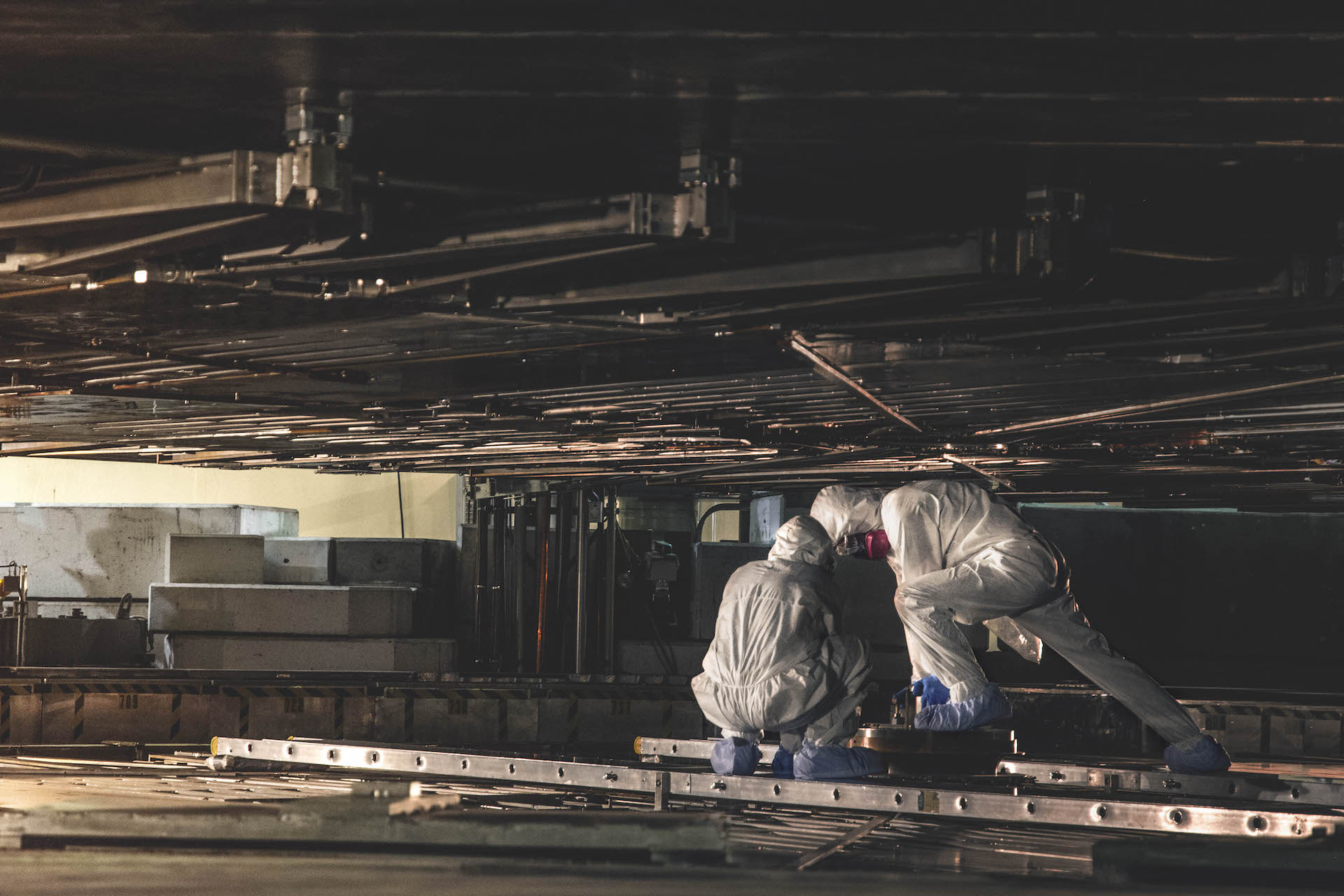
 Snolab's clean laboratory lies two kilometres below Sudbury, Ont., in the tunnels of a nickel mine. Photo: Handout/Snolab/Facebook

The Big Read
Canada’s world-leading labs warn of second-class status without funding overhaul
Triumf, Snolab and Canadian Light Source say they need capital and operations budgets that match the long-term science they do
Engineers working on the cyclotron tank at the Triumf particle accelerator in Vancouver, in March 2017. Photo: Handout/Triumf/Stuart Shepherd
OTTAWA — Three internationally renowned Canadian research centres say they’re losing ground and need the upcoming federal budget to change the way they’re funded, so they can stop cobbling together budgets from multiple parts of the government.
The most immediate need is at Triumf, a particle accelerator in Vancouver shared by 21 Canadian universities: Its latest five-year funding allocation runs out next year and it’s seeking $450 million to cover expenses from 2025 to 2030.
Talking Points
- Multiple universities share Canada’s national particle accelerator, synchrotron and underground neutrino observatory, but these labs are caught in a funding bind because they aren’t universities themselves
- Government funding cycles that are shorter than it takes to build major expansions or do extraordinary science have the labs scrounging to stay competitive as international peers come for their experiments—and the first-rate scientists who do them
“It’s always in the back of your mind. But you have to work under the assumption that there will be a continuation,” says Nigel Smith, Triumf’s chief executive since 2021.
Triumf is on the verge of opening the biggest expansion since it was founded in 1968, a project that began in 2010 and has spanned multiple funding rounds. Among other things, the Advanced Rare Isotope Laboratory is to dramatically increase Triumf’s capacity to study and produce medical isotopes for cancer treatments and allow it to it fill in on broader research during an impending three-year shutdown at CERN, Triumf’s massive cousin in Switzerland.
The facility is, nevertheless, heading toward a cliff. “Without a funding commitment in Budget 2024, Triumf will lack the certainty required to prepare and effectively execute a strategic plan in time for the next five-year operational cycle that is set to run from April 1, 2025 to March 31, 2030,” it told the government last fall in a novella-length appeal.
What Smith and the leaders of the Canadian Light Source synchrotron in Saskatoon and the deep-underground Snolab complex in Sudbury, Ont., want is a dedicated “major research facilities” fund that would pay for the capital costs for their equipment, the operating expenses to keep it running and the staff who work with the visiting scholars who use it.
Related Articles


As it is, these facilities are in a bind. Though they serve and are overseen by universities, they are not universities and aren’t funded like them. PhDs employed by the sites can support academic research but are generally not eligible for their own grants. And the major, sometimes world-changing, projects they’re built to host often have timelines longer than government planning horizons.
Canadian Light Source will see its current funding model all but disappear in late 2026, CEO Bill Matiko acknowledges. The University of Saskatchewan-based facility operates a synchrotron, a machine that produces extremely bright beams—mostly X-rays—that scientists use to look deep into the makeup of objects or materials, down to the cellular or atomic level. Last year, 1,488 people from 40 Canadian academic institutions participated in experiments there.
Their discoveries can have practical applications. For example, Vancouver-based Avivo is developing a method to convert blood cells to the universal-donor Type O, which might help ease transfusions and organ transplants.
Light Source received $20.6 million of its $38.2 million budget for the year through March 2023 from the Canada Foundation for Innovation (CFI), according to its latest annual report (about half of what it sought from the agency, Matiko says). For every 60 cents of that funding, it’s required to generate at least 40 cents from other sources. Federal granting councils provided an additional $7.6 million, while the province and university contributed a combined $6.3 million. But Light Source’s current agreements with its federal backers expire in 2026, and all have told the organization they won’t renew as it stands.
Light Source is targeting an operating budget of $50 million a year from 2027, with a small increase to its staff of 269. The facility is also developing a list of upgrades and other capital projects that could total more than $100 million.
Beyond the lifecycle approach all the facilities are seeking, Light Source is lobbying to eliminate the requirement that facilities secure other funding sources. “Matching is really a challenge,” Matiko says, although he still expects provinces to contribute.
Jodi Cooley, director of Snolab and renowned physicist, has wet hair. She’s taking a video call with The Logic in an office with a window, but spent the morning two kilometres underground, in Snolab’s facility in a Vale nickel mine under Sudbury.
The trip down involves a cage-elevator ride and a hike through more than a kilometre of tunnels, then showering and suiting up to protect the lab’s certified clean status. After coming back, you tend to be sweaty and covered in toxic dust, so Cooley makes a point of showering again before joining her colleagues above ground.
She was showing the facilities to a delegation from Carleton University, one of Snolab’s five partner universities, there to see sites for experiments that range from “a little bit bigger than tabletop” to ones that can fill a 10-storey cavern.
Such a megaproject is Snolab’s pride. Born as the Sudbury Neutrino Observatory, the facility’s first mission was almost outlandish: to hunt for certain subatomic particles born in fusion reactions in the sun, believed to exist in vast abundance but to be so insubstantial (with no electrical charge and possibly no mass) they’re almost ghosts. To find them, the researchers would aim detectors at 1,000 tonnes of heavy water in a special tank and watch for infinitesimal flashes of light.
The neutrinos they were looking for would leave trails as they passed through the water, which was buried in the nickel mine so cosmic rays didn’t mess with the findings.
The scientists found the neutrinos, but the particles were doing something so surprising—“oscillating” from one type to another—that the decades-old theory describing them had to be revised because it meant they had mass after all. Queen’s University scientist Art McDonald shared a Nobel Prize for it in 2015.
“It really is a world-class facility that does world-leading research and is a location of choice for some of the top experiments, the most promising experiments, in the field of neutrinos and dark matter,” said Cooley. She left a tenured professorship at Southern Methodist University in Dallas to come to Canada to run the place in 2022 (succeeding Smith, who went to oversee Triumf).
Many of Snolab’s projects take a long time. The facility is in the running to host a major international experiment on neutrinoless double beta decay, which is a big deal in particle physics and would build on Snolab’s Nobel-winning work. Documents from the Innovation Department that The Logic obtained through an access-to-information request reveal internal government wrestling with the problem that the experiment could take 10 years.
It’s one thing to attract a 10-year experiment with short-term funding if you’re the only facility of your type in the world, but Snolab has growing competition.
“There are other underground labs that are world-class, that you would say are peers,” Cooley says. “We want to make sure that the lab here in Canada always remains the lab that people are striving to be like.”
At Triumf, Smith is eager to talk up the particle accelerator’s value beyond advancing humanity’s understanding of the fundamental components, forces and very nature of the universe.
“Fundamentally, we are more of an engineering lab than a physics lab,” he says.
Early in the COVID-19 pandemic, Triumf and Canadian Nuclear Laboratories used their expertise in gas handling and controls to devise a new type of ventilator, he says. Work Triumf did on water purification for a neutrino detector in Japan—a competitor to Snolab, but that’s science for you—has potential uses for water testing in Indigenous communities.
“It’s the hunting for the invisible particles that gets many of us into physics and drives us to get out of bed—to search for that dark matter or whatever,” he says. But doing that develops techniques and capabilities that have potential benefit elsewhere, he adds.
Discussions about reforming the major research facilities’ funding system have been underway for years, with Ottawa opting in June 2021 to instead launch another installment of the existing CFI program. Despite the delays, Matiko says he’s hopeful Ottawa will finally make the move: federal officials have suggested to him that the new program could be included in next month’s budget, with money allocated from 2025.
Light Source has received assurances that federal and provincial agencies will provide transition funding at current levels if the updated system isn’t in place on time, Matiko says. “No one wants to see the light turned off.”
But the facilities can’t wait forever. Matiko says Light Source is already losing staff to the U.S. and Europe, and notes countries like the U.K. and Japan are increasing funding for the kinds of researchers that conduct experiments at its site. Without changes, “Canada will start to fall behind,” he says.
At Snolab, that worry remains just a potential future, but Cooley says it’s a killer concern when combined with Canada’s shrivelling support for graduate students. Lesser research and personal poverty are not appealing.
“It means that students and postdocs will go outside of Canada to be involved in these types of experiments,” she says. “And there’s the risk that once they leave Canada, they don’t come back.”



Loading...
Thanks for sharing!
You have shared 5 articles this month and reached the maximum amount of shares available.
CloseThis account has reached its share limit.
If you would like to purchase a sharing license please contact The Logic support at [email protected].
CloseGift the full article!
You have gifted 0 article(s) this month and have 5 remaining.
Recipients will be able to read the full text of the article after submitting their email address. They will not have access to other articles or subscriber benefits.
Photo: Handout/Triumf/Stuart Shepherd
Snolab's clean laboratory lies two kilometres below Sudbury, Ont., in the tunnels of a nickel mine.
Most Popular This Week




In-depth, agenda-setting reporting
Great journalism delivered straight to your inbox.
The Big Read
Beacon is building an AI empire by fixing Main Street’s software
Briefing
Inovia raises US$200M for new VC fund as it eyes AI’s impact
43% of eligible Albertans voted ahead of Monday’s referendum
AI chip company Tenstorrent raises US$1.5B, valuing it at US$6.2B
Best business newsletter in Canada
Get up to speed in minutes with insights and analysis on the most important stories of the day, every weekday.
Exclusive events
See the bigger picture with reporters and industry experts in subscriber-exclusive events.
Membership in The Logic Council
Membership provides access to our popular Slack channel, participation in subscriber surveys and invitations to exclusive events with our journalists and special guests.







