CALGARY — From breweries and industrial-scale bakeries to tech giants such as Microsoft and Amazon, companies wrestling with their carbon emissions are driving a renewable energy boom in Alberta with a flurry of power-buying deals for clean electricity.
Skip to content

 The popularity of PPAs has soared in recent years as companies look to ensure a clean supply of power for the energy-hungry data centres that power cloud services. Photo: Li Jun/China News Service/VCG via Getty Images

Analysis
Tech companies, heavy emitters drive a renewables boom in Alberta
From brewers to the likes of Microsoft and Amazon, companies have signed dozens of power-buying deals in the province, The Logic’s analysis shows
Wind power generators on a wind farm near the town of Pincher Creek. In 2022, Scotiabank signed a 15-year deal to purchase all of the electricity generated from a 40-megawatt wind farm in southern Alberta. Photo: The Canadian Press/Larry MacDougal
CALGARY — From breweries and industrial-scale bakeries to tech giants such as Microsoft and Amazon, companies wrestling with their carbon emissions are driving a renewable energy boom in Alberta with a flurry of power-buying deals for clean electricity.
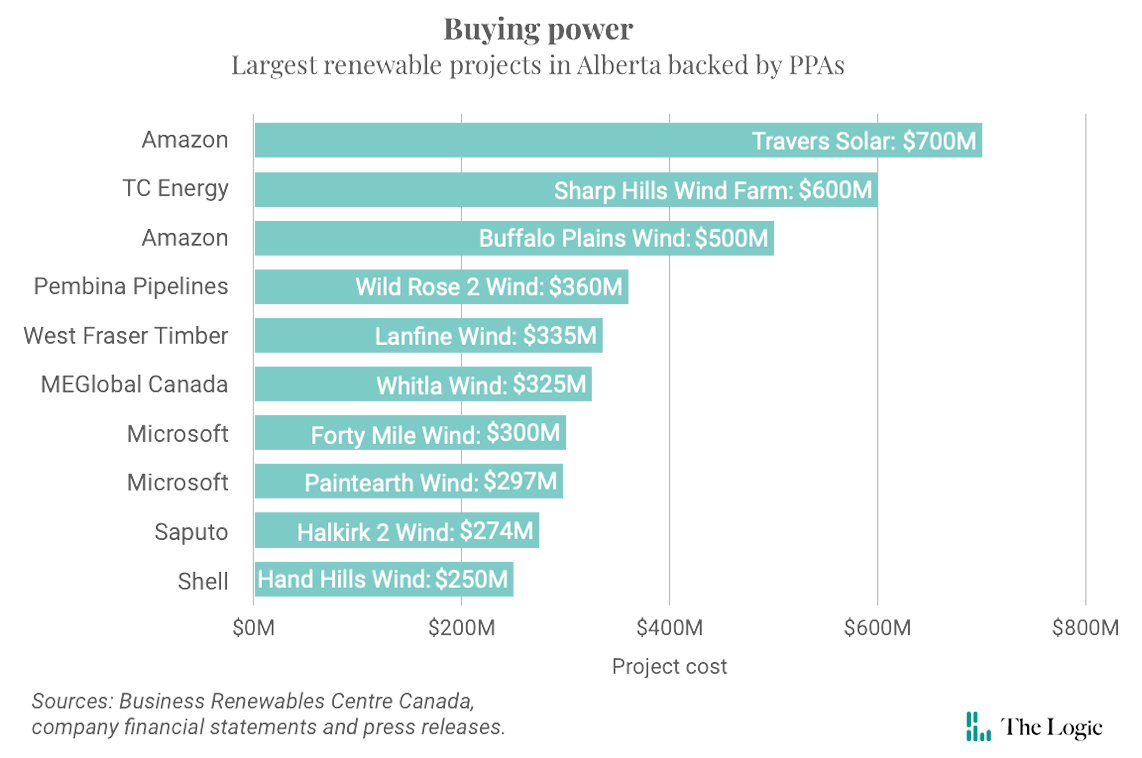
According to The Logic’s analysis, companies have signed at least 33 power purchase agreements with energy providers in the province since 2019, totalling nearly 3,000 megawatts, or enough to power roughly 1.8 million homes for a year. The spike in power buying has transformed Alberta’s electricity grid, prompting a massive buildout in wind and solar facilities totalling more than $5.9 billion, data show.
Talking Points
- With demand for clean energy on the rise, companies have signed a flurry of power purchase agreements directly with electricity providers
- The Logic’s analysis found at least 33 such power-buying arrangements, which have transformed the province’s power grid through a rapid increase in wind and solar capacity
The deals take the form of power purchase agreements (PPAs), or contracts that let companies buy power directly from suppliers. The arrangements are unique in Canada given the unregulated nature of Alberta’s electricity grid, which lets companies purchase power directly rather than through a regulated system.
The popularity of PPAs has soared in recent years as companies look to offset their greenhouse gas emissions, for example, or ensure a clean supply of power for the energy-hungry data centres that power cloud services. Globally, PPA activity increased 12 per cent in 2023 to a record high, led by companies including Amazon and French utility Engie, according to a BloombergNEF study.
PPAs are especially popular among companies with a focus on artificial intelligence such as Microsoft and Google, given how energy intensive the technology is and how quickly big tech companies are racing to achieve AI breakthroughs and bring them to market. Microsoft recently warned that its carbon emissions have leapt 30 per cent since 2020 as it races to build new AI servers, while Amazon’s emissions were up 40 per cent from 2019 as of last year.
Heavy-emitting companies such as chemical plants and oil producers have become another major buyer, with PPAs for clean power letting them offset their carbon footprints.
Related Articles



Most deals take the form of “virtual” PPAs, under which companies buy clean electricity to offset their use of dirtier power supplies elsewhere. Such arrangements are distinct from “physical” PPAs, where electrons are purchased to power specific infrastructure like manufacturing plants.
Experts say PPAs lend financial certainty to energy projects because they guarantee end buyers for the power they produce. And buyers often pay upfront for the power they secure. As a result, PPAs have played an outsized role in the rapid renewables expansion in Alberta, which in 2022 was responsible for three-quarters of all the clean energy projects built in Canada. The province also benefits from above-average levels of sunshine and a windy south, which make it a good spot for renewables.
Jorden Dye, director of the Business Renewables Centre Canada, said around 70 per cent of all renewables projects built in Alberta over the last five years have used PPAs.
“For a company to go to a bank to get financing for [a project], having a PPA is one of the requirements because it gives a guaranteed revenue stream,” he said in an interview. “So these buyers are acting as project anchors.”
The Logic compiled a database of Alberta’s PPAs using data from Business Renewables Centre Canada as well as other publicly available sources like press releases and financial statements.
They illustrate the range of the companies that have locked down PPAs in the province.
In 2022, Scotiabank signed a 15-year deal to purchase all of the electricity generated from a 42-megawatt wind farm in southern Alberta operated by a unit of Brookfield Renewable. Bimbo Canada, an industrial-scale bakery that makes Dempster’s bread and other products, locked down two PPAs to “offset 100 per cent of its electricity consumption” in Canada, according to the company. PepsiCo inked a deal with Alberta’s TransAlta for clean power supplies. Other deals involved oilsands giant Cenovus Energy, concrete maker Lafarge and the Canadian arm of Budweiser.
The Scotiabank deal, senior vice-president of real estate Stephen Morson said at the time, “not only achieves our goal of securing 100 per cent non-emitting electricity in Canada by 2025, but it also allows us to contribute to the growth of renewable energy development in Canada—a positive outcome for all involved.”
Tech companies including Amazon and Microsoft have been some of the most prominent PPA supporters in Alberta. With their emissions profiles poised to grow—Goldman Sachs sees data-centre power demand rising 160 per cent by 2030—they and their fellow U.S. tech companies are scrambling to offset CO2 output.
“Amazon or Microsoft, definitely what they’re looking for is just the renewable energy attributes so that they can say, ‘The electricity we are using is green,’” said Jaideep Nagpal, vice-president of project finance at Morningstar DBRS.
Microsoft has signed two wind PPAs and one solar PPA in the province, locking down contracts at major projects like Potentia Renewables’ 198-megawatt Paintearth wind project located between Calgary and Edmonton. Amazon is involved in three PPAs, one with the largest solar farm in Canada and another with a 495-megawatt wind farm in southern Alberta that was the source of fierce local opposition. Amazon cited access to clean power as a key reason behind its $4.3-billion decision to locate its second Canadian cloud-computing hub in Calgary.
Following the announcement of a PPA at Paintearth, Microsoft Canada president Chris Barry said such contracts “are key to meeting our goal of contracting 100 per cent of our energy consumption with renewable sources by 2025.”
The Alberta Electric System Operator, the province’s grid regulator, said it is currently reviewing six applications to build new data centres in the province—together totalling a whopping 2,000 megawatts of power—as more companies look to raise their computing capabilities.
Public entities like the City of Edmonton and Alberta’s rural school boards have also signed PPAs in recent years to offset emissions or reduce their exposure to electricity price fluctuations. (The Logic did not include public-led PPA deals in its database.)
In light of Alberta’s success with PPAs, other provinces have sought to follow suit. Nova Scotia’s government has passed legislation that lets it compel public utilities to sign PPAs with private customers, while Ontario is proposing amendments that would moderately open up the province’s grid to PPAs.
As has been the case with other carbon offset schemes, PPAs have also attracted critics who question whether they truly result in emissions reductions, or simply let well-financed firms buy virtual clean-power supply in bulk to improve their environmental bona fides.



Loading...
Thanks for sharing!
You have shared 5 articles this month and reached the maximum amount of shares available.
CloseThis account has reached its share limit.
If you would like to purchase a sharing license please contact The Logic support at [email protected].
CloseGift the full article!
You have gifted 0 article(s) this month and have 5 remaining.
Recipients will be able to read the full text of the article after submitting their email address. They will not have access to other articles or subscriber benefits.
Photo: The Canadian Press/Larry MacDougal
The popularity of PPAs has soared in recent years as companies look to ensure a clean supply of power for the energy-hungry data centres that power cloud services.
Most Popular This Week




In-depth, agenda-setting reporting
Great journalism delivered straight to your inbox.
Commentary
Carmichael: Canadian ignorance about India is a strategic weakness
Briefing
Aritzia shares pop after earnings rise 204%
First Nation in Alberta goes to court over fast-tracked oil pipeline
Chinese EV maker Geely Auto Group to launch in Canadian market in 2027
Best business newsletter in Canada
Get up to speed in minutes with insights and analysis on the most important stories of the day, every weekday.
Exclusive events
See the bigger picture with reporters and industry experts in subscriber-exclusive events.
Membership in The Logic Council
Membership provides access to our popular Slack channel, participation in subscriber surveys and invitations to exclusive events with our journalists and special guests.





