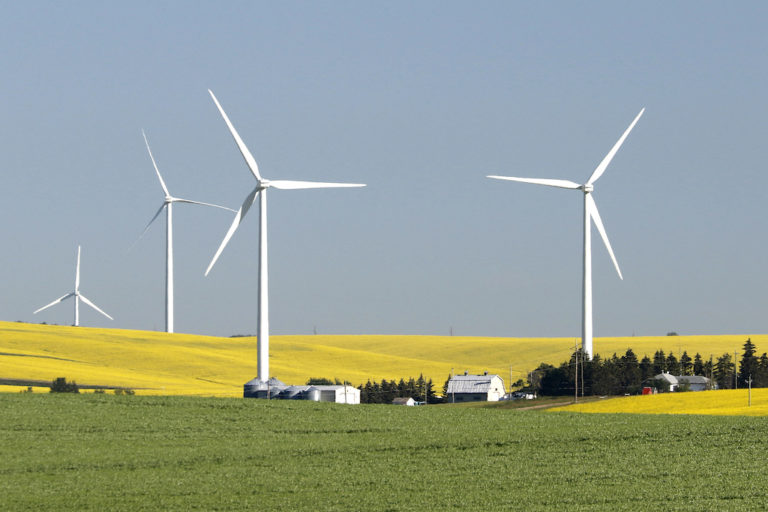
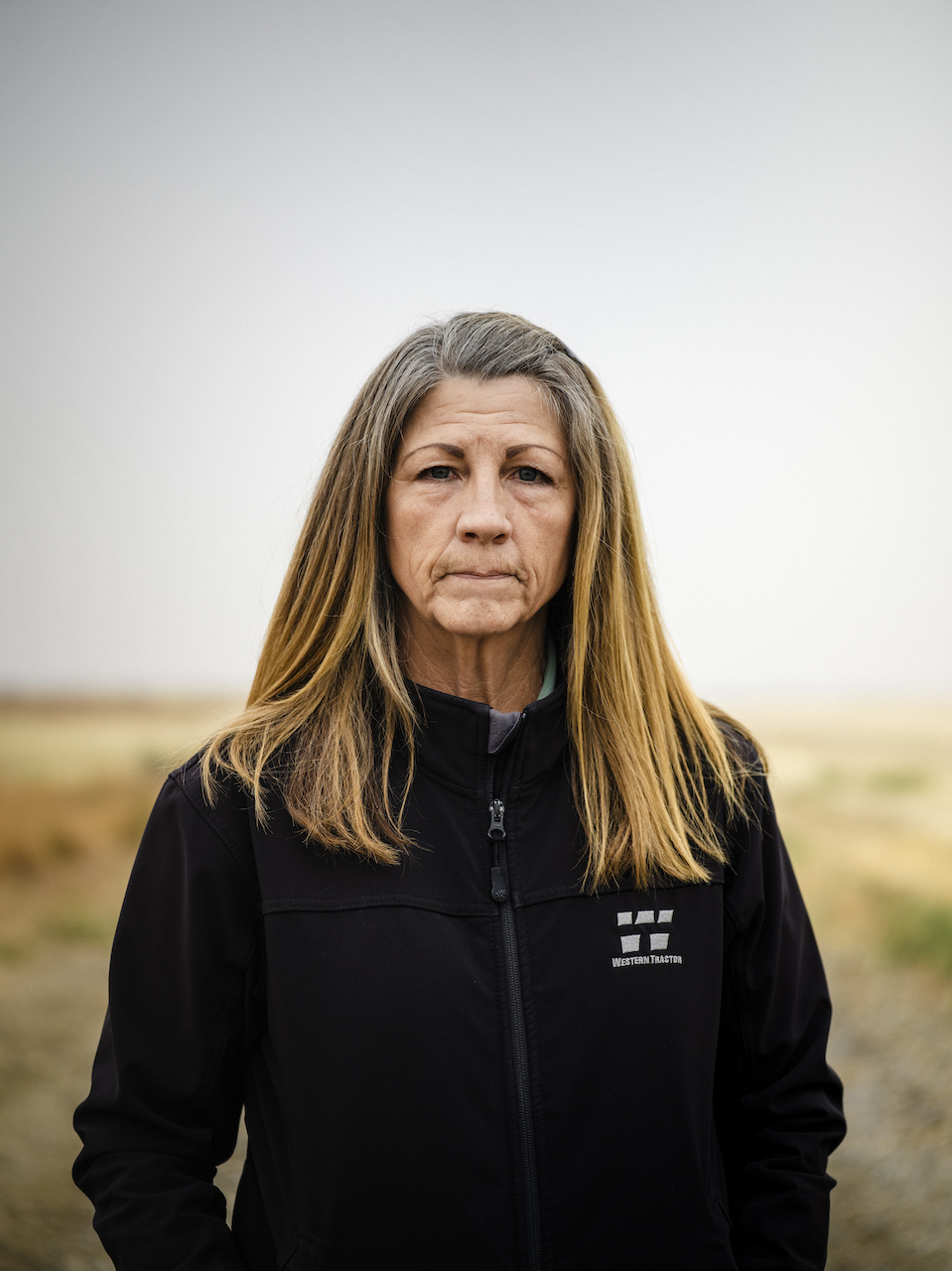
VULCAN COUNTY, ALTA. — Laura Schlaht gestures toward a freshly poured concrete foundation covered in a grid pattern of rusted rebar, where construction crews will soon erect one of 83 wind turbines that will tower over an endless expanse of farmland.
“That’ll be turbine number 20,” she says from a vantage just beyond her family’s property line. In her hand Schlaht holds a map detailing the $500-million Buffalo Plains Wind Farm, a sprawling 17,500-acre project where Danish investment firm Copenhagen Infrastructure Partners plans to build a forest of Siemens turbines, some standing 190 metres tall, or roughly the height of Calgary Tower.
Talking Points
- Three-quarters of Canada’s new cleantech projects were built in Alberta last year
- That rapid expansion is colliding with local opposition, and growing pushback from landowners could hinder the country’s net-zero efforts
Schlaht operates a nearby 6,400-acre farm with her husband, Randy, and other family members. She led a three-year campaign to stop Buffalo Plains’s development, arguing that the project is a blight on the local landscape that threatens bird and bat populations. Locals worry the project could remain unremediated after the end of the turbines’ roughly 20-year lifecycle.
The project divided the region surrounding this otherwise sleepy farming village of Lomond, Alta., 175 kilometres south of Calgary, pitting neighbours who worked with wind developers against those who refused.
The $500-million Buffalo Plains Wind Farm, a sprawling, 17,500-acre project near Lomond, has locals divided over environmental and sustainability concerns. Photo: Todd Korol for The Logic
Lomond is ground zero for a broader renewables boom taking place across southern Alberta, a province that accounted for three-quarters of Canada’s new clean-energy projects last year. Lomond is also a prime example of the growing general resentment among landowners toward renewables expansion.
Though their critics often call them NIMBYs, characterizing their objections as nothing more than “not-in-my-backyard” resentment, backlash from landowners has begun to spread beyond fossil-fuel-dependent projects like oil pipelines, and now threatens to slow or halt major projects that Canada is counting on to help it reach net-zero emissions. Some Alberta residents have levelled complaints against other wind and solar projects, and earlier this year the provincial utilities regulator rejected a 150-megawatt solar farm near High River, Alta., over concerns it would threaten various wetland bird species. Similar pushback has delayed wind farms in Ontario and emissions-free power lines originating in Quebec.
Lomond is ground zero for a broader renewables boom taking place across southern Alberta, a province that accounted for three-quarters of Canada’s new clean-energy projects last year. Photo: Todd Korol for The Logic
Alberta Premier Danielle Smith cited this opposition in August when she imposed a surprise seven-month pause on all renewable projects in the province, telling reporters the government would review “unanswered issues” like high electricity costs and how to enforce proper remediation of energy infrastructure.
In total, the moratorium brought 118 projects worth $33 billion to an immediate halt, according to the Calgary-based Pembina Institute, an environmental think tank. (Buffalo Plains received regulatory approval in February 2022, and is not included in the moratorium.)
Lomond is one of the larger centres for Alberta’s renewables expansion. Once built, Buffalo Plains will pump out 515 megawatts of power at maximum capacity, making it Canada’s largest single-phase wind farm.
The Travers Solar Project is Canada’s largest solar farm, located just southwest of one of the future wind turbine sites. Photo: Todd Korol for The Logic
Within view of Buffalo Plains, a short distance to the southwest of turbine 20, Canada’s largest solar farm—the Travers Solar Project operated by Calgary’s Greengate Power—stretches on for kilometres, endless rows of black panels blanketing the entire landscape. A short distance beyond that, the Blackspring Ridge Wind Project, a 300-megawatt wind farm owned by Enbridge and EDF Renewables, came online in 2014.
Schlaht said residents mounted little resistance to Blackspring. By the time Buffalo Plains was proposed, landowners were fed up. Photo: Todd Korol for The Logic
Schlaht said residents mounted little resistance to Blackspring. Years later, Travers Solar drew slightly more skepticism from locals. By the time Buffalo Plains was first proposed in 2020, many landowners had apparently grown fed up with renewables development. Residents filed 130 statements of intent against the project, according to the Alberta Utilities Commission filings. (Just four landowners let Copenhagen build turbines on their property.)
Locals levelled a litany of complaints and concerns against Buffalo Plains. They cited worries about the impacts of weeds; the inability for crop-dusting planes to fly low enough to spray pesticides; concerns that their land values would fall; and how the project would affect migratory birds and wetlands.
“When the birds are gone, they’re gone,” Schlaht said. “When the bats are gone, they’re gone.”
Angst over wind and solar development comes amid wider concerns about the reliability of the province’s electricity grid, a multifaceted problem intensified by Alberta’s growing dependence on renewable sources that produce power intermittently, or only when the sun shines and the wind blows.
In August, Alberta’s electricity operator issued a warning that the province’s grid was heavily strained due to hot temperatures and low wind output. The grid operator issued similar warnings during a cold snap last winter. In the last year, Alberta’s electricity system has redlined seven times, Smith told reporters last month.
“I’ve been approached by turbine companies multiple times … And I keep telling them, ‘No.’”
The Buffalo project came to dominate conversations over cups of coffee, causing tension between neighbours.
“It was ugly here for about a year,” said one Lomond resident outside of a mechanic shop, who asked not to be identified given local sensitivities on the matter. “There were guys fighting. If they saw each other on Main Street they’d just about duke it out.”
Others said wind development has become a matter of social courtesy.
Anthony Dillabough, a 23-year-old who inherited his grandfather’s grain farm south of Lomond, said he’s been approached several times by turbine developers, but has resisted their offers in order to remain in good standing with his neighbours. Dillabough is surrounded by cattle ranchers who, he said, are opposed to the turbines over concerns that they produce a thrumming sound that unsettles livestock.
Stores along Railway Avenue in Lomond, Alta. Photo: Todd Korol for The Logic
“Everybody would hate me,” he said. “I’ve been approached by turbine companies multiple different times saying, ‘Can we put turbines on your land?’ And I keep telling them no.”
Local opposition to renewable energy developments runs counter to broader efforts to reduce emissions from Alberta’s grid.
Jason Wang, a senior analyst at the Pembina Institute, said Alberta will have to continue to ramp up investment in wind and solar assets in order to meet the province’s target of 30 per cent renewable electricity by 2030. Currently, Alberta’s grid is about 14 per cent powered by renewables.
Renewables are intermittent power suppliers—they only produce when the wind is blowing or the sun is shining—and that is partly responsible for Alberta’s electricity demand occasionally outpacing supply, he said, but suggested that other sources of power like hydrogen or hydro power from B.C. can eventually be used to fill in the dips. (Experts have touted the stabilizing benefits of building an east-west electricity grid in Canada for years, to no avail—the grid currently runs mostly north-south.)
“We did slow them down a lot, and we cost them a lot of money.”
At the same time, the rapid development of wind and solar in the province has caused an “electron traffic jam” that overwhelms the grid in times of high wind and solar output, Wang said, posing the inverse problem that power shortages do.
Wang said Alberta’s moratorium on renewables came as a shock to the sector that puts billions of dollars’ worth of projects at risk.
A South Country Co-op location (left), and the Lomond Community Library (right). Photo: Todd Korol for The Logic
“I don’t think anything like this has ever happened in Alberta—a complete freeze on approvals,” he said.
Other observers warn that growing resistance to energy infrastructure—including anything from oil pipelines to wind farms—threatens Canada’s economic growth over the longer term. In a recent interview with The Logic, Cenovus Energy’s executive chair Alex Pourbaix warned that Canada’s failure to build critical energy infrastructure is a problem with “no solution” in sight.
The Business Council of Canada, a lobby group representing more than 170 major company executives, warned the federal environment minister in a July letter that Canada’s major projects permitting process is “too slow and burdensome” and threatens to stifle the country’s competitiveness.
While they weren’t able to stop the Buffalo Plains project, Schlaht said she and the rest of the advocacy group Lomond Opposing Wind Projects—which counts 165 residents and five companies among its members—had managed to slow the pace of construction. The group triggered a hearing process that extended the project’s approval to more than a year, well beyond the 90 days it might have taken in the absence of a public hearing.
“We did slow them down a lot, and we cost them a lot of money,” Schlaht said.
Those delays were compounded this June, when the province’s main environmental agency raised the project’s risk to the ferruginous hawk, an endangered bird of prey native to the region, from low to high after finding several nests in the area. Copenhagen was forced to relocate seven turbines away from the newly discovered nesting grounds following the findings, according to a letter the company sent the provincial power regulator in July.
Despite her efforts, Schlaht accepts that the wind farm project will go through. Photo: Todd Korol for The Logic
Copenhagen did not directly respond to questions about regulatory delays or local opposition to Buffalo Plains. In a written statement, it said “mitigating adverse impacts on local ecosystems are an integral part” of CIP projects.
Since the approval of the Buffalo Plains project, conversation in Lomond about the wind farm has faded, replaced by standard agricultural chatter. On an August afternoon in the fields around Schlaht’s farm, harvest season has come early after the most severe droughts in recent memory stifled yields of wheat, canola and barley.
In her three years fighting the wind farm development, Schlaht gathered reams of information on the project that now sits in paper stacks on a desk in her family home. She is gradually coming to accept that, despite her hardest efforts and the emotional strain of a prolonged regulatory ordeal, very tall and imposing new fixtures will soon stand upright in the prairie where she’s spent most of her 59 years.
“It’s quite a process,” she said. “I wouldn’t wish it upon anybody.”