Skip to content

News
New data shows how AI is eating software investment
Canada’s venture financing market grew faster than most advanced economies in 2025, driven in part by AI megadeals
Toronto-based Cohere raised US$600 million last year. AI-native firms received 40 per cent of the venture dollars invested across Canada in 2025. Photo: Cole Burston for The Logic
TORONTO — The AI boom continues to dominate Canada’s technology financing market, with firms that sell AI taking an ever-growing share of venture capital funding, according to a new report from Inovia Capital.
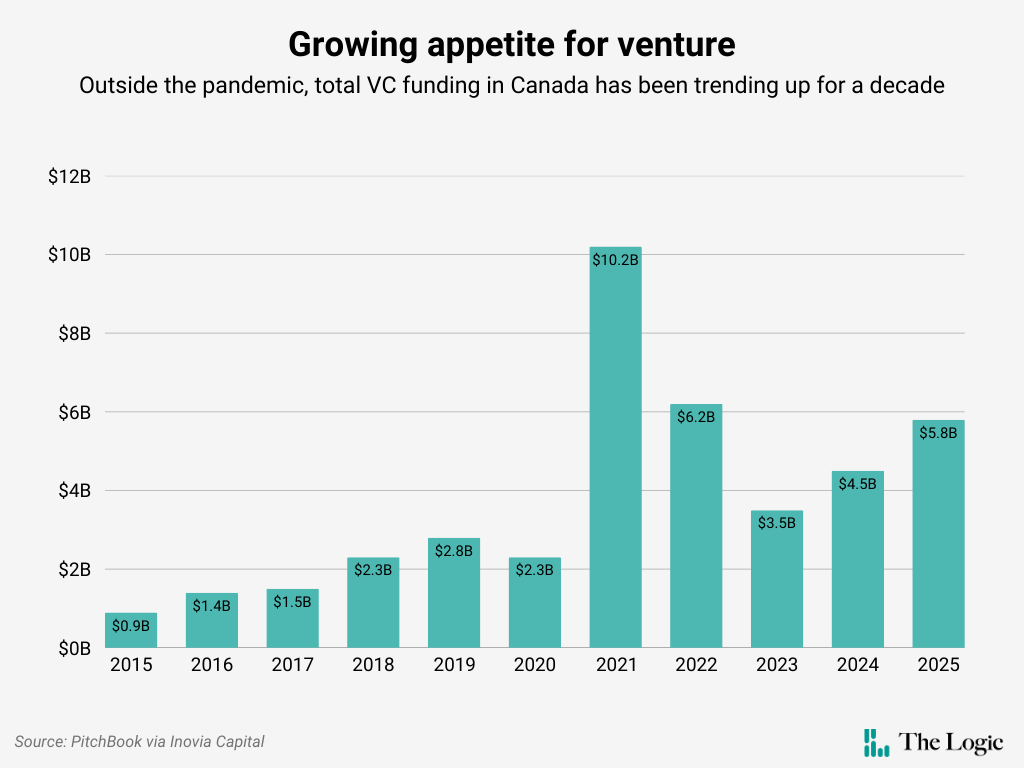
Canadian companies collectively raised US$5.6 billion in VC deals in 2025, up 29 per cent year over year, according to the Montreal-based investment firm’s analysis of PitchBook data.
That’s below the rate of growth in the U.S., at 52 per cent, driven by established and nascent AI labs like OpenAI, Anthropic, Safe Superintelligence and Periodic Labs raising huge sums to build more powerful models. Still, Canada saw a larger increase in VC funding than other advanced economies, with the U.K. (up 26 per cent), France (down one per cent), Australia (down five per cent), Germany (down five per cent) and Singapore (down six per cent) all ranking lower.
Related Articles


“It’s an indication of the excitement of the things coming out of Canada,” said Inovia partner Kory Jeffrey, noting that domestic firms are raising from investors around the world.
Megadeals have accounted for a lot of the recent growth in financing figures. That includes both established firms that are raising big money to keep expanding, and newer companies scaling up on “a truncated timeline,” Jeffrey said. Well-capitalized firms become anchors for the tech ecosystem by attracting talent, he added, spinning off more startups, and giving staff the money to reinvest in other firms.
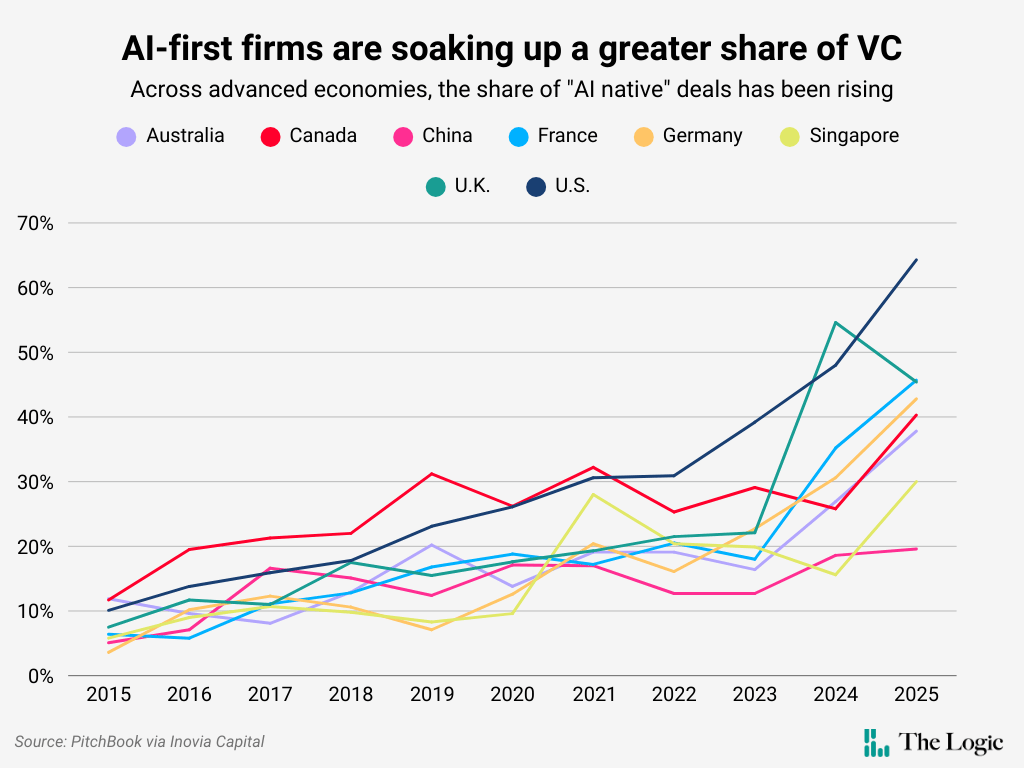
The sector is also riding the AI wave. Inovia’s analysis shows that so-called AI-native firms—whose products have the technology at their core, and wouldn’t work or be useful without it—received 40 per cent of the venture dollars invested across the country in 2025. That’s up 14 percentage points from 2024, and twice that from 2015.
The increase is partly down to a few megadeals for later-stage firms. Toronto-based Waabi raised a US$750 million Series C to expand its self-driving technology to robotaxis in one of the largest-ever venture capital deals for a private Canadian firm; while the deal was announced last month, corporate filings show it was logged last year. Model maker Cohere, meanwhile, raised US$600 million in a round that Inovia co-led.
After those two firms, there’s a steep drop-off in deal size. Other large rounds last year for AI startups included Blue J’s US$122-million Series D in August for its tax tools; Moonvalley’s US$84 million raise in July for its video-generation platform; CoLab’s US$72 million round in November for product design software and Spellbook’s US$50-million Series B for contract review tools.
Jeffrey said the range in deal sizes reflects different approaches to building AI businesses. “Technologist companies need a boatload of money [for] compute, and [to] buy world-leading individuals who hold PhDs in machine learning,” he said. That describes model makers like Waabi and Cohere. By contrast, companies like Blue J or Spellbook are building applications for specific domains on top of all that infrastructure. “You need way less money,” Jeffrey said.
While AI firms are pulling in a lot of the new funding in Canada, the tech financing markets in other advanced economies are even more AI-dominated. AI-native deals accounted for almost two-thirds of the venture dollars invested in the U.S. in 2025. The U.K., France and Germany all also topped Canada’s two-fifths mark.
Growth in AI’s share of venture capital is driven by firms building applications with the technology, and Canada has been slower to translate its research strengths into startups, Jeffrey said. “You’re seeing a bit of that lag here.”
Still, the trend is positive. Canada has many firms building generative AI applications for specific sectors and uses that deliver big returns for buyers, according to Inovia’s annual State of Canadian Software report. It cites areas like health care and pharmaceuticals, with firms like BenchSci, Reliant AI and Signal 1; Bench IQ, Clio, and Spellbook in legal services or Arteria AI and Coveo helping large enterprises boost productivity.
AI is also spreading in sectors like financial services, cybersecurity and travel. Firms are employing AI agents for tasks like reconciling the books and writing reports, while others try to build safeguards to stop them from leaking data and being hacked. Vacation apps, meanwhile, are using automated assistants to sell to and support customers once they’ve booked their travel.
It wasn’t an entirely smooth year on the other end of the company lifecycle. U.S. President Donald Trump’s “Liberation Day” tariff proclamation in April slowed mergers and acquisitions in Canada in the second quarter, according to Inovia, as “dealmakers evaluated its impact.” The third and fourth quarters were the strongest since 2021, suggesting a return in confidence.
Much as is in the VC market, big-ticket transactions drove global M&A, and both strategic and financial buyers were chasing AI advantages. Companies won’t fetch a premium valuation if they can’t “articulate how you advance an acquirer’s AI agenda,” said Scott Munro, Inovia’s head of corporate development.
Secondary deals—in which founders, staff and early backers sell shares to other investors—filled some of the gap created by the lack of exits in Canada. Canadian firms reported US$919 million worth of such transactions in the first three quarters of last year, more than the US$789 million across the whole of 2024.



Loading...
Thanks for sharing!
You have shared 5 articles this month and reached the maximum amount of shares available.
CloseThis account has reached its share limit.
If you would like to purchase a sharing license please contact The Logic support at [email protected].
CloseGift the full article!
You have gifted 0 article(s) this month and have 5 remaining.
Recipients will be able to read the full text of the article after submitting their email address. They will not have access to other articles or subscriber benefits.
Photo: Cole Burston for The Logic
Most Popular This Week




In-depth, agenda-setting reporting
Great journalism delivered straight to your inbox.
Commentary
Carmichael: Being boxed in will help Canada focus on what matters
Briefing
Rio Tinto gets nearly $165M in additional federal funds for Quebec aluminum
U.S. to lift tariffs on some Canadian products crucial to Maine: Collins
Carney warns of tech dependence after Starlink disruptions in Ukraine
Best business newsletter in Canada
Get up to speed in minutes with insights and analysis on the most important stories of the day, every weekday.
Exclusive events
See the bigger picture with reporters and industry experts in subscriber-exclusive events.
Membership in The Logic Council
Membership provides access to our popular Slack channel, participation in subscriber surveys and invitations to exclusive events with our journalists and special guests.






