CALGARY — The company building Canada’s first commercial hydrogen facility says there are problems with the federal government’s flagship effort to drive investment in the nascent sector, warning the policy could handicap domestic firms and drive capital out of Canada to the U.S.
Skip to content

News
Builders of Canada’s first commercial hydrogen project warn federal policy could handicap industry
Air Products, which is building a $1.6B hydrogen complex in Edmonton, says tax credit needlessly penalizes hydrocarbons
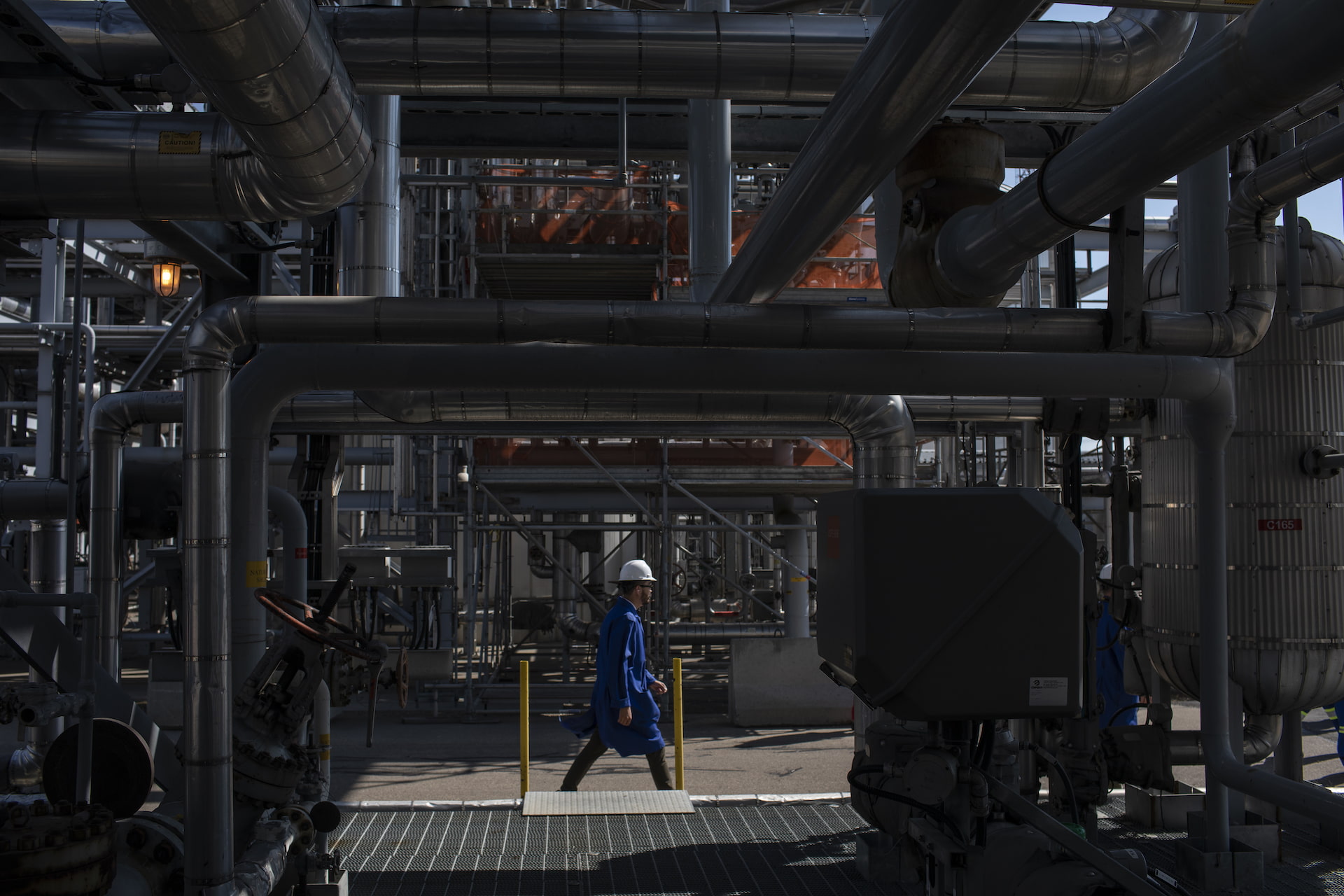
The Air Products hydrogen production plant in Edmonton in August 2022. The company says Ottawa’s proposed investment tax credit for clean hydrogen will “penalize” projects based in Canada. Photo: The Canadian Press/Amber Bracken
CALGARY — The company building Canada’s first commercial hydrogen facility says there are problems with the federal government’s flagship effort to drive investment in the nascent sector, warning the policy could handicap domestic firms and drive capital out of Canada to the U.S.
In this spring’s budget, the federal government announced a clean-hydrogen investment tax credit that would let developers write off a portion of the upfront costs of building hydrogen projects. Finance Minister Chrystia Freeland has yet to release the policy’s full details, but the budget outlined a tiered system that would let companies write off between 15 and 40 per cent of costs depending on the carbon intensity of emissions.
Talking Points
- The federal government has proposed a key tax credit to incentivize capital investment in Canada’s nascent hydrogen sector
- But the company building a major hydrogen complex in Alberta says the policy puts Canadian developers at a disadvantage to U.S. counterparts by penalizing fuels derived from hydrocarbons
As part of its pre-budget recommendations to Finance officials, Pennsylvania-based Air Products, currently building a $1.6-billion hydrogen facility complex in Edmonton, said the tax credit’s tiered structure discriminates against hydrogen derived from fossil fuels like natural gas, which puts Canadian developers at a stark disadvantage to those in the United States. Labour requirements built into the tax credit also threaten “project competitiveness,” the company said in its submission.
Air Products did not respond to The Logic’s requests for comment.
Ottawa has ambitions to develop a hydrogen industry in Canada worth an annual $50 billion by 2050. The Liberal government has thus far seemed to favour “green” hydrogen—hydrogen derived from renewable sources like wind and solar—rather than “blue” hydrogen made from natural gas, which currently makes up roughly 75 per cent of Canada’s production of the emissions-free fuel.
Some consider hydrogen a crucial bridge fuel in meeting Canada’s net-zero emissions, and much of the development in the space—including Air Products’s complex—is in Alberta. Dow Chemical has proposed a $10-billion ethylene facility near Edmonton powered by hydrogen, for example, while rail giant CP Rail plans to build hydrogen fueling stations in Edmonton and Calgary, and recently ran initial tests on its new hydrogen-powered locomotives.
Related Articles
As The Logic first reported late last year, the federal government granted Air Products $300 million through its Strategic Innovation Fund to help finance the project.
The Net-Zero Hydrogen Energy Complex, as the Air Products project is called, will use carbon-capture technology to gather up more than 90 per cent of atmospheric emissions. To offset the emissions associated with electricity use, the company will install a hydrogen-fuelled power generator to feed electrons back into the grid; Air Products will also equip the project with the province’s first-ever commercial hydrogen refuelling station for zero-emissions vehicles. The energy complex is scheduled to come online in 2024.
In its recommendations to government, Air Products said the current tax credit would “penalize resource-based clean hydrogen production projects in Canada relative to the U.S. projects,” and suggested raising the upper limit of the tiers to “level the playing field” with developers south of the border.
Under Canada’s tiered system, projects with a carbon intensity higher than four kilograms of CO2 equivalent for every kilogram of hydrogen will be ineligible for the hydrogen tax credit. Projects with a CO2 intensity between two and four kilograms can receive a 15 per cent rebate, while those with a CO2 intensity below 0.75 kilograms could be eligible for the maximum 40 per cent writeoff.
Hydrogen projects that fall under U.S. President Joe Biden’s Inflation Reduction Act, by comparison, will be eligible for a dollar-based per-kilogram rebate based on carbon intensity. Projects with a CO2 intensity below 0.45 kilograms can receive the maximum US$3-per-kilogram rebate; those with an intensity between 1.5 and 2.5 kilograms can get US$0.75, according to regulatory documents.
Air Products’s complaints about the current structure of the tax credit comes amid broader industry concerns over the federal government’s delayed rollout of major subsidies for clean energy projects.
In particular, a carbon-capture tax credit first promised in the 2021 budget has not yet passed through Parliament, a delay that some observers say could hinder Canada’s net-zero targets and has already caused capital to flow into American projects at the expense of Canadian developers.
Katherine Cuplinskas, senior communications adviser to Minister Freeland, said in a statement that Ottawa is working in “close collaboration with industry” to develop the hydrogen tax credit. Freeland’s office did not respond on the record about what industry sees as a delayed rollout of the tax credits, saying only that the credits will be applied retroactively to accommodate investments that come before the government policies are finalized.
In draft legislation published in August, Finance Canada said the “cleanest forms of blue hydrogen” would be eligible for the tax credit. The draft specified that hydrogen projects using energy-efficient autothermal reforming technology—a process Air Products will deploy at the Edmonton plant that involves mixing natural gas with steam to produce a hydrogen-based synthesis gas—would also be eligible.
Michael Gullo, vice-president of policy at the Business Council of Canada, said tax credits including the hydrogen and carbon-capture tax credits have lagged those in the U.S., while the American incentives are also more clearly written. In Canada, it’s not always clear how large a rebate companies are eligible for—a distinction that can cause project cost estimates to fluctuate dramatically.
“When you get into the details, and you understand the clawback provisions and the numerous requirements that have to be met, it’s pretty difficult for a chief financial officer to sign off on that,” he said.
In a study released this summer, environmental non-profit Clean Prosperity said Canada’s low-carbon incentives remain “well behind” the U.S., despite Ottawa rolling out an array of massive new spending programs and tax cuts in its last budget.



Loading...
Thanks for sharing!
You have shared 5 articles this month and reached the maximum amount of shares available.
CloseThis account has reached its share limit.
If you would like to purchase a sharing license please contact The Logic support at [email protected].
CloseGift the full article!
You have gifted 0 article(s) this month and have 5 remaining.
Recipients will be able to read the full text of the article after submitting their email address. They will not have access to other articles or subscriber benefits.
Photo: The Canadian Press/Amber Bracken
Most Popular This Week




In-depth, agenda-setting reporting
Great journalism delivered straight to your inbox.
Commentary
Carmichael: Canadian ignorance about India is a strategic weakness
Briefing
Aritzia shares pop after earnings rise 204%
First Nation in Alberta goes to court over fast-tracked oil pipeline
Chinese EV maker Geely Auto Group to launch in Canadian market in 2027
Best business newsletter in Canada
Get up to speed in minutes with insights and analysis on the most important stories of the day, every weekday.
Exclusive events
See the bigger picture with reporters and industry experts in subscriber-exclusive events.
Membership in The Logic Council
Membership provides access to our popular Slack channel, participation in subscriber surveys and invitations to exclusive events with our journalists and special guests.