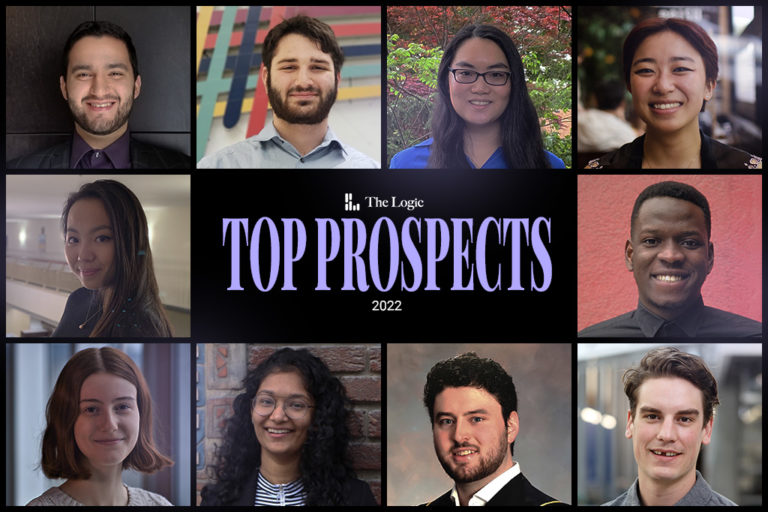
Top Prospects: Leading innovators from the Class of 2023
For the sixth year in a row, The Logic reached out to some of Canada’s most highly-regarded engineering and computer-science schools to find the next potential leaders of the innovation economy.
Some of this year’s top graduates are working to harness technology and entrepreneurship to enhance the lives of their broader communities—whether that’s with developing EV innovations, ambitions in space exploration, or efforts to encourage diversity, equity and inclusion.
In alphabetical order, here are 11 of Canada’s leading innovators from the Class of 2023.
Intelligence
Top Prospects: Leading innovators from the Class of 2023
A look at this year’s rising stars from Canada’s leading computer-science and engineering universities
For the sixth year in a row, The Logic reached out to some of Canada’s most highly-regarded engineering and computer-science schools to find the next potential leaders of the innovation economy.
Some of this year’s top graduates are working to harness technology and entrepreneurship to enhance the lives of their broader communities—whether that’s with developing EV innovations, ambitions in space exploration, or efforts to encourage diversity, equity and inclusion.
In alphabetical order, here are 11 of Canada’s leading innovators from the Class of 2023.
Amelia Dai
School: University of British Columbia
Program: Chemical and biological engineering
Employment status: Drafted by the Massachusetts Institute of Technology
Dai spent a co-op term at Tesla where she worked on lithium-ion battery-cell development and two co-op terms at UBC researching electrochemistry in water treatment. She also volunteered as a justice, equity, diversity and inclusion project director for two years at the Volta Foundation, a non-profit dedicated to advancing the global battery ecosystem. She will begin her PhD in chemical engineering at the Massachusetts Institute of Technology this fall. “I like the endless learning opportunities in R&D … and renewable energy because it allows me to embrace my nerdy side of loving science and math, as well as using it to do something that’s benefitting society,” said Dai.
Nick Di Scipio
School: York University
Program: Mechanical engineering
Employment status: Entrepreneur, re-drafted by York University
When the COVID-19 pandemic closed university campuses and shut down makerspaces, Di Scipio’s 3D-printing company started with a printer his uncle gifted him. York University’s Bergeron Entrepreneurs in Science and Technology program provided him with space and helped him transition the startup into an on-demand 3D-printing service for small- and medium-sized companies. He also started a 3D-printing waste collection project on campus and recycled it back into usable filament. He will start his master of mechanical engineering this fall.
Megan Gran
School: York University
Program: Space engineering
Employment status: Undrafted
Gran is a two-time bronze medal winner in the Canada-Wide Science Fair and has competed in robotics competitions since Grade 8. She competed in the Canadian International Rover Challenge as a member of York University Robotics Society’s Mars rover team. In 2019, she was one of 23 students around the world selected to launch a rocket in Norway with the European Space Agency, where she used a light sensor to study the rocket’s rotation. “I really want to work in the aerospace industry. I always said my goal is to put a robot in space,” said Gran.
Emma Hannaford
School: Simon Fraser University
Program: Sustainable energy engineering
Employment status: Drafted by European Institute of Innovation and Technology
Hannaford spent two co-op terms at Modulous in England where she calculated and helped reduce the carbon emissions on the life cycle of affordable modular homes. She also wrote software to automate data on BC Hydro’s transmission line defects to help prioritize maintenance work. Hannaford currently works at QuantoTech testing automated light, water and nutrient systems for a vertical farm. In September, she will pursue a dual master’s degree in smart electrical networks and systems from the Royal Institute of Technology in Sweden and the Grenoble Institute of Technology in France.
Oliver Kiessling
School: McMaster University
Program: Mechanical engineering and management
Employment status: Undrafted
Kiessling completed three co-op terms during his studies: He created a 3D-printed version of InMotive’s two-speed EV transmission, tested the life cycle fatigue of Smarter Alloy’s memory wires that get back into shape after being heated and designed a servo motor that worked a kilometre under water for submarine company Blue Robotics. He co-founded Bluprints, which started as a 3D printing service for students, but later used his printers to make face shield holders and mask tensioners for healthcare workers when the COVID-19 pandemic hit. In his final year, he co-developed Stretch 1.0, a tensile tester (a machine that measures how much force it takes to break an object) for low-strength materials, such as 3D printed products, for hobbyists and academics that costs about 20 times less than industrial options. He wants to design Stretch 2.0 before searching for work in the fall.
Mark Mangaliag
School: University of Manitoba
Program: Electrical and computer engineering
Employment status: Drafted by Electranix
Mangaliag was involved in the University of Manitoba’s SAE International chapter where he helped code the Formula Electric team’s car software and helped design the aero team’s remote-controlled plane. He spent a co-op term at Manitoba Hydro where he designed the street light connections, a task not usually assigned to summer students. This year, he received the Friends of Engineering Co-op/Industrial Internship Program Student of the Year Award, which recognizes engineering excellence in an industry setting. Mangaliag works at power consulting firm Electranix and said he hopes to become more involved in the green transition.
Benn McGregor
School: University of Waterloo
Program: Software engineering
Employment status: Drafted by Zoom
McGregor helped organize Citizen Hacks in 2019, a Toronto hackathon with about 150 participants on privacy and technology. With his interest in privacy issues, McGregor’s capstone project used AI to automate the redaction of refugee legal files in collaboration with the Refugee Law Lab at Osgoode Hall Law School, a process that the government traditionally does by hand. McGregor also co-built Row, a role-playing video game about surviving natural disasters. “We use this very powerful medium to tell stories about climate change and about climate action and living sustainably,” said McGregor. He will join Zoom’s security engineering team in September.
Anaïs Poirier
School: University of Toronto
Program: Electrical engineering
Employment status: Drafted by Zipline
Poirier had her first space-related job when she completed a co-op term in Kentucky at microgravity research company Space Tango, where she tested hardware for scientific equipment going up to the International Space Station. Last summer, she interned at satellite-emissions-monitoring firm GHGSat, where she created a visualization tool to assist with planning the orientation and schedule of individual satellites. After graduation, Poirier will move to San Francisco to test flight hardware for drone delivery company Zipline, which delivers medical supplies to remote communities.
James Shaw
School: University of British Columbia
Program: Computer science
Employment status: Drafted by Microsoft
Shaw promoted rural education by reaching out to Indigenous students through non-profit Geering Up. He also co-wrote curriculums to help instructors include Indigenous reconciliation in engineering courses. It’s like “weaving Indigenous ways of knowing with Western science concepts,” he said. Shaw said he became interested in researching computer vision in a university lab and took courses on machine learning. These experiences led him to an internship with Microsoft’s shopping division last year, where he used computer vision models to classify millions of product images. He will work at Microsoft on AI and machine learning after graduation.
Arden Song
School: University of Waterloo
Program: Management engineering
Employment status: Entrepreneur, re-drafted by the University of Waterloo
Song’s capstone project was to help build a machine-learning tool to reduce a job recruiter’s workload by automating the candidate shortlisting process. Her team filed a patent and founded their startup Calamansi in January with hopes to eventually commercialize the program. “It’s just a learning experience and to spend time with friends, and if we get money out of it, that’s just a pleasant surprise,” she said. Song will return to the University of Waterloo in September to pursue a master of management sciences. She will research how to use technologies like electronic ink displays to integrate physical elements into online board and card games.
Tony Xu
School: Western University
Program: Software engineering and honours in business administration
When Xu was in Grade 12, he co-built the Rabbit Hole of Knowledge, a learning tool that made scientific literature more accessible to high schoolers. “It sparked my interest in realizing the process of getting an idea and actually implementing it,” he said. “It was also what sparked my interest in graduate studies.” At Western, he used machine learning to classify tornadoes, detect driver drowsiness and is now working on a guidance system for brachytherapy needles for prostate cancer treatment. Xu will pursue a master of computer engineering at McGill.
Recipients will be able to read the full text of the article after submitting their email address. They will not have access to other articles or subscriber benefits.
Photo: Photo illustration by Hanna Lee for The Logic
Great journalism delivered straight to your inbox.
News
Tech firms want AI models to create better versions of themselves
By
Murad Hemmadi
Briefing
Canadian businesses want Ottawa to hold out for a better U.S. trade deal: KPMG survey
By Joanna Smith |
Online banks are attracting younger Canadians, report shows
By Chaimae Chouiekh |
Lightspeed cuts 250 jobs through layoffs and attrition
By Claire Brownell |
Best business newsletter in Canada
Get up to speed in minutes with insights and analysis on the most important stories of the day, every weekday.
Exclusive events
See the bigger picture with reporters and industry experts in subscriber-exclusive events.
Membership in The Logic Council
Membership provides access to our popular Slack channel, participation in subscriber surveys and invitations to exclusive events with our journalists and special guests.