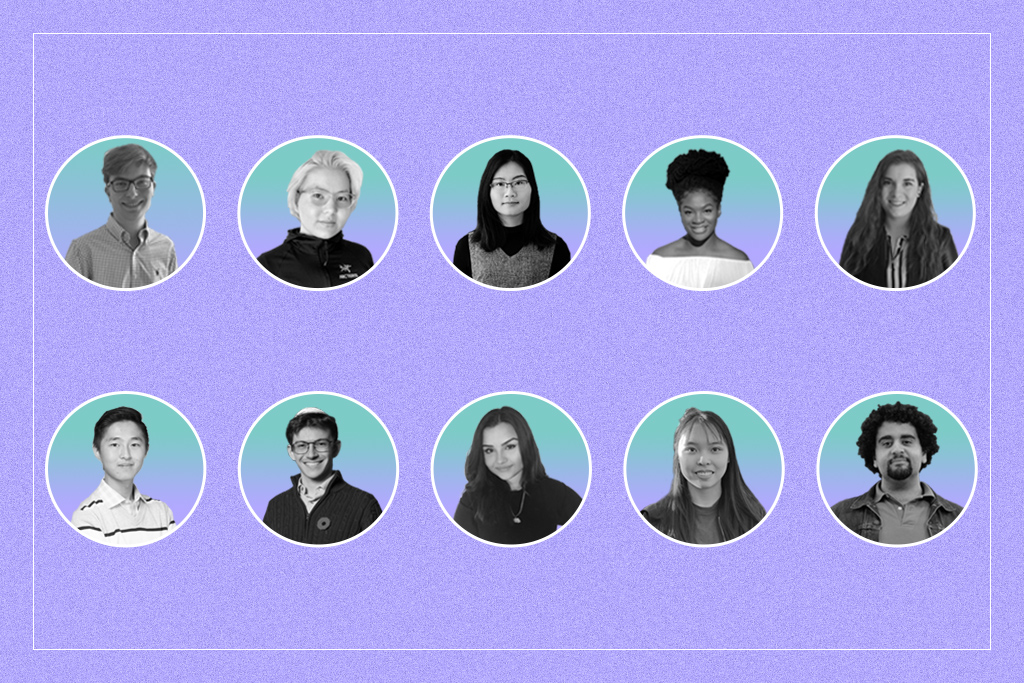
For the fourth consecutive year, The Logic asked some of Canada’s best engineering and computer-science schools to tell us about a few of their rising stars most likely to shape the future of Canada’s innovation economy.
This year’s class includes students who are harnessing technology for the collective good—from data analysis for diversity, to social enterprises and crowdsourced scientific research.
In alphabetical order, here are 10 of Canada’s leading innovators from the Class of 2021.
Sheha Akbari
- School: University of Waterloo
- Program: Management engineering
- Employment status: Entrepreneur
Akbari will stay on as director of innovation at the Sola Foundation, an organization she co-founded to help Afghan youth lead social enterprises. Born in Canada to Afghan refugees, Akbari went to Afghanistan for a term, employing women in a handicraft social enterprise, and spent almost two years translating for refugees in Greece. She also has a patent pending with Apple, after spending two co-op terms in Cupertino and designing part of the core iOS technology that lets users reply to a specific message in conversations.
Betty Cai
- School: University of British Columbia
- Program: Materials engineering
- Employment status: Drafted by Stanford University
Cai will be 18 when she graduates top of her department from UBC, and is heading off to a PhD program at Stanford, where she’ll study biomaterials. Cai spent her summers as a research intern studying titanium alloys, systems biology and wearable electronics under UBC professors, and is described by the school as a determined and passionate role model for women in science. She also helped lead a program that encouraged first-year engineering students to connect with each other during the pandemic, and helped redesign a lab course for virtual learning.
Dawn Chandler
- School: Simon Fraser University
- Program: Computing science and linguistics
- Employment status: Drafted by SkipTheDishes
Chandler was the president of SFU’s Women in Computing Science, encouraging high school students to explore careers in the field through coding and robotics workshops. They also used their enthusiasm for learning languages to volunteer in a program for people with cognitive disabilities. Chandler interned at Microsoft, IBM, Thomson Reuters and Environment and Climate Change Canada before joining SkipTheDishes as a software engineer in January.
Adam Gierlach
- School: University of Toronto
- Program: Electrical and computer engineering
- Employment status: Drafted by the Massachusetts Institute of Technology
Gierlach will finish an internship with Apple’s health-sensing hardware team before heading to a PhD program at MIT. He worked as a co-op student at MIT’s Koch Institute for Integrative Cancer Research, designing devices that gather diagnostic data by travelling through the human digestive system. He also worked in a lab at Holland Bloorview Kids Rehabilitation Hospital, and at the Toronto Western Hospital’s Neuron To Brain Lab, which developed devices that could one day treat epilepsy, Parkinson’s disease and dementia.
Robert Lee
- School: University of Victoria
- Program: Computer engineering
- Employment status: Drafted by Microsoft
Inspired by his grandparents, Lee founded a program at the university that has helped more than 650 senior citizens use technology better, while managing a team of 180 volunteers. He also helped create a tech event at the school that over 200 students and alumni attended, and spent a co-op term working on a Mission Impossible-themed engineering summer camp for first- and second-grade children. Lee will be a full-time software engineer in Microsoft’s Azure group, after multiple co-op terms at the tech giant.
Keer Liu
- School: University of Waterloo
- Program: Computer science
- Employment status: Drafted by Apple
As an undergraduate, Liu built connections between Waterloo, Ont. entrepreneurs and MiraclePlus (formerly Y Combinator China), a Chinese incubator founded by Qi Lu, a veteran executive of Baidu and Microsoft. On top of her MiraclePlus fellowship, her co-op placements included Uber, Slack and Coinbase. Until April, she was also the marketing lead for Tutturu, a startup she built with her classmates that won $50,000 at the university’s Velocity pitch competition in 2020. She will join Apple full time after working one of her six co-op terms there.
Nicole Osayande
- School: Queen’s University
- Program: Biomedical computing
- Employment status: Drafted by McGill University
At Queen’s, Osayande worked with a professor to build software for a hip-replacement surgery tool. She also held part-time and summer jobs in the admissions office, conducting data analysis and assisting with equality, diversity and inclusion initiatives. After discovering she was one of the first from her high school to attend Queen’s, Osayande founded the Queen’s Student Diversity Project to encourage students from diverse backgrounds to apply to the university. Her work on promoting diversity won her a Tricolour Award, which recognizes distinguished service to Queen’s. She will pursue a master’s degree in biological and biomedical engineering at McGill University next year as an inaugural McCall MacBain Scholar.
Taegen Poles
- School: Queen’s University
- Program: Mechanical engineering
- Employment status: Re-drafted by Queen’s University
Poles has applied her engineering skills to motorsport, a passion she discovered when she was seven. At Queen’s, Poles was a program coordinator for W.A.F.F.L.E.S. Community Robotics, a volunteer-led program for Kingston youth, and helped found Second Robotics, a virtual simulated tournament that is live-streamed for fans. In 2019, Poles was selected as one of 54 qualifying drivers for the W Series, a global racing championship for women that promotes equity in the sport. She is working toward a master’s of applied science in mechanical and materials engineering at Queen’s and hopes to eventually pursue a career in racing.
Benjamin Rudski
- School: McGill University
- Program: Computer science and biology
- Employment status: Re-drafted by McGill University
Rudski will begin a PhD in McGill’s quantitative life-science program this year, building on his undergraduate work. He recently won the Governor General’s Silver Medal, an award given to students graduating with the highest academic standing from bachelor’s degree programs in Canada. As an undergraduate, Rudski conducted research on ant evolution with a McGill professor, first getting involved as a lab assistant in charge of feeding the insects a few times a week. His role eventually grew into a project where he developed a mobile app using “citizen science” to get crowdsourced sightings of ant reproduction, bolstering the lab’s trove of data.
Michael Wahba
- School: University of Calgary
- Program: Computer science
- Employment status: Drafted by the University of Southern California
Wahba plans to launch a career in the gaming industry, where he can combine his technical skills and storytelling ability with the use of new technologies like artificial intelligence and virtual reality. In addition to his degree, he also has a certificate in creative writing. As a student, Wahba worked as the lead writer for Atrio: The Dark Wild, a video game being produced by a Calgary-based indie development studio. He also developed a virtual reality simulation that modelled how COVID-19 spread, allowing users to learn about it by interacting. In the fall, Wahba will pursue a master’s program in interactive media at USC.