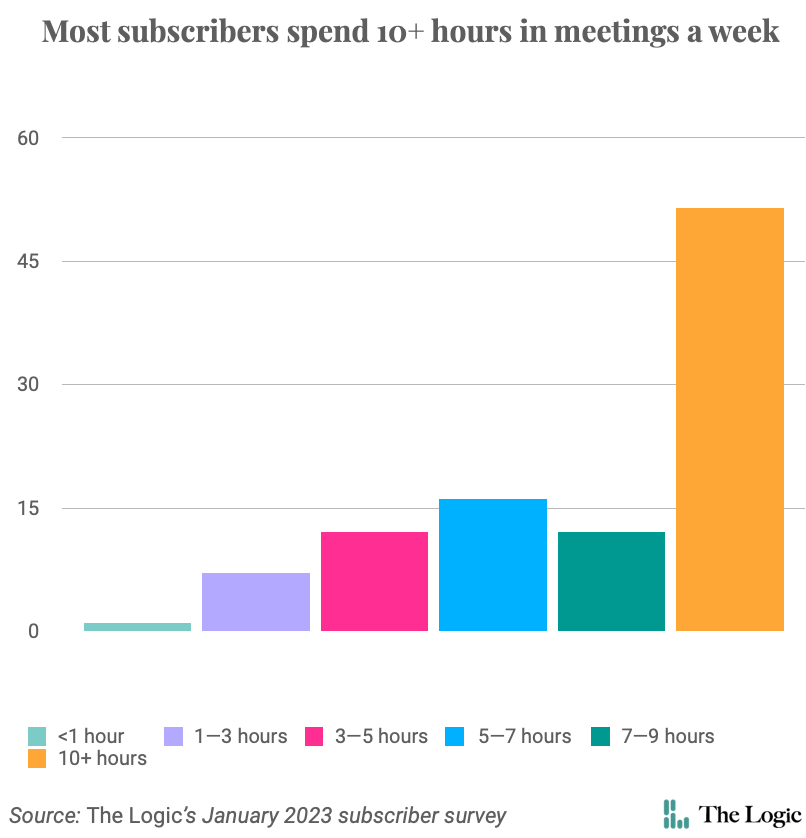
More than half of respondents to The Logic’s January subscriber survey said they spend 10 hours or more in meetings per week, and most are satisfied with that.
Skip to content
 Most respondents to The Logic’s subscriber survey said they feel meetings are essential to connecting with their teammates, especially in remote settings. Photo: Chris Montgomery/Unsplash


Subscriber Survey
‘They’re critical’: Meetings essential to productivity, most subscribers say
On heels of Shopify ban, 66% of respondents say scrapping them altogether isn’t good idea
Most respondents to The Logic’s subscriber survey said they feel meetings are essential to connecting with their teammates, especially in remote settings. Photo: Chris Montgomery/Unsplash
More than half of respondents to The Logic’s January subscriber survey said they spend 10 hours or more in meetings per week, and most are satisfied with that.
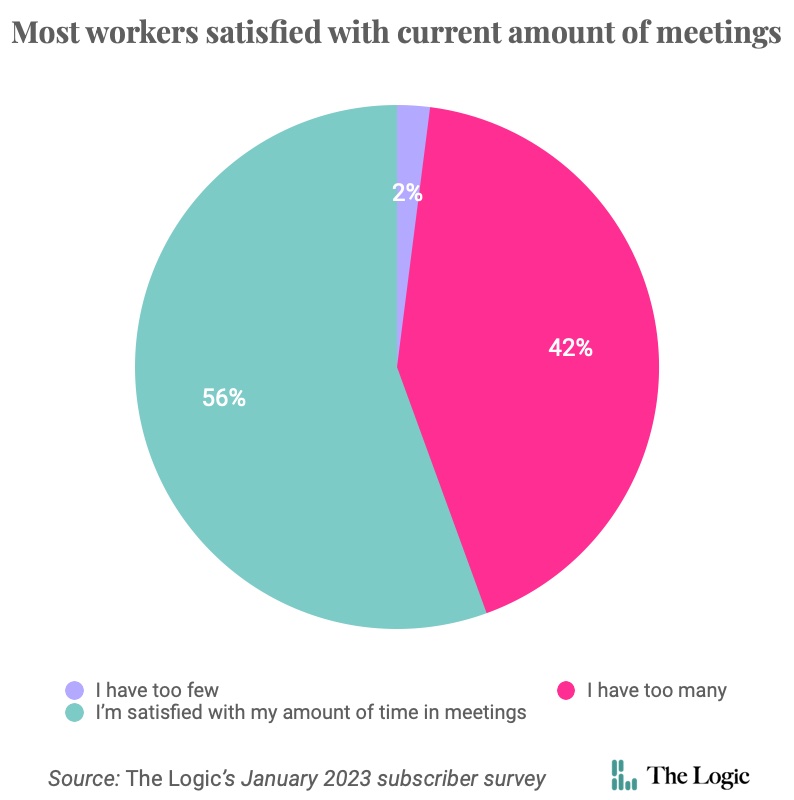
Still, a large portion—42 per cent—of respondents said they spend too much time in meetings. The split in responses comes after Shopify ignited debate over meetings and how they impact employee productivity. The Canadian commerce firm announced at the start of the year that it would temporarily cut the majority of meetings across the company, and imposed a two-week “cooling-off period” before any meetings with more than two people could be added back to calendars.
Similarly, in 2020, Alphabet CEO Sundar Pichai ended the year by encouraging employees to “cancel all routine and non-critical meetings” for a week to “create space for Googlers to either focus on independent work, or make it easier to switch off entirely and take a vacation,” according to a leaked memo.
Related Articles

While some subscribers expressed concern about how much time they had to work outside of meetings, others said they were necessary. “It definitely depends on the week, but often I am in so many meetings I have no time left in the day to do actual work,” wrote one subscriber.
But another respondent said, “I always want to be more efficient with [meetings], but they’re critical to keeping everyone aligned—especially with remote work. Leave someone alone for days and they end up down rabbit holes, very efficiently wasting their time.”
Overall, most subscribers said they felt meetings made them productive and allowed them to collaborate with colleagues (48 per cent), but 22 per cent said meetings kept them from deep or strategic thinking. Another 14 per cent said they prevented them from completing their work.
Despite this, many respondents said that meetings are essential to connecting with teammates and feeling like a part of the organization, especially while working remotely. When asked if scrapping meetings would improve their productivity, almost 66 per cent of respondents said “No.”
“It would reduce my … ability to know others better and assess culture/attitudes informally,” one subscriber said.
“I’m a people leader mainly working remote—meetings are one of the main touchpoints with my team,” another subscriber said.
The findings underscore how, for many respondents, the key to productivity is focus, not more or less blocked-off work time. The Logic previously polled subscribers on a four-day work week in June 2021, and found that 64 per cent of respondents would support its implementation. This latest subscriber survey found that 35 per cent said they would achieve the same level of productivity in a four-day work week as they do now.
“We’ve experimented with this and will continue to do so in varying ways. As it stands now, we make a concerted effort to not schedule meetings on a specific day of the week,” wrote one respondent.
“This frees people up to focus without the fear that they will be interrupted. It’s not a four-day work week, but it is a shift in mindset that has been helpful.”
Only about a third of respondents said a four-day work week would make them more productive, and 18 per cent said it’d decrease their productivity.
“The issue isn’t meetings,” one subscriber said. “The real culprit is [a] lack of process. Investing in process takes more skill, more commitment, more tension. The default to meetings and emails and emails about meetings is due to a lack of commitment to focus.”
Methodology
The Logic emailed subscribers a private link to an online survey on Jan. 11 and the survey closed Jan. 13. Respondents’ identities were kept anonymous. Subscribers were asked, “How many hours a week do you spend in meetings on average?” and could select: “Less than an hour,” “1–3 hours,” “3–5 hours,” “5–7 hours,” “7–9 hours,” or “10 or more hours.” They were then asked, “Which situation best describes how you feel about meetings at work?” and could answer: “I have too few,” “I have too many,” or “I’m satisfied with my amount of time in meetings.” Next, they were asked, “Which situation best describes how meetings affect your productivity?” and could answer: “They keep me from completing my work,” “They keep me from deep or strategic thinking,” or “They make me productive and allow for collaboration with colleagues.” After that, they were asked, “Would scrapping meetings improve your productivity at work?” and could select: “Yes” or “No.” Finally, respondents were asked, “How do you think a four-day work week would affect your productivity?” and could select: “It would make me more productive,” “I’d achieve the same level of productivity,” or “It would make me less productive.”



Loading...
Thanks for sharing!
You have shared 5 articles this month and reached the maximum amount of shares available.
CloseThis account has reached its share limit.
If you would like to purchase a sharing license please contact The Logic support at [email protected].
CloseGift the full article!
You have gifted 0 article(s) this month and have 5 remaining.
Recipients will be able to read the full text of the article after submitting their email address. They will not have access to other articles or subscriber benefits.
Photo: Chris Montgomery/Unsplash
Most Popular This Week




In-depth, agenda-setting reporting
Great journalism delivered straight to your inbox.
News
An obscure data standard is the latest open banking holdup—and an unlikely political hot potato
Briefing
Cohere says it caught an Alibaba model trying to send data to a server in China
Feds and First Nations to work on sharing resource revenue, with a sovereign wealth fund one option
Zafin buys U.S. fintech Naehas in nine-figure deal
Best business newsletter in Canada
Get up to speed in minutes with insights and analysis on the most important stories of the day, every weekday.
Exclusive events
See the bigger picture with reporters and industry experts in subscriber-exclusive events.
Membership in The Logic Council
Membership provides access to our popular Slack channel, participation in subscriber surveys and invitations to exclusive events with our journalists and special guests.