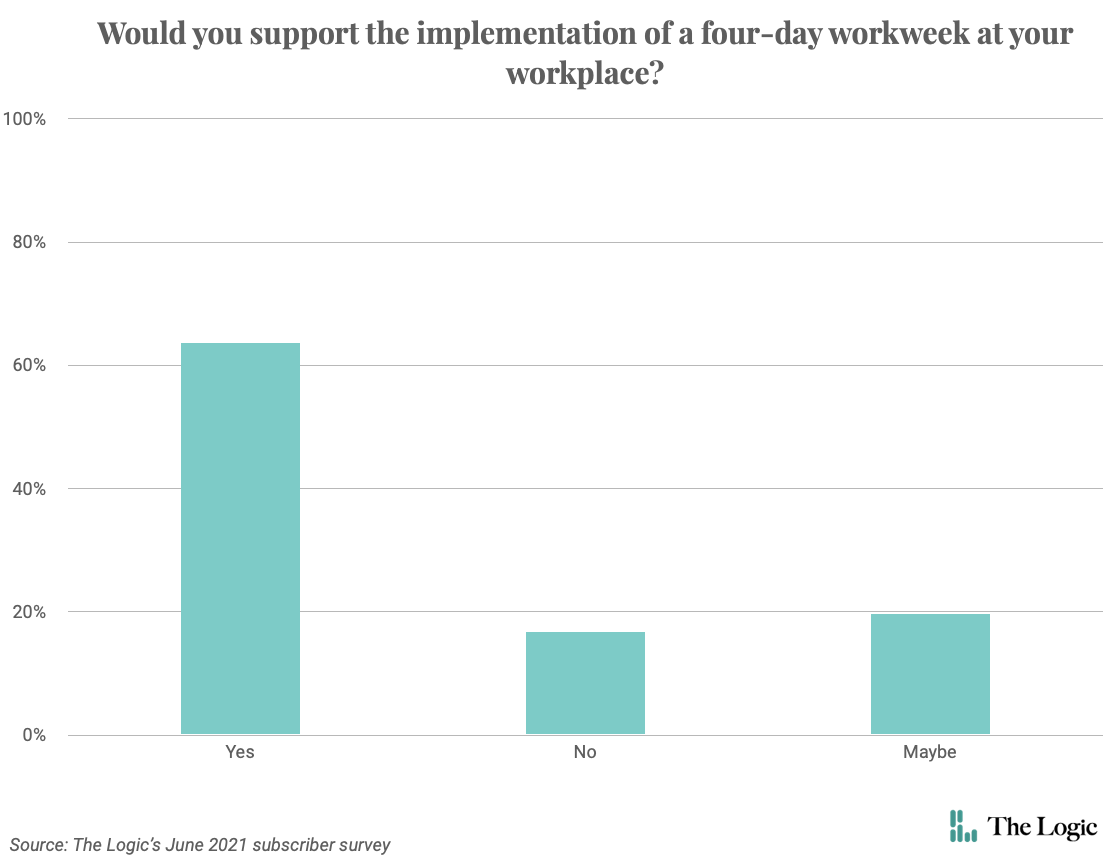
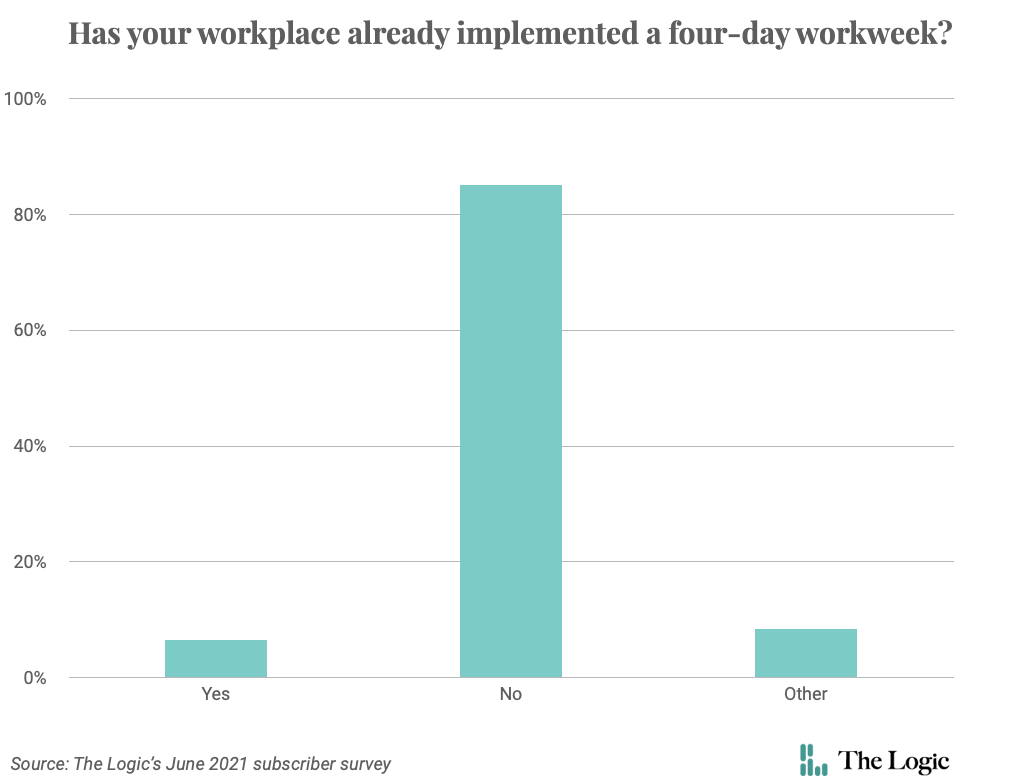
Nearly two-thirds of The Logic’s subscribers would support the implementation of a four-day workweek. However, fewer than seven per cent of their workplaces have introduced one.
Skip to content


Subscriber Survey
Most subscribers support four-day workweek, but few employers have it: Survey
Photo: Chris Montgomery/Unsplash
Nearly two-thirds of The Logic’s subscribers would support the implementation of a four-day workweek. However, fewer than seven per cent of their workplaces have introduced one.
Sixty-four per cent of respondents said they favoured a four-day workweek, The Logic’s latest subscriber survey found. Seventeen per cent said they would not support its introduction, and 20 per cent said they may consider it. Meanwhile, 85 per cent of subscribers said their workplace had not implemented one.
Many subscribers believe that a shortened workweek would benefit workers by reducing stress and improving work-life balance—particularly during COVID-19.
“WFH is extending work days. Results, relationships and processes have been maintained and in some cases improved. However, it is vital that people are able to disconnect to replenish their bank of creativity away from work. A four-day week supports that,” one subscriber wrote.
Methodology
The Logic emailed subscribers a private link to an online survey on June 24, and the survey closed June 28. Respondents’ identities were kept anonymous and duplicates were removed as needed. Subscribers were asked: “Would you support the implementation of a four-day workweek at your workplace?” Their choices were: “Yes,” “No,” “Maybe,” “I don’t know.” They were also asked: “Has your workplace already implemented a four-day workweek?” Their choices were “Yes,” “No,” “Other.” In addition, they were asked: “How do you think a four-day workweek would impact your workplace’s operations or bottom line?” Their choices were: “Very negatively,” “Somewhat negatively,” “Neither positively nor negatively,” “Somewhat positively,” “Very positively,” “I don’t know.” Finally, they were asked: “Is your company exploring any additional options for paid time off?” Their choices were: “Yes,” “No,” “I don’t know,” “Other.”
After many firms pivoted to remote work during the pandemic, some are considering revamping schedules for greater flexibility. The four-day workweek is not a new concept, but it’s gaining momentum. Kickstarter and Unilever are both experimenting with it. Spain is trialling it nationally, while Japan is encouraging firms to introduce the option. Proponents say companies that condense their workweek remain equally productive, while the environment, labour market, and workers also reap rewards.
The Logic’s subscribers certainly see benefits, with many saying they would expect to remain productive and efficient, while being better rested. “Would rather focus hard during the week and have a bigger break on the weekends. Will have me feeling more refreshed on Monday rather than just doing chores all weekend and restarting work on Monday,” one wrote.
However, some subscribers were hesitant about whether they could realistically make it work, particularly in industries with customers or clients who aren’t on the same schedule. “I love the idea of a four-day week but am also cognizant that we have clients to serve who may not adopt a four-day workweek. If it could be implemented in a way to ensure a high service standard, I would be fully supportive,” one said.
Others worried that their Friday hours would bleed into the rest of the week, or suggested that their workload wouldn’t allow for it.
“I would settle for a five [day] workweek at this point,” one said.
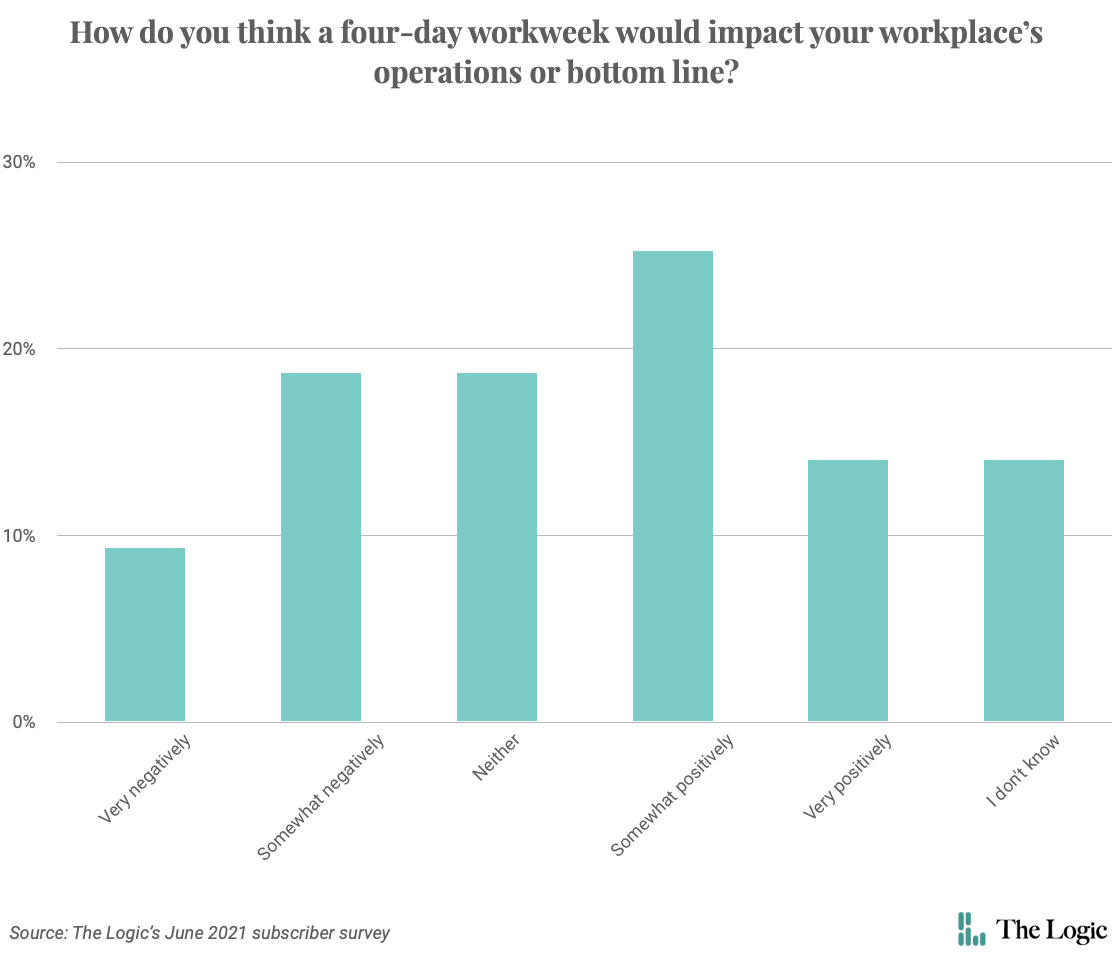
Subscribers were generally confident that a four-day workweek would be good for operations and the bottom line. Thirty-nine per cent of respondents said it would have a positive impact, and 28 per cent said it would have a negative impact. Fourteen per cent said they didn’t know. One subscriber noted that the model would help attract and retain talent.
Besides the four-day workweek, companies have been experimenting with other approaches to provide paid time off during the pandemic. For example, Kitchener, Ont.-based Miovision has extended all three-day holiday weekends to four days, and Austin, Texas-based dating-app maker Bumble is giving its entire staff an extra week off to recover from burnout.
While only a small majority of subscribers currently work a four-day week, several said their employers have introduced “summer hours,” with half days on Fridays, or extended long weekends. Still, one respondent said they don’t really unplug during that time. “Of course, I just catch up with my work that afternoon and don’t actually take it off.”
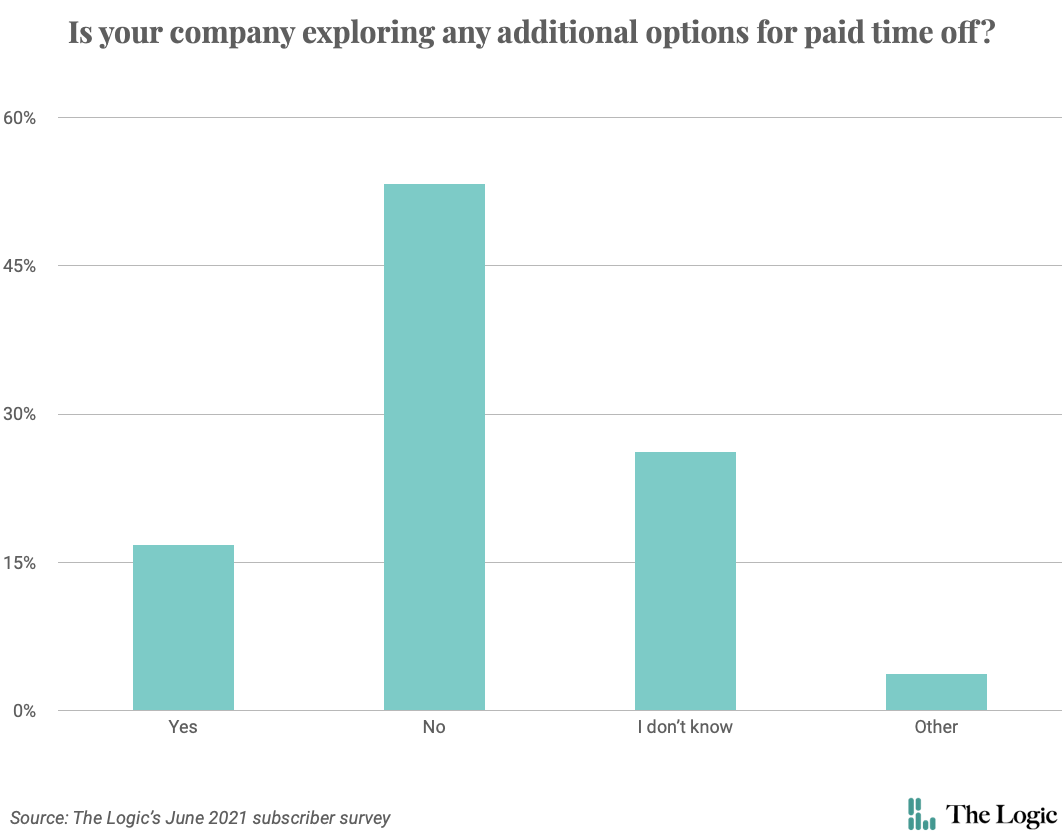
Seventeen per cent of subscribers said that their companies have introduced additional options for paid time off, including more personal days, vacation days and paid sick leave. At one subscriber’s workplace, COVID-19 was a catalyst to shorten their workweek.
“Early on in the pandemic, the added professional and personal stress the whole team was going through compelled us to trial a four-day workweek. We haven’t looked back,” one subscriber wrote.



Loading...
Thanks for sharing!
You have shared 5 articles this month and reached the maximum amount of shares available.
CloseThis account has reached its share limit.
If you would like to purchase a sharing license please contact The Logic support at [email protected].
CloseGift the full article!
You have gifted 0 article(s) this month and have 5 remaining.
Recipients will be able to read the full text of the article after submitting their email address. They will not have access to other articles or subscriber benefits.
Photo: Chris Montgomery/Unsplash
Most Popular This Week




In-depth, agenda-setting reporting
Great journalism delivered straight to your inbox.
News
Adam Waterous proposes massive crude exports to Asia by rail through northern B.C.
Briefing
Rivals may be ‘horrified’ to realize how exposed their investments are to AI, Aviva CIO warns
Shopify, Sequoia co-lead US$200M investment in online-selling platform Whop
Amid revenue gains, 1Password bets on tools to protect data from AI agents
Best business newsletter in Canada
Get up to speed in minutes with insights and analysis on the most important stories of the day, every weekday.
Exclusive events
See the bigger picture with reporters and industry experts in subscriber-exclusive events.
Membership in The Logic Council
Membership provides access to our popular Slack channel, participation in subscriber surveys and invitations to exclusive events with our journalists and special guests.







