Skip to content

Canada's Business and Tech Newsroom

  • Professional Subscription
  • Partnerships & Advertising
  • Licensing & Syndication
Log In Subscribe
Welcome,
  • My Account
  • Log Out
  • Business
  • Tech
  • National
  • The Big Read
  • Briefings
  • Commentary
Search
Log In Subscribe
Welcome,
  • My Account
  • Log Out
Subscriber Survey

Most of you don’t think prediction markets should be legal in Canada

Listen Now
0:00
Subscriber Survey

Most of you don’t think prediction markets should be legal in Canada

As Canadian fintechs get in on prediction markets, The Logic’s subscribers say the risks of betting on real-life events outweigh the rewards

By Leila El Shennawy
A large advertisement on the side of a building reads, "Polymarket. Okay, Trade." The shows two men facing each other.
In the U.S., prediction markets like Kalshi and Polymarket are broadly legal and booming. The multibillion-dollar industry is largely driven by the popular sports and elections categories, which are still not allowed in Canada. Photo: AP Photo/Olga Fedorova
Jul 3, 2026
A A
A Small A Medium A Large
Share

Gift

Share

Listen Now
0:00

Nearly 58 per cent of respondents to The Logic’s latest subscriber survey said they do not support legalization of prediction markets in Canada, and more than half do not think sports-betting platforms are appropriately regulated in the country. 

While single-game online sports betting has been legal in Canada since 2021, prediction markets, or exchanges that allow users to bet on the outcomes of real-world events, remain heavily restricted. Toronto fintech Wealthsimple received regulatory approval earlier this year to offer prediction markets trading limited to three topics: climate trends, financial markets and economic indicators. Last month, Wealthsimple announced the launch of a prediction markets trading app where it will offer Canadians access to nearly 4,000 event contracts on popular U.S. predictions exchange Kalshi this summer. (Wealthsimple made the announcement partway through The Logic’s survey period.)

Related Articles

A person holds a smartphone with the Wealthsimple app, which displays various company names, including SoFi, Ciena, Affirm Holdings and Discord, on a dark screen.

Wealthsimple will let Canadians place bets on prediction market Kalshi

By Claire Brownell

Wealthsimple gets the go-ahead to launch prediction markets trading in Canada

By Claire Brownell

Online gambling is everywhere. Except Quebec

By Martin Patriquin

Only nine per cent of readers said they have participated in prediction markets trading before, while roughly 91 per cent said they have not. 

“It’s hard to see the overall benefit [of prediction markets], except for the companies that create and run the platforms,” wrote one reader. “Sure, a few people might get rich or at least make money, but likely the majority will not.” 

In the U.S., prediction markets like Kalshi and Polymarket are broadly legal and booming. Trading volume on U.S. prediction markets grew from US$15.8 billion to US$63.5 billion between 2024 and 2025 according to Web3 security company CertiK, largely driven by the popular sports and elections categories, which are still not allowed in Canada.
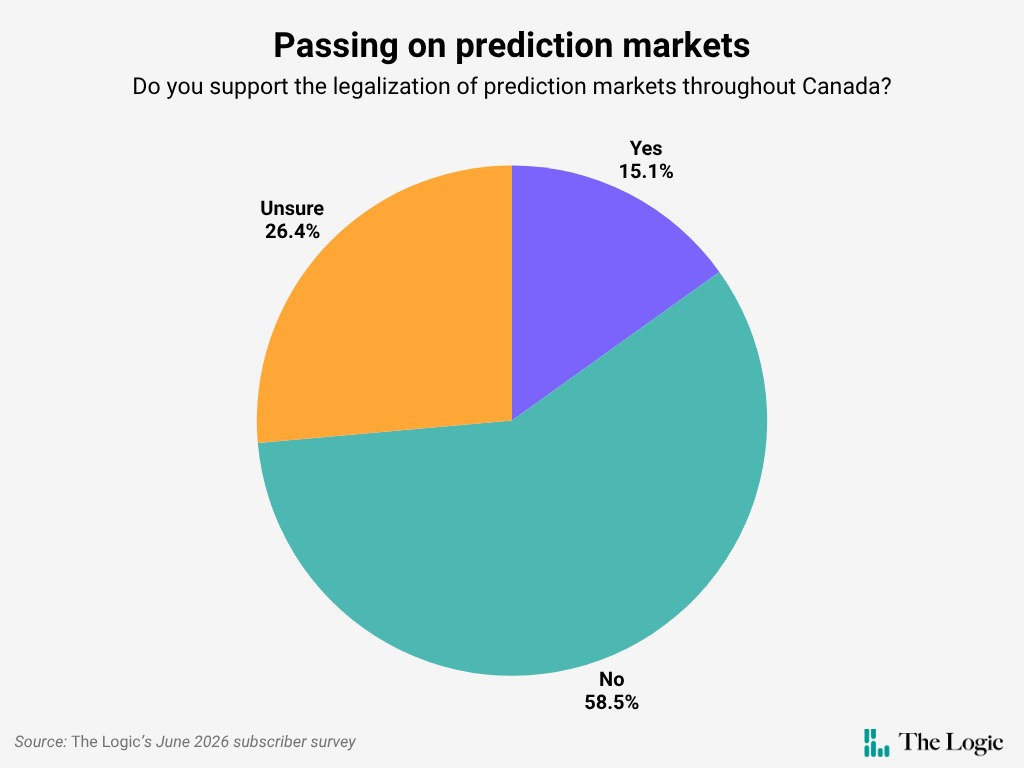
A pie chart titled "Passing on prediction markets: Do you support the legalization of prediction markets throughout Canada?" The results of the chart show Yes (15.1%), No (58.5%) and Unsure (26.4%). The source of the data is The Logic's June 2026 subscriber survey.

Both Kalshi and Polymarket have recently come under scrutiny, with regulators considering tighter insider trading controls and other parameters. Trading on controversial topics such as geopolitical conflicts and natural disasters has raised ethical concerns. Many readers cited similar market manipulation concerns as reasons they oppose legalization. Prediction markets create “incentives for well-placed agents to behave differently to benefit from their own prediction bets,” wrote one reader, while another said the platforms are “wide open to abuse” by people with insider information.  

Almost 53 per cent of subscribers also said sports-betting platforms are not appropriately regulated in Canada, with only 13 per cent saying they are. Canadian law treats prediction market contracts as financial derivatives, rather than as a form of gambling like sports betting. Many of The Logic’s readers said they felt prediction markets were closer to gambling than trading and that stricter regulations were needed as a result. 

Readers opposed prediction markets in part because of concerns it could compound problem gambling already evident in the country’s US$4.1-billion sports-betting market. One reader said they don’t want prediction markets in Canada because they have family members who struggle with gambling addiction. “The house always wins. Gambling has destroyed many lives,” wrote another reader. 
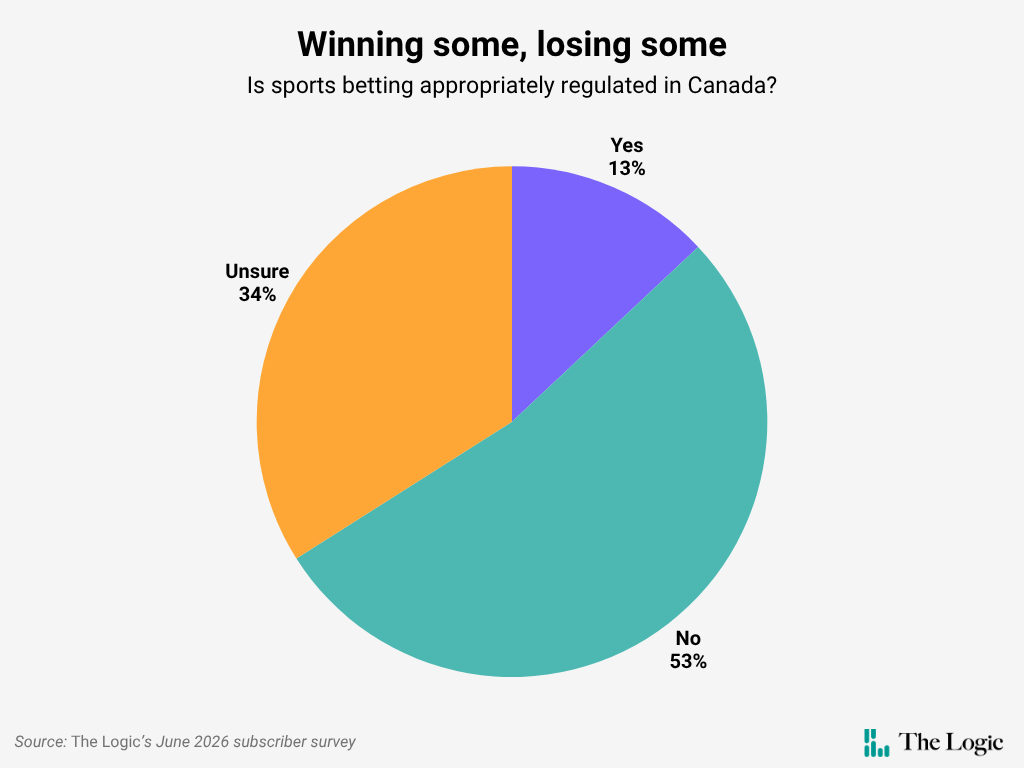
A pie chart titled "Winning some, losing some: Is sports betting appropriately regulated in Canada?" The results of the pie chart are divided among Yes (13%), No (53%) and Unsure (34%). The source of the data is The Logic's June 2026 subscriber survey.

Some subscribers pointed to the proliferation of sports-betting advertisements on streaming platforms, from online sportsbooks like Bet365 and FanDuel, as evidence of the problem. One reader wrote that the volume of sports-betting ads “is ample evidence that the door has swung open too wide.” Another said they find the “omnipresence” of sports-betting ads “nauseating.”  

Some readers felt prediction markets are inherently unethical, with one reader calling them “cruel and inhumane.” Another subscriber said they felt that prediction markets seek to “financialize all human behaviour,” which they called “fundamentally anti-human.”

“It treats events like entertainment, rather than consequential matters that affect people’s lives,” wrote one subscriber. “I believe betting on real-world events decreases empathy and desensitizes people from the impact beyond [their] winnings.”  

Proponents of prediction markets say they’re sources of potentially valuable crowd-sourced data that could be used to improve business forecasting. Readers who said they supported legalization of prediction markets cited tax revenue and data collection as reasons. “Group wisdom is by far the best predictor of actual outcomes,” wrote one subscriber. “The fact that there are bad actors should not stop adoption.”  

Only about a quarter of readers believed prediction markets have value beyond serving as trading platforms.
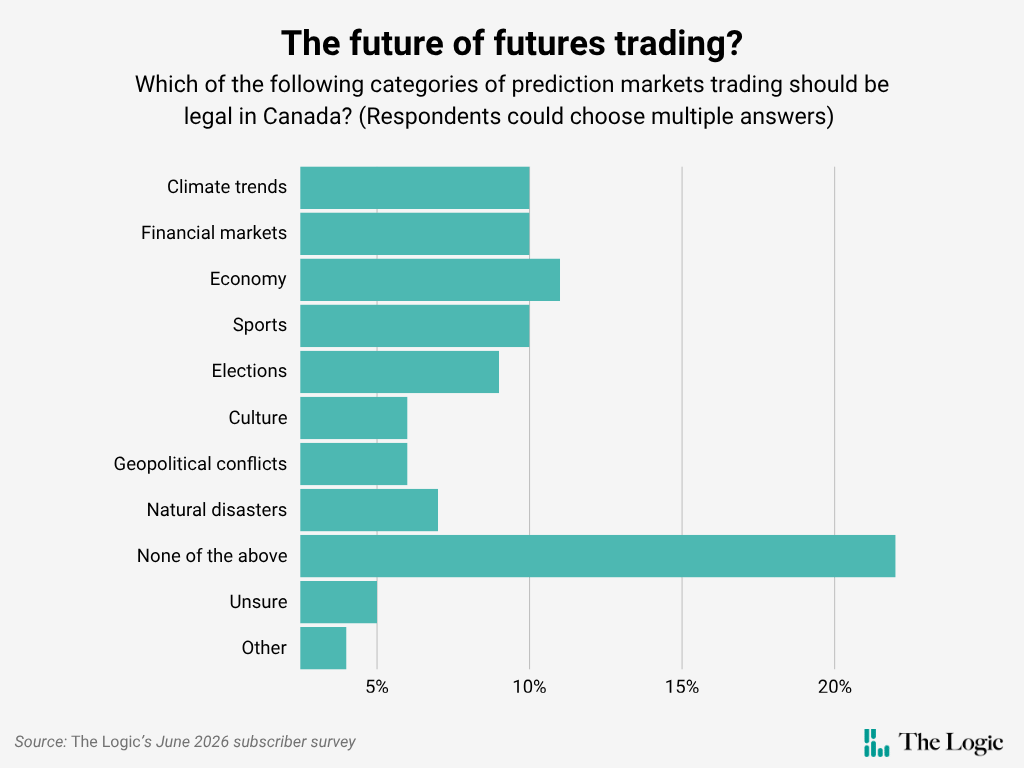
A row chart titled "The future of futures trading? Which of the following categories of prediction markets trading should be legal in Canada? (Respondents could choose multiple answers)." The options listed are climate trends, financial markets, economy, sports, elections, culture, geopolitical conflicts, natural disasters, none of the above, unsure, and other. The most frequent selection is none of the above, exceeding over 20% of responses. Other categories fall between 5% and 13%, with unsure and other receiving 5% or less responses. The source of the data is The Logic's June 2026 subscriber survey.

Twenty-two per cent of readers said they did not support the legalization of any of the prediction market contract topics included in the poll. Only a fraction of subscribers said they support the legalization of betting on the economy (11 per cent), financial markets (10 per cent) or climate trends (10 per cent)—the three prediction contract topics currently allowed in Canada.

Gift the full article

One reader said that while they could support broader legalization of prediction markets if certain regulatory conditions were met, the chances those criteria could be satisfied are slim. “Placing the odd bet isn’t technically hurting [anyone], but the safeguards to protect those with gambling addictions or financial difficulties simply aren’t there—and it’s unlikely they ever could be,” they wrote. 

Prediction markets are “filling in a gap left by the failed policies that eroded traditional paths to prosperity,” wrote another subscriber. “They are a symptom of a broken social contract.”


#Business #commentary #prediction markets #sports betting #Subscriber Survey #Wealthsimple

Loading...

Thanks for sharing!

You have shared 5 articles this month and reached the maximum amount of shares available.

Close
This account has reached its share limit.

If you would like to purchase a sharing license please contact The Logic support at [email protected].

Close
Want to share this article?

Upgrade to all-access now

Close
Gift the full article!

You have gifted 0 article(s) this month and have 5 remaining.

Copy link and gift
Copy Link
Email to a friend
Send Email
Gift on Social Media

Recipients will be able to read the full text of the article after submitting their email address. They will not have access to other articles or subscriber benefits.

A large advertisement on the side of a building reads, "Polymarket. Okay, Trade." The shows two men facing each other.

Photo: AP Photo/Olga Fedorova

A pie chart titled "Passing on prediction markets: Do you support the legalization of prediction markets throughout Canada?" The results of the chart show Yes (15.1%), No (58.5%) and Unsure (26.4%). The source of the data is The Logic's June 2026 subscriber survey.

A pie chart titled "Winning some, losing some: Is sports betting appropriately regulated in Canada?" The results of the pie chart are divided among Yes (13%), No (53%) and Unsure (34%). The source of the data is The Logic's June 2026 subscriber survey.

A row chart titled "The future of futures trading? Which of the following categories of prediction markets trading should be legal in Canada? (Respondents could choose multiple answers)." The options listed are climate trends, financial markets, economy, sports, elections, culture, geopolitical conflicts, natural disasters, none of the above, unsure, and other. The most frequent selection is none of the above, exceeding over 20% of responses. Other categories fall between 5% and 13%, with unsure and other receiving 5% or less responses. The source of the data is The Logic's June 2026 subscriber survey.

Most Popular This Week

A shot of a placard on a table reading "Let Alberta Decide." There is a person out of focus in the foreground wearing a cowboy hat.
The Big Read

What Alberta’s corporate heavyweights really think about separation

By Meghan Potkins
A person in glasses and a blue top is sitting and typing on a laptop in an office. A desktop screen next to the laptop displays some blurred-out coding work.
News

A niche white-collar role is becoming the AI industry’s hot new job

By Anita Balakrishnan
A logo that reads AI in blue lettering against a light yellow background.
News

What happened when a VC firm let AI do almost everything

By Catherine McIntyre
News

Canada joins the movement to make AI more open source

By Murad Hemmadi

In-depth, agenda-setting reporting

Great journalism delivered straight to your inbox.

A high-angle shot of workers sorting and packing lettuce along conveyors in an industrial facility.
Commentary

Carmichael: The age-old trade problem Carney’s trying to solve with food

By Kevin Carmichael

Briefing

GFL stock jumps on report of takeover interest

By Anita Balakrishnan   |   Jul 3, 2026

McKinsey to challenge internal leaders on AI plans under new leadership structure

By Anita Balakrishnan   |   Jul 3, 2026

Lobby group can participate in crypto miners’ lawsuits against Hydro-Québec, judge rules

By Martin Patriquin   |   Jul 3, 2026

Best business newsletter in Canada

Get up to speed in minutes with insights and analysis on the most important stories of the day, every weekday.

Exclusive events

See the bigger picture with reporters and industry experts in subscriber-exclusive events.

Membership in The Logic Council

Membership provides access to our popular Slack channel, participation in subscriber surveys and invitations to exclusive events with our journalists and special guests.

Recent Popular Stories

Analysis

It turns out Trump does need something from Canada—aluminum

By Joanna Smith   |   Jun 25, 2026
A close-up of a made-in-Canada stamp on the end of a cylindrical piece of raw aluminum.
The Big Read

What Alberta’s corporate heavyweights really think about separation

By Meghan Potkins   |   Jul 2, 2026
A shot of a placard on a table reading "Let Alberta Decide." There is a person out of focus in the foreground wearing a cowboy hat.
News

What happened when a VC firm let AI do almost everything

By Catherine McIntyre   |   Jun 29, 2026
A logo that reads AI in blue lettering against a light yellow background.
News

A niche white-collar role is becoming the AI industry’s hot new job

By Anita Balakrishnan   |   Jun 30, 2026
A person in glasses and a blue top is sitting and typing on a laptop in an office. A desktop screen next to the laptop displays some blurred-out coding work.
Exclusive

Ssense has laid off photo and make-up teams and says AI will do much of their work

By Catherine McIntyre   |   Jun 22, 2026
News

Alberta to free up a huge amount of power to attract Big Tech and its data centres

By Meghan Potkins   |   Jun 24, 2026
A wide landscape shot of high-tension power lines over green and golden fields in rolling countryside.

Canada's most influential executives and policymakers are reading The Logic

  • CPP Investments
  • Sun Life Financial
  • C100
  • Amazon
  • Telus
  • Mastercard
  • bdc
  • Shopify
  • Rogers
  • RBC
  • General Motors
  • MaRS
  • Government of Canada
  • Uber
  • Loblaw Companies Limited
logic-logo

Canada's Business and Tech Newsroom

100% human-crafted journalism

Newsroom

  • News Tips
  • AI Policy
  • Editorial Disclosures
  • Story Pitches

Company

  • About Us
  • Terms of Service
  • Privacy Statement
  • Corporate Information

Contact

  • Contact Us
  • Advertise
  • FAQs
  • Work at The Logic

© 2026 The Logic Inc. All Rights Reserved.

Trusted by leaders

Error

Account creation failed.

Please email us at [email protected].

Create Account

[wppb-register form_name=”cozmo-registration-form-for-modal”]

I do have an account
Login
or

[wppb-login]

I don’t have an account