Skip to content


Subscriber Survey
Leaders at Cohere, Wealthsimple top The Logic readers’ votes as Canada’s leading innovators of 2025
AI darling and fast-growing fintech tie at the head of a crowded field
Toronto Tech Week 2025 likely won’t be the last time Wealthsimple’s Michael Katchen, left, and Cohere’s Aidan Gomez share the spotlight. Photo: Handout/Toronto Tech Week
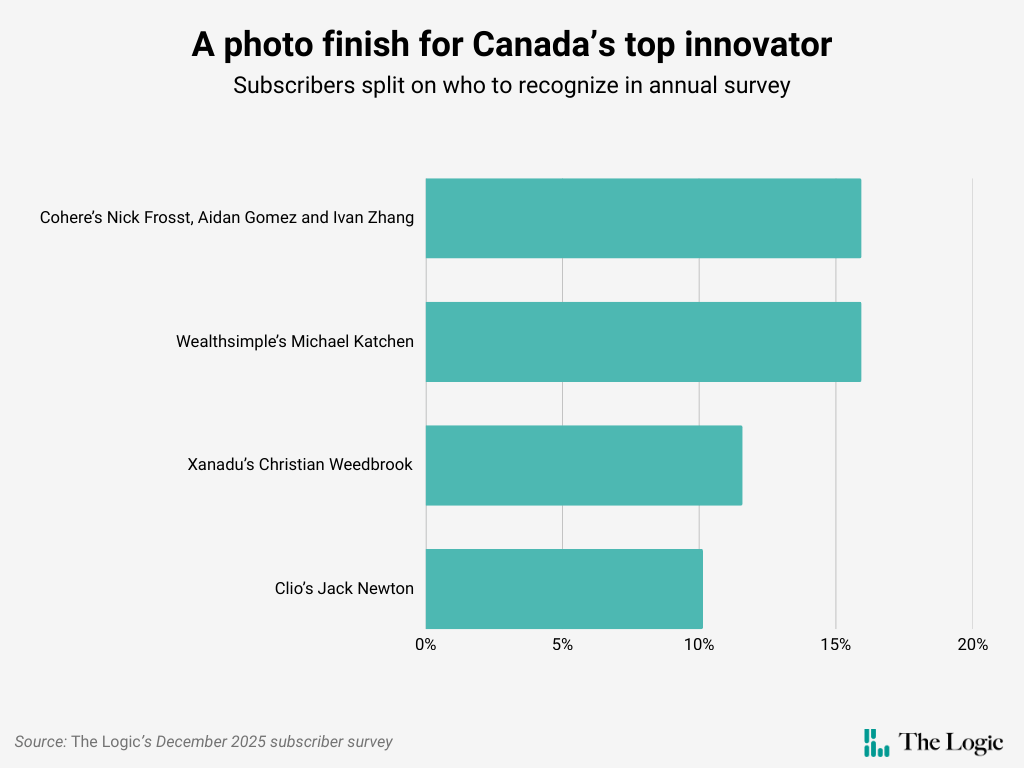
Cohere’s co-founders Aidan Gomez, Nick Frosst and Ivan Zhang tied with Wealthsimple CEO Michael Katchen as the Canadian innovation leaders of 2025, according to The Logic’s readers.
The results of the annual survey were splintered, with the winners tying at just under 16 per cent of the votes and Christian Weedbrook of quantum computing company Xanadu just slightly behind.
Katchen took half the top spot this year after coming a fairly distant second behind the Cohere trio in last year’s survey and fourth in 2022.
Related Articles


The Western University business grad co-founded Wealthsimple in 2014. It has grown into a trading platform for traditional securities, gold and cryptocurrency, offering portfolio management, basic tax and investment advisory services. It holds about $100 billion of investor money.
“I have young adult children who all are [Wealthsimple] clients and are clearly engaged with their growth and marketing strategy,” wrote one survey respondent, explaining a vote for Katchen. “The year-on-year growth is impressive.”
Katchen himself was unavailable to comment to The Logic about his win.
Meanwhile, Cohere’s Canadianness is a boon as Canadian companies, governments and individuals figure out how to handle the rise of AI amid a broken relationship with the United States and worries about Canadian sovereignty. Its “focus on multilingual models, sovereign deployments and international expansion beyond the U.S. positions Canada as a serious AI producer, not just an adopter or subcontractor,” wrote one respondent.
“Canada has the makings of a true global champion in Cohere, and that is rare,” wrote another.
Cohere led the pack in responses to a different question: which company readers will be watching most closely in 2026.
The company is Canada’s AI darling, a supplier of large language models (LLMs) and associated tools aimed directly at corporate customers. OpenAI’s ChatGPT or Google’s Gemini are open to public use; Cohere deals with individual organizations, customizing its tools to their needs.
Its 2025 highlight reel started with a January introduction of an agentic platform called North, allowing the employees of corporate clients to build tools to execute tasks with AI beyond working with text. North’s first customer: RBC, Canada’s biggest bank.
“We’ve been building the business,” Zhang said in an interview.
Cohere has said its revenue grew significantly in 2025, as it landed major clients like telecom giant Bell and defence prime Thales.
“This year is when we’ve closed the gap between, ‘Hey, you can buy this LLM and prompt it,’ to, ‘OK, you can use this capability for actual business impact,’” Zhang said. North is the bridge, letting customers run AI wherever they want—even on ships.
Cohere has plenty of room to keep growing, according to Zhang. “There’s still a lot of demand from enterprises to integrate AI,” he said. “They’re getting pressured to streamline operations and unlock top-line revenue growth.”
The reel also includes $240 million in federal funding for a major compute project and, later, a first-of-its-kind agreement to explore how Cohere’s tools can help the federal government work better; US$600 million in financing across two deals, the latter of which valued it at US$7 billion; hiring AI star Joelle Pineau away from Meta; and drawing new global interest as an alternative to U.S. hyperscalers.
Those hyperscalers are, nevertheless, interested in what Cohere has to offer. Pitching his company as a friend to Canada, Microsoft president Brad Smith promised to bring Cohere’s language models to the world through the Azure cloud computing platform.
The company has also been sued over alleged copyright violations in training its models (it rejects the claim) and been through a leadership shakeup that saw president Martin Kon step aside and top researcher Sara Hooker leave. Fast growth means growing pains.
A couple of respondents expect trouble for artificial intelligence companies in the year to come. The “AI bubble may expand and then a burst could follow,” one offered as a prediction for 2026.
Or, as another reader put it: “AI will go snaky.”
Cohere has tried to avoid getting sucked into the AI bubble, or all the chatter about it. Unlike OpenAI or xAI, the firm isn’t contracting for hundreds of billions of dollars worth of data centres. And it’s not chasing “superintelligence,” the smarter-than-human version of AI that Meta is spending big to build.
“A lot of hype will probably not pan out,” Zhang said, claiming Cohere has chosen a more capital-efficient path—it’s buying, not building, the compute it needs to fulfill customers’ demands, and building new products based on their feedback. Its relationships with its big-business customers also tend to stick longer than consumer app subscriptions, where users might swap among ChatGPT, Gemini and other services from month to month.
Cohere’s goal is to “sustainably grow and scale these models based on how useful they are,” Zhang said. “That’s what’s protecting us a bit from the bubble.”
He’s looking for someone to seize the title as Canada’s top national innovator in 2026. “I want to see more Canadian innovation in the ecosystem,” he said. “Hopefully we’ll be unseated next year by another amazing company in Canada.”
Maybe that will be Wealthsimple and its CEO. Wealthsimple’s stated goal is to break into the top tier of Canadian financial institutions and eventually become No. 1. It has some way to go (and it’s not the only fintech with big dreams), but in 2025 it took a step in that direction by adding traditional retail services like credit cards, loans and even physical cheques, directly challenging traditional banks in the basics of consumer finance.
Wealthsimple raised $750 million this past autumn—at a $10-billion valuation, more than doubling the value Wealthsimple’s key shareholder, Power Corp., had put on it late in 2024.
“It’s important that our balance sheet matches the scale of our ambitions,” Katchen told The Logic at the time of the fundraise.
Though Weedbrook landed third in this year’s survey, several responses suggested he and Xanadu will be contenders to watch in years to come, comparing quantum computing to the advent of the internet and artificial intelligence, or even agriculture and electricity. Xanadu announced plans to go public in November, valued at US$3.6 billion.
Wrote one person: “Quantum is the next big thing.”
Clio CEO Jack Newton (whose legaltech firm raised US$500 million at a US$5-billion valuation in November) drew just over 10 per cent of the votes. “Huge dealmaking, huge reach and under the radar for so long,” commented one respondent who picked him.
Methodology
The Logic emailed subscribers a private link to an online survey on Dec. 15, and the survey closed Dec. 17. Respondents’ identities were kept anonymous. Subscribers were asked: “Who do you vote for as Canada’s innovation leader of 2025?” with the following options:
- Ammar Al-Joundi, Agnico Eagle
- Janet Bannister, Staircase Ventures
- Eva Clayton Nisga’a Nation
- Stephan Crétier, GardaWorld
- Daniel Debow and Lucy Hargreaves, Build Canada
- Bruce Flatt, Brookfield
- Nick Frosst, Aidan Gomez and Ivan Zhang, Cohere
- Ahmad Ghahreman, Cyclic Materials
- Éric Martel, Bombardier
- Andrew Moor, EQB
- Jack Newton, Clio
- Dan Parkin, Clutch
- Matt Proud, Plantro
- Teresa Resch, Toronto Tempo
- Ken Seitz, Nutrien
- Crystal Smith, Haisla Nation
- Danielle Smith, Province of Alberta
- Nancy Couthern, ATCO
- Christian Weedbrook, Xanadu
- Other (please specify)
They were also asked “What’s your top tech or business prediction for 2026?” and “What Canadian tech company will you be watching most closely in 2026?” The final question was: “What is your company or organization’s biggest priority in 2026?”



Loading...
Thanks for sharing!
You have shared 5 articles this month and reached the maximum amount of shares available.
CloseThis account has reached its share limit.
If you would like to purchase a sharing license please contact The Logic support at [email protected].
CloseGift the full article!
You have gifted 0 article(s) this month and have 5 remaining.
Recipients will be able to read the full text of the article after submitting their email address. They will not have access to other articles or subscriber benefits.
Photo: Handout/Toronto Tech Week
Most Popular This Week




In-depth, agenda-setting reporting
Great journalism delivered straight to your inbox.
News
An obscure data standard is the latest open banking holdup—and an unlikely political hot potato
Briefing
OSFI won’t dictate whether banks block AI agents, says Routledge
Deep Sea Minerals files to raise US$5M as U.S. spurs on seabed mining
Celestica expects sales to nearly double next year as AI demand surges
Best business newsletter in Canada
Get up to speed in minutes with insights and analysis on the most important stories of the day, every weekday.
Exclusive events
See the bigger picture with reporters and industry experts in subscriber-exclusive events.
Membership in The Logic Council
Membership provides access to our popular Slack channel, participation in subscriber surveys and invitations to exclusive events with our journalists and special guests.