One of Bank of Canada governor Tiff Macklem’s favourite books is Lords of Finance: The Bankers Who Broke the World, by Liaquat Ahamed, who contends that few deserve more blame for the worst economic calamity in modern history than the central bankers who stood back and let it happen.
Skip to content

Commentary
Carmichael: The Bank of Canada’s interest rate decision just got a lot more complicated
The trade war could throw a wrench into the central bank’s plans
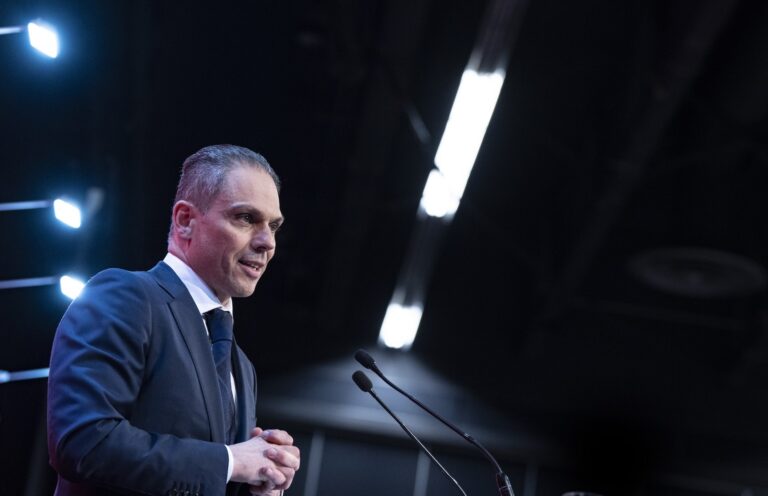
Tiff Macklem at the Bonaventure Hotel in Montreal in February 2024. Late in an eventful term as governor of the Bank of Canada, he must now help the country survive a trade war. Photo: Nasuna Stuart-Ulin for The Logic
One of Bank of Canada governor Tiff Macklem’s favourite books is Lords of Finance: The Bankers Who Broke the World, by Liaquat Ahamed, who contends that few deserve more blame for the worst economic calamity in modern history than the central bankers who stood back and let it happen.
“The Great Depression was not some act of God or the result of some deep-rooted contradictions of capitalism but the direct result of a series of misjudgments by economic policy makers,” Ahamed wrote in his epilogue.
Imagine going to work every day with that in the back of your mind.
Macklem probably has had to make more consequential decisions than any Canadian central banker in history. He began his tenure in the middle of the COVID-19 crisis, then fought off the worst bout of inflation since the early 1980s. Now, with two years of his seven-year term remaining, Macklem must return to the front for an economic war with U.S. President Donald Trump.
Related Articles


Macklem’s first opportunity to engage comes Wednesday, when the Bank of Canada publishes its next interest-rate update. The central bank probably will cut borrowing costs again, but that decision won’t be as easy as it might seem.
After Macklem cut interest rates for the sixth straight time in January, there was a sense that it was time for a pause. Those cuts had dropped the benchmark rate by two percentage points, a significant amount of stimulus in a relatively short period of time.
Recent releases by Statistics Canada show the cuts were working. Gross domestic product grew at an annual rate of 2.6 per cent in the fourth quarter, much faster than policymakers were expecting. Exports and imports surged in January, as companies hedged against Trump’s tariff threats by stockpiling. Even labour productivity showed signs of life. The economy had built up some momentum.
Faster growth naturally generates price pressures. Headline inflation has been hovering in the two-per-cent target range since August, but the “core” measures that policymakers use to separate signal from noise have gotten stuck at the high end of the central bank’s comfort zone of one to three per cent. That’s a reason to tap the brakes.
“Remaining stickiness to core inflation could still give BoC officials pause given factors like a much weaker Canadian dollar,” Citibank economist Veronica Clark advised her clients on Feb. 18. “We continue to expect officials to skip a rate cut in March before resuming cuts again in April.”
Clark’s instinct was correct. The latest monthly survey of small business sentiment by the Canadian Federation of Independent Business found that respondents planned to increase prices by an average 3.1 per cent over the next 12 months, the highest since April 2024. Inflation has been tamed, but maybe not contained. Yet Clark recently changed her mind and now predicts a quarter-point cut on Wednesday, followed by more cuts later this year. “The March BoC decision is all about tariffs,” she and a colleague wrote in a note on Friday.
The mood was dark when the Bank of Canada last met at the end of January. This week it turned grave, as Prime Minister Justin Trudeau said explicitly that he thought Trump was trying to orchestrate the collapse of the Canadian economy in order to make his “51st state” memes a reality.
Canada’s political leaders signalled the seriousness with which they are taking the situation by rushing to sweep away internal trade barriers that have impeded commerce for decades. These examples of micro-protectionism had been in plain view for so long that doing something about them had become a joke. Like Trump’s constant trolling about annexation, leading a country where it’s easier to trade abroad than within its own borders has stopped being funny. For the first time since the 1990s, when governments were forced to confront their budget deficits, the country is united in its willingness to make difficult decisions to generate economic growth.
Given the national mood, it would be difficult for the Bank of Canada to do nothing. Statistics Canada reported Friday that hiring stalled in February, leaving the jobless rate unchanged at 6.6 per cent—not terrible given all that the economy has been through over the past few years, but considerably higher than the monthly average of 5.7 per cent in 2019. Investment in machinery and equipment fell 2.1 per cent in 2024, another sign of strain.
Now that the trade war is on, it makes sense to pull forward any rate cuts that the Bank of Canada might have assumed would be needed later in the year. The more difficult choice facing Macklem could be whether to go big. To move the needle, the Bank of Canada would have to surprise bond traders with a half-point cut, as most already assume the policy rate will either drop by a quarter-point or remain unchanged in the short term.
“What you need is deeper, faster cuts to surprise the markets to the positive and to drive down that yield curve,” Adrian Rocca, founder and chief executive of Fitzrovia, a Toronto-based builder of rental housing, said in an interview after the Bank of Canada’s January decision. That quarter-point cut was “in line with expectations, which really doesn’t change anything,” he said.
Macklem has gone out of his way to signal to finance ministers and executives that they shouldn’t rely on him to be the one to change things this time. Tit-for-tat tariffs will be both inflationary and deflationary, jamming the Bank of Canada’s room to maneuver. He has little choice but to move carefully.
A quarter-point cut is probably the best the central bank can do this time, considering inflation continues to smoulder. That could disappoint some people, but the stronger growth at the end of 2024 and a weaker exchange rate suggest the economy has some cushion for the first phase of the trade war. If things take a turn for the worse, Macklem’s reading of history will guide him on what to do.
Kevin Carmichael is The Logic’s economics columnist and editor-at-large. He has spent more than two decades covering economics, business and finance for outlets including Bloomberg News, The Globe and Mail and the Financial Post, where he also served as editor-in-chief.



Loading...
Thanks for sharing!
You have shared 5 articles this month and reached the maximum amount of shares available.
CloseThis account has reached its share limit.
If you would like to purchase a sharing license please contact The Logic support at [email protected].
CloseGift the full article!
You have gifted 0 article(s) this month and have 5 remaining.
Recipients will be able to read the full text of the article after submitting their email address. They will not have access to other articles or subscriber benefits.
Photo: Nasuna Stuart-Ulin for The Logic
Most Popular This Week




In-depth, agenda-setting reporting
Great journalism delivered straight to your inbox.
News
National Bank CEO warns AI alone won’t give banks a lasting edge
Briefing
Canada and Ontario commit over $5B to support tariff-hit steel sector
Hackers will see cars as major targets in next 3 years, 83% of car-tech workers say
EA shutting down Edmonton studio BioWare
Best business newsletter in Canada
Get up to speed in minutes with insights and analysis on the most important stories of the day, every weekday.
Exclusive events
See the bigger picture with reporters and industry experts in subscriber-exclusive events.
Membership in The Logic Council
Membership provides access to our popular Slack channel, participation in subscriber surveys and invitations to exclusive events with our journalists and special guests.





