Stephen Poloz is back. Finance Minister Chrystia Freeland’s budget said the former Bank of Canada governor will lead a working group that will “explore how to catalyze greater domestic investment opportunities for Canadian pension funds,” suggesting the government has decided to control—for now—the impulse to direct federally regulated pension funds to invest more of their treasure at home.
Skip to content


Commentary
Carmichael: Poloz to safeguard Canada’s pensions from one of the great economic threats of our time
Canada might need trillions in investment, but budget opens door to decisions driven by politics
Former Bank of Canada governor Stephen Poloz will lead a working group to explore how Canadian pension funds can potentially increase domestic investments. Photo: The Canadian Press/Adrian Wyld
Stephen Poloz is back. Finance Minister Chrystia Freeland’s budget said the former Bank of Canada governor will lead a working group that will “explore how to catalyze greater domestic investment opportunities for Canadian pension funds,” suggesting the government has decided to control—for now—the impulse to direct federally regulated pension funds to invest more of their treasure at home.
That idea has generated a surprising amount of heat, both positive and negative, reflecting an aging society’s sensitivity about its pension contributions being used for political ends. It also underscores a desperate need to do something about chronically weak private-sector investment in infrastructure, research and development, and intellectual property.
“The government believes that encouraging the pension funds to invest in Canada would help grow the Canadian economy and provide stable long-term returns needed to deliver strong pensions for Canadians,” the budget said.
Still, Freeland appears to have heard the counter-argument—that there’s a dearth of opportunities in Canada that match the long-term payoffs the pension funds can find globally. Poloz’s group will explore what’s stopping the funds from deploying money in things like digital infrastructure and AI; physical infrastructure; airports; venture capital; building more homes; and removing rules that bar funds from owning more than 30 per cent of a company. It’s due to report its recommendations by the end of the summer.
The budget also revealed that the transport minister will release a “policy statement” this summer that “highlights existing flexibilities” that could allow for more investment in the federally owned airports. It’s a potentially lucrative source of revenue for the government, and the kind of asset that pension funds like to add to their portfolios because they offer predictable returns over a long period of time.
Read more from Federal Budget 2024

So, it looks like it will be Poloz’s job to protect Canada’s highly regarded public pensions from one the biggest macroeconomic threats of our age: political polarization.
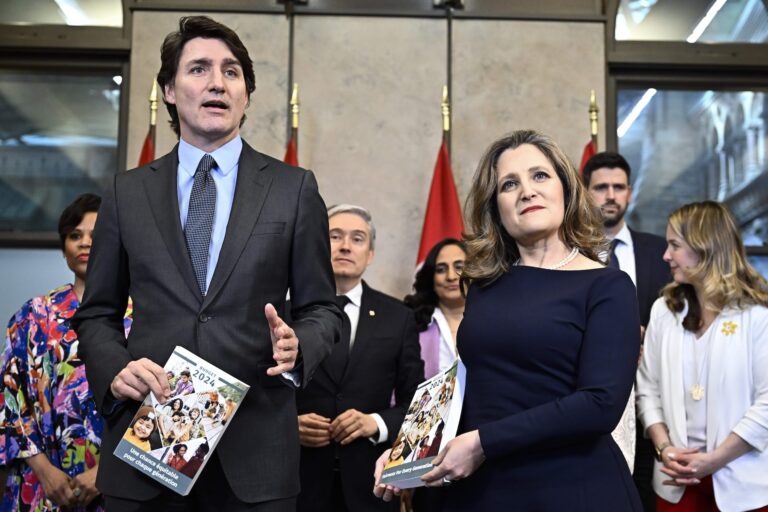
Freeland’s budget is a mish-mash of policies that could help address what are perhaps the most pressing issues the economy faces, and others that are designed to excite narrow blocks of the electorate that the Liberals hope will be enough to cobble together a fourth victory when its current term runs out next year.
The risk is the policies driven by politics outweigh the good stuff. It’s far from an ideal way to make economic policy, and it could hinder Canada’s ability to set itself up for a future dominated by climate change, artificial intelligence and a wave of geopolitical threats.
Poloz will understand all of this. He identified the politics of extreme inequality as one of the tectonic forces that will reshape the world in his award-winning book, The Next Age of Uncertainty. Poloz argued that the wide gap that opened up between the ultra-rich and everyone else would dictate electoral outcomes going forward. The ascent of Pierre Poilievre proves the point, as the Conservative leader has surged to the top of opinion polls by campaigning against the political and corporate elite.
It’s no longer just the Conservatives who see a path to victory by dividing the electorate into in-groups and out-groups. The biggest surprise in the budget was Freeland’s plan to tax the rich by raising the rate on capital gains earned above $250,000 a year from 50 per cent to two-thirds.
The government estimated the change will generate $19.3 billion through 2029, revenue that will help Freeland fulfill her promise to keep the deficit at around one per cent of gross domestic product and the debt-to-GDP ratio on a downward track. All things equal, that means federal spending won’t be a source of new inflationary pressure, which could make it easier for the Bank of Canada to cut interest rates as soon as June.
Related Articles
But keeping the finances in order wasn’t the government’s primary aim. The tax increase was framed not as a means to raise revenue, but as a levelling device that will bring “fairness” to an economy that favours those who have benefited a couple of decades of surging asset markets.
“By increasing the capital gains inclusion rate, we will tackle one of the most regressive elements in Canada’s tax system,” the budget said. “Our government is proud to be reducing this inequity.”
The measure works as a leveller, but at what cost? Raiding the pension funds for domestic investment might be misguided, but there’s no denying that Canada will need trillions of dollars to plug the housing shortfall, adapt to climate change and take advantage of the positives that come with technological disruption. The richest Canadians could help that, yet curbing what they can earn by deploying their wealth in the country will create an incentive for them to find ways to avoid the new measures.
“We thought very, very carefully about the investment climate,” Freeland told reporters before delivering her budget speech Tuesday. “I am confident that the measure we are putting forward today will not have a negative effect on business certainty, on business investment.”
It could have been worse. There was talk the government was considering a broad wealth tax. The budget includes a slew of measures that could offset the capital gains increase, including a couple of measures the government said would reduce capital gains taxes on as much as $3.25 million for entrepreneurs when they sell all or part of their businesses. The sale of a primary residence will remain exempt, because “this is central to the promise of Canada,” according to the budget.
Another central promise of Canada was moderate politics that allowed for cross-party consensus on difficult issues. The country spent a couple of weeks reflecting on this after Brian Mulroney died last month. But those days are gone. Freeland’s budget shows that politics will make an uncertain future even more so.
Kevin Carmichael is The Logic’s economics columnist and editor-at-large. He has spent more than two decades covering economics, business and finance for outlets including Bloomberg News, The Globe and Mail and the Financial Post, where he also served as editor-in-chief.



Loading...
Thanks for sharing!
You have shared 5 articles this month and reached the maximum amount of shares available.
CloseThis account has reached its share limit.
If you would like to purchase a sharing license please contact The Logic support at [email protected].
CloseGift the full article!
You have gifted 0 article(s) this month and have 5 remaining.
Recipients will be able to read the full text of the article after submitting their email address. They will not have access to other articles or subscriber benefits.
Photo: The Canadian Press/Adrian Wyld
Most Popular This Week




In-depth, agenda-setting reporting
Great journalism delivered straight to your inbox.
News
RBC’s AI chief sounds the alarm over AI agents
Briefing
Canada and Ontario commit over $5B to support tariff-hit steel sector
Hackers will see cars as major targets in next 3 years, 83% of car-tech workers say
EA shutting down Edmonton studio BioWare
Best business newsletter in Canada
Get up to speed in minutes with insights and analysis on the most important stories of the day, every weekday.
Exclusive events
See the bigger picture with reporters and industry experts in subscriber-exclusive events.
Membership in The Logic Council
Membership provides access to our popular Slack channel, participation in subscriber surveys and invitations to exclusive events with our journalists and special guests.







