Donald Trump’s stats page at World Wrestling Entertainment’s website lists the following as his career highlights: former owner of Monday Night Raw (one of the company’s television shows); 2013 inductee into the WWE Hall of Fame; and 45th president of the United States. The tally is missing some other accomplishments, such as Trump’s “Battle of the Billionaires” with WWE co-founder Vince McMahon, not to mention his return to the White House this year as the 47th president of the United States.
Skip to content

Commentary
Carmichael: Economics can’t explain Trump. Professional wrestling can
Like the WWE, the U.S. president is a master of directing the power of the crowd
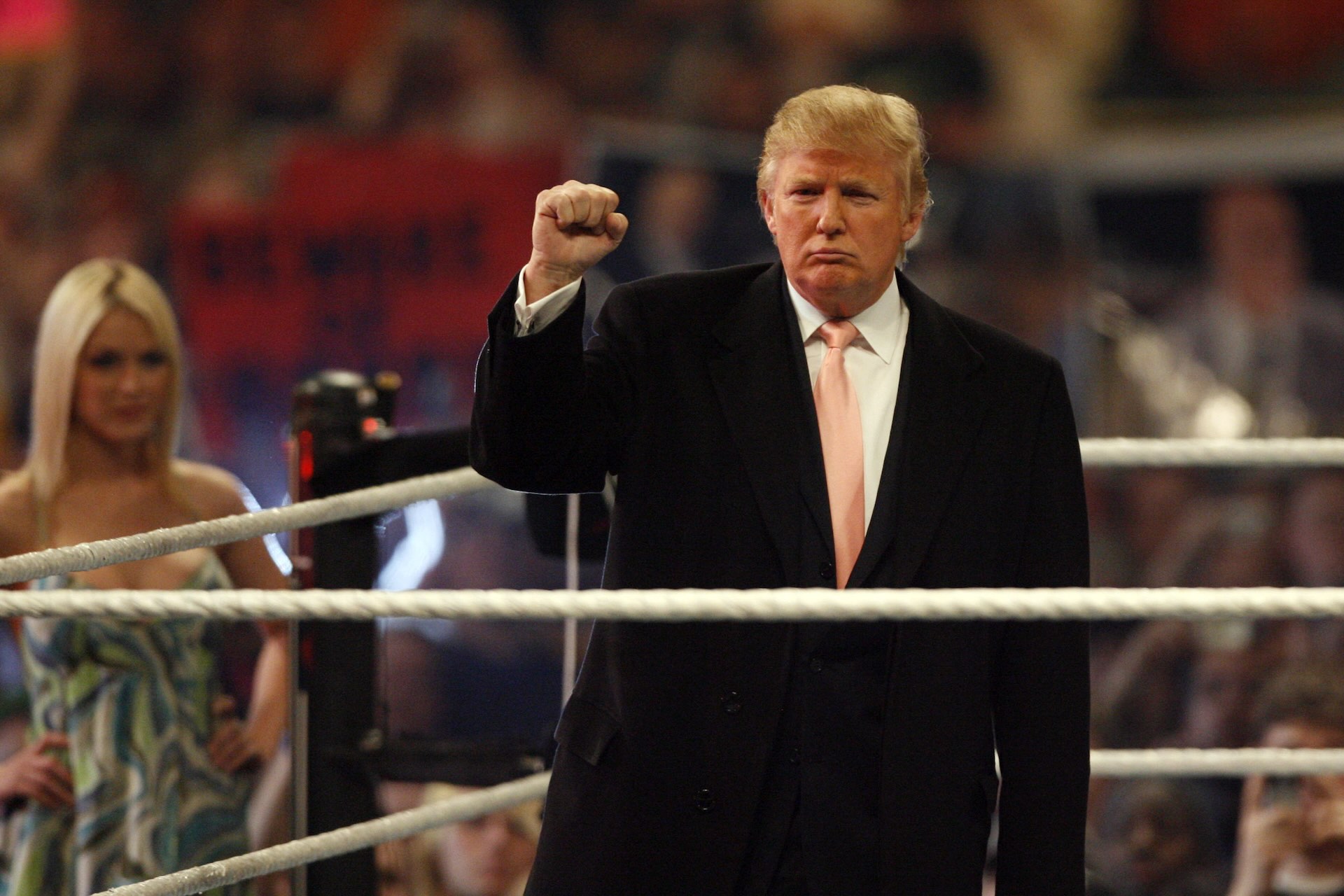
Donald Trump in the ring before he wrestled Vince McMahon in the "Hair vs. Hair" match, part of WWE’s WrestleMania 23 at Ford Field in Detroit, Michigan on April 1, 2007. Photo: WireImage/Leon Halip
Donald Trump’s stats page at World Wrestling Entertainment’s website lists the following as his career highlights: former owner of Monday Night Raw (one of the company’s television shows); 2013 inductee into the WWE Hall of Fame; and 45th president of the United States. The tally is missing some other accomplishments, such as Trump’s “Battle of the Billionaires” with WWE co-founder Vince McMahon, not to mention his return to the White House this year as the 47th president of the United States.
Relevance at this moment of extreme economic and financial dread? Music producer Rick Rubin characterizes pro wrestling as truer than non-fiction because everyone knows it’s fake. I wonder if that insight might also help understand Trump, a real president who nonetheless operates in ways that defy what the history books tell us about how presidents behave.
Most everything Trump is doing is about power, a subject about which economics has little to say. But other domains know quite a lot about power, including entertainment. And in the world of entertainment, few understand how to direct the power of the crowd better than those in professional wrestling—especially WWE, which last year sold the rights to most of its live programming for US$5 billion.
Related Articles
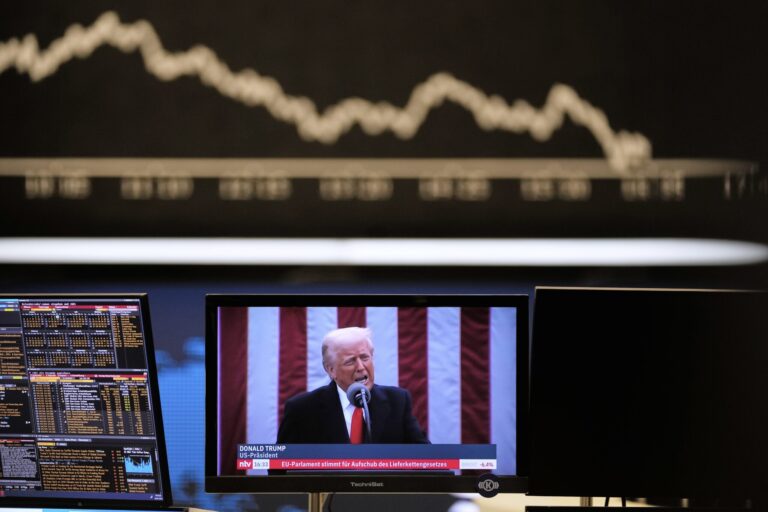

The first couple of posts I saw on LinkedIn on Thursday morning were from economists trying to make sense of the math the Trump administration used as a basis for America’s liberation from all of us insufficiently awed Lilliputians. The first headline I saw heralded the end of the current era of globalization. There were numerous allusions to the Smoot-Hawley tariffs that deepened the Great Depression.
All helpful for theoretical conversations about where this could lead, but less helpful in thinking about whether there’s anything to be done. Seeking rational frames for irrational actors can only lead to more misjudgements, such as the assumption that Trump’s tariff threats were a ploy and not a plan. It might even perpetuate the normalization of what Trump is doing, the “sanewashing” that some have begun to complain about.
Correcting Trump’s absurd math doesn’t matter when the entire project is absurd. Nor is it useful to fret about the sudden end of an era of commercial arrangements that ended years ago, when notions such as “reshoring” and “friendshoring” were introduced to the lexicon. If liberal democracies such as Canada disliked the direction of travel, they could have made a greater fuss over former president Joe Biden’s use of tariffs, sanctions and subsidies to bend the global economy to the U.S.’s liking. They didn’t, which allowed Trump to bring his “tariff policy in through a wide open door,” economist Dan Ciuriak wrote in a paper on the trade war last month.
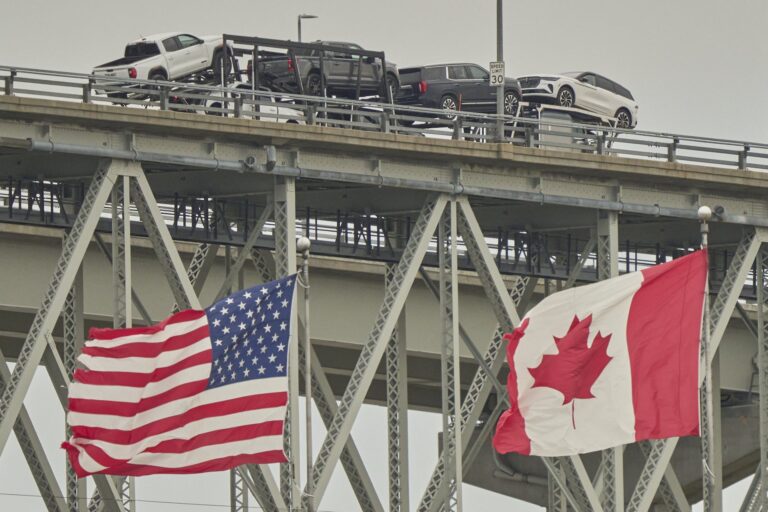
Distance and greater trade diversification give Asians and Europeans a little more time to search for the organizing principle behind Trump’s trade policy. For Canada, time’s up. Canadian employment fell in March for the first time in more than two years, a harbinger of what’s to come, since there’s no reason to believe Trump intends to end his economic war anytime soon. The paralyzing uncertainty would persist even if he did.
That means we need to adopt a mental model that helps process Trump’s yo-yo economics without wasting time on ephemera. And while the president’s motivations are a mystery, the source of his power isn’t. Like all populists, it’s the audience. The oath of office bestowed Trump with the authority to wreak havoc, but the extent to which he keeps it up could hinge on whether his fans continue to enjoy the show.
WWE presaged America’s turn towards an angry form of populism in the mid-1990s, when audiences turned against the company-anointed “good guys” and started cheering for the “bad guys.” This was the era when Trump emerged as an occasional star of the show. He would have sensed what philosopher Douglas Edwards described in his book Philosophy Smackdown as a desire for authenticity, manufactured or otherwise.
Trump’s early attacks on Canada and Mexico followed a classic pro-wrestling pattern. The main protagonists always vanquish lesser talents on their path to a clash with their arch rivals, something to watch for free ahead of the live pay-per-view extravaganza.
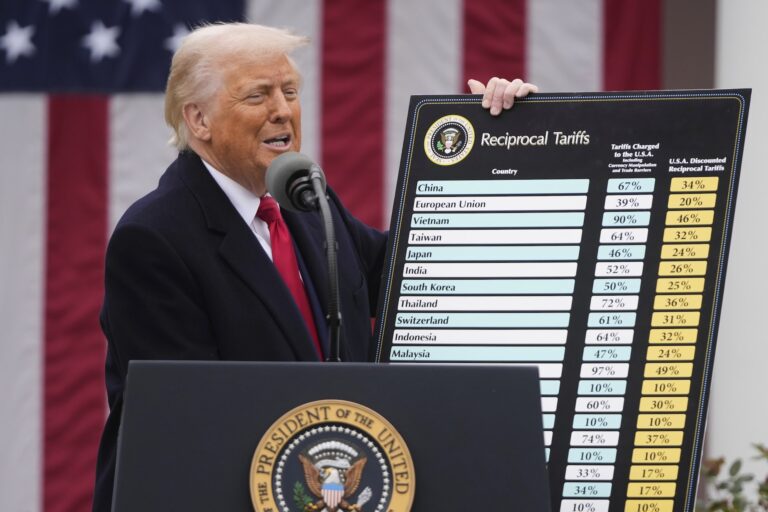
All those impromptu press scrums that Trump performs from the White House and Air Force One mirror pro wrestling’s use of “promos” to keep stories going between the actual matches. “Liberation Day,” with its over-the-top charts and staging in the Rose Garden, was the sort of spectacle that monarchs and promoters have used to channel the authority of the masses for ages.
Image and spectacle are so powerful that Robert Greene, author of The 48 Laws of Power, says there is no way to reverse the power of those who wield them. If that’s true, then what can Mark Carney, Pierre Poilievre or anyone else do to change the country’s fortunes?
Maybe nothing, which is why economist Ciuriak proposes a range of outside-the-box policies meant to restore some measure of economic independence, ranging from erasing internal trade barriers, to building trade corridors, to nationalizing the Hudson’s Bay Company and turning it into a modern digital retailer that could batter Amazon.
The other thing Canada can do is think like a pro wrestler. Canada’s current electoral drama has featured some interesting cameos. Jon Stewart. Jordan Peterson. Mike Myers. Caroline, Mark and Ben Mulroney. I find myself thinking about Rami Sebei, a Montrealer who currently wrestles in the WWE as the character Sami Zayn.
Current WWE culture is different from the one Trump knew. Reality and fiction blur by design. This gives the audience as much power over stories as the scriptwriters. Zayn, a typical scrappy underdog character, was given a secondary role as part of a larger story. Sebei performed his character so well that the audience propelled him into a championship match. That wasn’t the plan, but the WWE has learned that its power as a multibillion-dollar media brand rests with keeping the audience happy.
Same with Trump. You won’t beat him with facts and arguments. Nor will make quick concessions; that just makes you a jobber, a head on which to walk on the way to the main event. You beat Trump by remembering that Americans can’t resist an underdog story.
Kevin Carmichael is The Logic’s economics columnist and editor-at-large. He has spent more than two decades covering economics, business and finance for outlets including Bloomberg News, The Globe and Mail and the Financial Post, where he also served as editor-in-chief.



Loading...
Thanks for sharing!
You have shared 5 articles this month and reached the maximum amount of shares available.
CloseThis account has reached its share limit.
If you would like to purchase a sharing license please contact The Logic support at [email protected].
CloseGift the full article!
You have gifted 0 article(s) this month and have 5 remaining.
Recipients will be able to read the full text of the article after submitting their email address. They will not have access to other articles or subscriber benefits.
Photo: WireImage/Leon Halip
Most Popular This Week



In-depth, agenda-setting reporting
Great journalism delivered straight to your inbox.
The Big Read
Beacon is building an AI empire by fixing Main Street’s software
Briefing
Inovia raises US$200M for new VC fund as it eyes AI’s impact
43% of eligible Albertans voted ahead of Monday’s referendum
AI chip company Tenstorrent raises US$1.5B, valuing it at US$6.2B
Best business newsletter in Canada
Get up to speed in minutes with insights and analysis on the most important stories of the day, every weekday.
Exclusive events
See the bigger picture with reporters and industry experts in subscriber-exclusive events.
Membership in The Logic Council
Membership provides access to our popular Slack channel, participation in subscriber surveys and invitations to exclusive events with our journalists and special guests.







