Hudson’s Bay workers at the Mayflower Mall in Sydney, N.S., found themselves locked out of the department store when they turned up for work last Friday morning.
Skip to content


News
The collapse of Hudson’s Bay will hit small-town Canada hard
For small-town malls, where the Bay has been an anchor tenant for decades, finding a replacement is likely to be fiendishly difficult
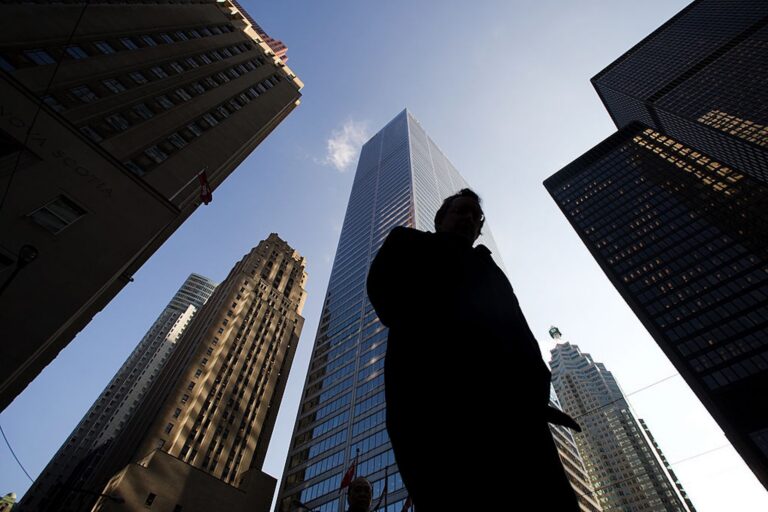
After 355 years doing business, the Bay is on the brink of insolvency. Its locations in small-town malls across Canada could be the first to close as it looks to dramatically cut costs. Photo: The Canadian Press/Nathan Denette
Hudson’s Bay workers at the Mayflower Mall in Sydney, N.S., found themselves locked out of the department store when they turned up for work last Friday morning.
The company hadn’t paid rent for February and March, and the missed payments from the mall’s biggest tenant were weighing on the landlord. Shortchanged, the small-town mall terminated the Bay’s lease, in a move that would end a near-45-year relationship with the iconic Canadian retailer. Hours later, Hudson’s Bay declared insolvency.
Talking Points
- Hudson’s Bay is expected to close about half of its 80 stores in Canada as the iconic retailer tries to claw its way out of insolvency
- While some landlords may view the Bay’s closure as an opportunity to replace the department store with higher-traffic tenants, small-town malls may struggle to fill the void
Mayflower Mall is one of more than a dozen small-town shopping centres in Canada that count Hudson’s Bay as an anchor tenant. As the 355-year-old retailer fights for its life in bankruptcy court, the future of these malls is in jeopardy.
Insolvency records show that Huduson’s Bay owes $1.13 billion in total debt with just $3 million in cash on hand, as of Jan. 1. An Ontario Superior Court judge has granted the company temporary protection from debt holders including Mayflower’s owner HOOPP Realty Inc., preventing them from taking legal action against it while it restructures the business.
The order forced the Mayflower to reinstate the company’s lease. But the mall’s property manager isn’t sure how long the relationship will last—or what’s next for the mall if the Bay leaves for good.
“It’s a big deal,” said William Correia, director of operations in Eastern Canada for McCor Management, Mayflower’s property manager. “The Bay is an important partner for us, and especially at this location.”
Related Articles

Hudson’s Bay is expected to shutter about half of its 80 stores in Canada as it tries to overcome its liquidity crisis. The company hasn’t said which locations it plans to close, and didn’t respond to The Logic’s questions about the possible closures—but commercial real estate experts say small-town malls like the Mayflower may have the most to lose if Hudson’s Bay disappears.
Hudson’s Bay is well represented at small-town malls across Canada. It has 17 stores in towns with fewer than 100,000 people, including in Rosemère, Que., Langley, B.C., and Medicine Hat, Alta. The company hasn’t said whether these locations are at higher risk of closing, but their chances of thriving without Canada’s oldest retailer may be slimmer than malls in urban centres.
For decades, the Bay has been a familiar anchor tenant at malls across Canada. But the department store has become less of a draw for customers, as shopping habits shift, said Kris Mutcher, a Colliers vice-president specializing in retail real estate in Winnipeg. “We’re looking at a 50-year-old concept of how those malls were constructed and how people interacted with them,” he said. “The department store model is broken.”
The problem is, many small-town malls were basically built around big department stores—and the Bay is one of the last ones standing. As a result, Correia said it’s unlikely the Mayflower will find a single large tenant to replace it. “I don’t think there are too many left that can take over that much space,” he said. Instead, the mall could try and strike deals with smaller stores and non-retail tenants like restaurants or offices. “We’ll look at the opportunity to redevelop that space that’s going to be attractive for our customers and for the community,” he said.
Mutcher said some mall landlords may welcome the chance to end long-term leases with low-traffic Hudson’s Bay stores and replace them with a mix of more popular retailers or non-retail tenants such as cinemas, or even residential and office space, he said.
When Sears closed shop in 2017, many malls in Canada filled the vacant space with cinemas, fitness centres and smaller retailers like SportChek and Mark’s. Others chose to find new department store tenants, like Nordstrom and Hudson’s Bay-owned Saks Fifth Avenue.
That was 2017. In 2025, Mutcher said, there are fewer and fewer options available to fill the spaces the Bay will leave behind in small-town Canada.
Nordstrom, for example, has left Canada entirely, and Saks appears on its way out. Meanwhile, smaller tenants that filled space vacated by Sears are unlikely to bid again to fill the void left by the Bay. “Many of those deals have been exhausted,” Mutcher said. “If you’ve already done a large-scale fitness user in your Sears box, you’re not going to do another one at the other end of your mall in the Bay.”
Small-town malls may be especially hard-pressed to find replacement tenants for Hudson’s Bay. While Mutcher said shoppers are now drawn to malls for popular stores like Apple and Lululemon, those retailers are unlikely to set up shop in low-population towns that Hudson’s Bay has continued to serve. “They’re in for some trouble if the Bay chooses to close those stores,” he said.
For years after Sears’ bankruptcy, many suburban malls struggled to fill the empty space the department store left behind. It took nearly six years for Georgian Mall in Barrie, Ont., to reopen the space as a HomeSense, and the former Sears at Lime Ridge Mall in Hamilton is still awaiting demolition to eventually be redeveloped.
“This is an iconic brand for our country,” said Mutcher. “There’s a lot of people pulling to find a way to come out of this. But it’s going to be a lot of work and a long time to reimagine some of these spaces.”



Loading...
Thanks for sharing!
You have shared 5 articles this month and reached the maximum amount of shares available.
CloseThis account has reached its share limit.
If you would like to purchase a sharing license please contact The Logic support at [email protected].
CloseGift the full article!
You have gifted 0 article(s) this month and have 5 remaining.
Recipients will be able to read the full text of the article after submitting their email address. They will not have access to other articles or subscriber benefits.
Photo: The Canadian Press/Nathan Denette
Most Popular This Week




In-depth, agenda-setting reporting
Great journalism delivered straight to your inbox.
News
AI could help invent new materials. First, firms must figure out how to make them
Briefing
Canada and Japan urged to modernize double taxation deal
Defence Investment Agency to be a Crown corporation so it can get deeper into Canada’s military industry
Mark Carney says he’ll work with Quebec separatist premier-to-be on housing, infrastructure, big projects
Best business newsletter in Canada
Get up to speed in minutes with insights and analysis on the most important stories of the day, every weekday.
Exclusive events
See the bigger picture with reporters and industry experts in subscriber-exclusive events.
Membership in The Logic Council
Membership provides access to our popular Slack channel, participation in subscriber surveys and invitations to exclusive events with our journalists and special guests.