A decline in spending by large and foreign firms dragged down investment levels in Canada over a decade and a half, according to a Statistics Canada study that provides new insights into the country’s productivity problem.
Skip to content


News
Big, foreign firms cut business investment the most, new data shows
Investment per worker fell nearly 20% between 2006 to 2021, according to Statistics Canada
In 2006, companies invested $3,573 per worker on buildings, machinery, intellectual property and other assets. By 2021, that figure was nearly 20 per cent lower. Photo: The Canadian Press/Andrew Lahodynskyj
A decline in spending by large and foreign firms dragged down investment levels in Canada over a decade and a half, according to a Statistics Canada study that provides new insights into the country’s productivity problem.
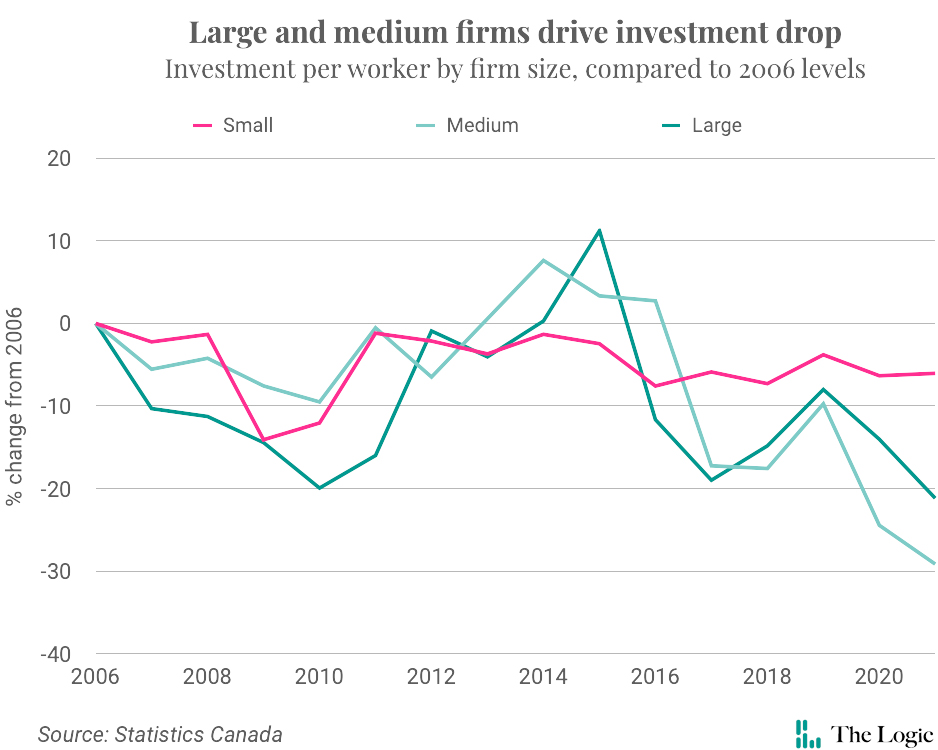
The topline: In 2006, companies invested $3,573 per worker on buildings, machinery, intellectual property and other assets, the study found. By 2021, that figure was $628.80 lower, or nearly 20 per cent.
The bigger they are: Large firms employ over a third of all workers, and invest the most. So their cutbacks over the 15-year span had larger impacts, making up 70 per cent of the drop. Mid-sized firms accounted for another 22 per cent. Foreign-controlled firms also invested less than ones headquartered here; the StatCan authors noted that resource-sector reductions in response to plummeting commodity prices might explain both trends.
In recent weeks, Finance Minister Chrystia Freeland has called for firms to put more money into the economy, touting the recent inflow of foreign direct investment. “We’d like to see more Canadian businesses investing more in Canada,” she said earlier this month. Business Council of Canada CEO Goldy Hyder fired back that Ottawa needs to first take down regulatory barriers.
Related Articles


Money for nothing (tangible): When firms did invest, they put more of their money into assets like patents and the value of their brands. In 2021, intangibles accounted for 17.3 per cent of companies’ balance sheet assets, up from 8.4 per cent in 2006.
Foreign firms led the way in boosting spending on intangibles. Internationally held companies grew such assets from 10.7 per cent to 26.4 per cent of their total over the 15-year span, while domestic ones only jumped from 7.8 per cent to 14.4 per cent. Some innovation-economy executives argue that kind of investment doesn’t deliver the same spinoff benefits to the Canadian economy that, say, a foreign firm building a factory here would.
What’s next: Investment intentions are on the decline. Desjardins chief economist Jimmy Jean expects 2024 to be “a pretty sluggish year,” as businesses worry about consumer spending and rate hikes. While policymakers are expressing a sense of urgency to boost productivity growth, it’s been a “serial disappointment over many decades,” he said, suggesting governments give firms more clarity on energy-transition incentives and address interprovincial trade barriers.



Loading...
Thanks for sharing!
You have shared 5 articles this month and reached the maximum amount of shares available.
CloseThis account has reached its share limit.
If you would like to purchase a sharing license please contact The Logic support at [email protected].
CloseGift the full article!
You have gifted 0 article(s) this month and have 5 remaining.
Recipients will be able to read the full text of the article after submitting their email address. They will not have access to other articles or subscriber benefits.
Photo: The Canadian Press/Andrew Lahodynskyj
Most Popular This Week




In-depth, agenda-setting reporting
Great journalism delivered straight to your inbox.
Commentary
Carmichael: Canadian ignorance about India is a strategic weakness
Briefing
Aritzia shares pop after earnings rise 204%
First Nation in Alberta goes to court over fast-tracked oil pipeline
Chinese EV maker Geely Auto Group to launch in Canadian market in 2027
Best business newsletter in Canada
Get up to speed in minutes with insights and analysis on the most important stories of the day, every weekday.
Exclusive events
See the bigger picture with reporters and industry experts in subscriber-exclusive events.
Membership in The Logic Council
Membership provides access to our popular Slack channel, participation in subscriber surveys and invitations to exclusive events with our journalists and special guests.





