Listen Now
0:00
HOUSTON — At the end of day two of CERAWeek, the annual global energy jamboree hosted by S&P Global, a Canadian could have grabbed a free drink courtesy of Cheniere Energy and contemplated what might have been.
Houston-based Cheniere hosted a reception to mark the 10th anniversary of its first international shipment of liquefied natural gas, which was also the U.S.’s first export of LNG. It’s an extraordinary achievement, one that deserved commemoration better than the mediocre wine and mushy jambalaya on offer.
Related Articles

“American LNG has transformed the global economy,” Chris Wright, the U.S. energy secretary and a former shale oil executive, said while introducing Cheniere CEO Jack Fusco.
Before Cheniere turned to LNG, the U.S. was “building gas pipelines from Canada,” along with import terminals, in anticipation of remaining a net importer. Now, U.S. exports of natural gas are the only reason countries in Asia and Europe aren’t entirely at the mercy of Russia, or facing more severe shocks from instability in the Middle East. “We needed bold and entrepreneurial businesses to make that happen,” Wright said.
Cheniere’s pivot dates to 2010. That’s roughly when the world was waking up to the possibility that Asia was on a trajectory that would leave its fast-growing countries desperate for energy. The U.S. shale boom was underway. In 2014, the International Monetary Fund called natural gas the “new gold.” Cheniere was well on its way to cashing in.
It took Canada longer to join the rush. LNG Canada only delivered its first shipment from Kitimat, B.C., last summer after more than a decade of planning and construction. That delay, and delays to other oil and gas projects, is why there’s a hollowness to the talk of Canada being an energy superpower. It remains an aspirational statement, with little in our recent history to show we can back it up.
Nevertheless, the world might be willing to give us a second chance.
“The world is more open to Canada than any [other] time,” said Mark Maki, chief executive of Trans Mountain, the Crown pipeline company that has altered the trajectory of Canada’s economic growth since it expanded the pipeline sending Alberta oil to the West Coast in the spring of 2024. Refiners in China “love Canadian oil, love Canada,” Maki said. “We hear the same thing from India. They would love more access to Canadian oil.”
There are lots of reasons Canada missed its first chance to matter to the world. The most important one, I think, was that Canada forgot how to talk to itself. An ideologically motivated Conservative government spent the better part of a decade forcing its world view on the country, even though it never won more than 39.6 per cent of the vote. Then, an ideologically motivated Liberal government spent the better part of a decade forcing its world view on the country, even though it never won more than 39.5 per cent of the vote.
A compromise on energy was further complicated by a political and business elite conditioned by a colonial mindset. They initially resisted the cultural and legal shift that empowered First Nations, making progress impossible. (“We weren’t as good as we could be,” Alberta Energy Minister Brian Jean said at one of his public appearances at CERAWeek.) Add Twitter, Facebook, YouTube and TikTok, and you have a political climate hostile to anything harder than a tax cut.
The Canadian headline at CERAWeek was that the politicians are talking to each other again. Alberta Premier Danielle Smith and Natural Resources Minister Tim Hodgson spoke as if they shared a speechwriter. The premiers of Newfoundland and Labrador and Nova Scotia were here, saying similar things. So was Sharleen Gale, executive chair of the board of the First Nations Major Projects Coalition. “The table is set,” said Gale. “It’s just about coming together and collaborating.”
Political consensus is important. It’s why Canada has remained committed to open trade as the U.S. has turned protectionist. A broad agreement on energy should lead to enough policy and regulatory certainty to secure investment and put shovels in the ground. Hodgson went out of his way to remind one of his audiences this week that he, the prime minister, the head of the federal bureaucracy and the prime minister’s chief of staff all have deep experience in business and capital markets. The message was clear: The crusaders have been run out of town. Canada is a serious country again.
However, political consensus on a general approach to things is different from agreement on a strategy. Canada’s pitch this week would have been stronger if Smith and Hodgson actually had a plan to significantly expand current production. Some LNG projects are moving along, but Smith was forced to concede on the first day of CERAWeek that one of the prerequisites for a new pipeline to the West Coast will likely miss its first deadline. The federal government supports it, on the condition that the five members of the Oil Sands Alliance make good on their pledge to build the world’s biggest carbon capture and storage system. The producers insist they will do so only if the federal and provincial governments make it worth their while.
“Where we sit is ‘yes’ to being really responsible, and if that’s doing a carbon capture project around our assets we’ll keep having that discussion,” said Jeff Lawson, an executive vice-president at Cenovus. “But we will never separate that discussion from fixing policy, so we can actually have the growth we want, and making sure the proper incentives are in place to do it so we’re not losing money hand over fist.”
The Alberta energy minister was sitting one seat away as Lawson drew that red line. “If you look at [oil sands companies’] balance sheets over the last three years before we saw these [recent] increases in [oil] prices, you’ll see that they’ve gone from a position that is OK to a position that is incredible,” Jean said. “We are absolutely making sure that it’s competitive, but we also have obligations to the world, and the world is looking at us.”
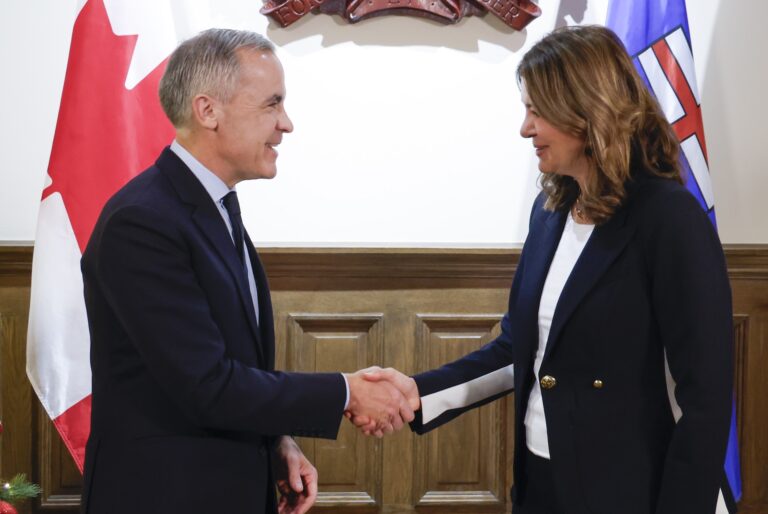
It was fascinating to watch the negotiations between the oilsands companies, Alberta and Ottawa spill into public view. The vibes in Houston suggest the three parties will get things sorted eventually, if only because the stakes are so high. Don’t be surprised if it’s the government that blinks. Carney and Smith might feel obliged to help Canada’s allies secure their supplies of energy. The producers have made it clear that their only obligation is satisfying their shareholders.
Kevin Carmichael is The Logic’s economics columnist and editor-at-large. He has spent more than two decades covering economics, business and finance for outlets including Bloomberg News, The Globe and Mail and the Financial Post, where he also served as editor-in-chief.