Bank of Canada governor Tiff Macklem made it relatively easy to predict when he would start cutting interest rates. He stated his criteria and followed through when all the boxes had been checked. If you got lost, it was mostly your fault.
Skip to content

 Housing related costs such as rent, mortgage rates and housing prices rose 5.3 per cent in August—down from 5.7 per cent in July, but still high. Photo: The Canadian Press/Sean Kilpatrick

Commentary
Carmichael: A rare bull’s-eye on inflation, but cautious Macklem may still be behind the curve
Signs keep piling up that demand is waning
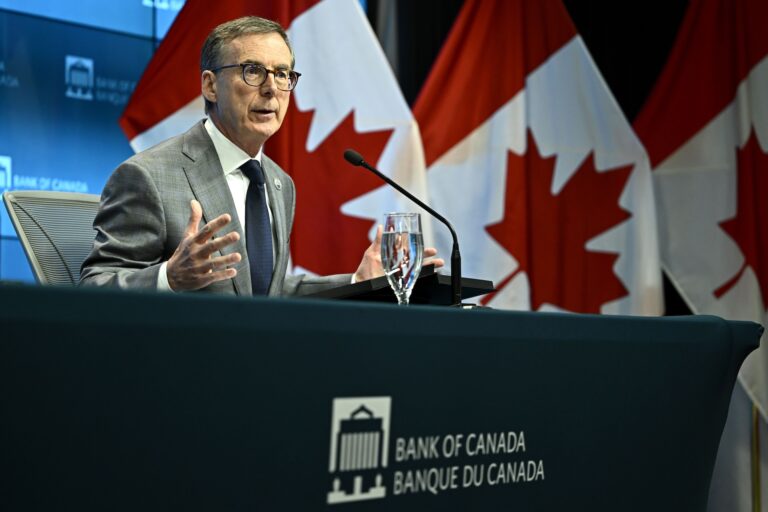
Bank of Canada governor Tiff Macklem at a rate announcement in Ottawa in April 2024. Photo: The Canadian Press/Adrian Wyld
Bank of Canada governor Tiff Macklem made it relatively easy to predict when he would start cutting interest rates. He stated his criteria and followed through when all the boxes had been checked. If you got lost, it was mostly your fault.
Lately, it’s been different. When the central bank cut rates in July, it was vague on how it would proceed. Macklem suggested the bank was inclined to continue pushing rates lower, but he would be making decisions one meeting at a time. The new guidance was more star chart than map. The implication: proceed slowly or risk losing your way in the dark.
A little ambiguity is OK with Andrew Moor, chief executive of Equitable Bank. He’s a fan of Macklem’s work, and he appreciates that after all that we’ve been through, the central bank will want to make certain that inflation has been snuffed out before cutting rates too much.
Related Articles

Traders and analysts disagree over pace, but most see the benchmark rate dropping to about 2.5 per cent by the end of next year, compared with 4.25 per cent currently. Moor can work with that, but he concedes that someone who is considering taking out a loan might see things differently. “Our developer clients would probably be the ones who [would] respond better to … certainty,” he said.
Like other central banks, the Bank of Canada misjudged how much inflation was building through the pandemic, and therefore waited too long to start raising interest rates.
But so far, there have been few obvious missteps in its campaign to get inflation under control. Macklem was more aggressive than many of his peers in raising rates as inflation rose, correctly betting that some pain upfront would allow him to reverse course sooner than he would otherwise. The Bank of Canada was the first major central bank to cut interest rates this year, and the only one to do so three times.
The latest victory came Tuesday, when Statistics Canada reported the consumer price index increased two per cent in August from a year earlier, a sharp drop from 2.5 per cent in July. It was a rare bull’s-eye for policymakers. They raise and lower interest rates to keep year-over-year changes in the consumer price index between one to three per cent. It does that by aiming for the midpoint of that band: two per cent. The latest numbers will help restore the central bank’s reputation—scarred when inflation surged to a peak of 8.1 per cent in June 2022.
“Inflation is now contained,” Brian Yu, chief economist at Central 1, a credit union, said in a note.
Macklem and his deputies probably will resist such definitive statements. Lower gasoline prices, an important but volatile component of the price basket, were responsible for much of the deceleration from July.
Elsewhere, some inflationary fires are still burning. The shelter component—a blend of housing related costs such as rent, mortgage rates and housing prices—rose 5.3 per cent, down from 5.7 per cent in July, but still high. Services increased 4.3 per cent, while goods dropped 0.7 per cent. The Bank of Canada will like seeing inflation at target, but it might not be satisfied. After getting caught flat-footed in 2021, the bar for declaring a final victory will be high.
Inflation’s arrival at target is an example of why the Bank of Canada is so cautious. In July, the central bank predicted inflation was headed back to target, but not until the end of 2025. It’s been a long time since the central bank has had to manage a period of high inflation. That lack of history makes forecasting difficult. This miss was like a lucky bounce. The next one could go the other way.
There’s mounting danger that the Bank of Canada’s caution has left it behind the curve. Weaker economic growth has created deflationary currents that are pushing against upward pressures. Broadly speaking, the prices of many discretionary items have fallen below 2023 levels, signalling weak demand.
Statistics Canada said that if gasoline had been excluded from the index, the increase from a year earlier would have been 2.2 per cent. And if mortgage interest costs had been excluded from the calculation, inflation would have been a mere 1.2 per cent.
There’s little evidence of an inflationary threat in those numbers. Meanwhile, signs that demand is waning keep piling up. Statistics Canada observed that the clothing category typically gains momentum in August as students head back to school. This year, prices dropped for the first time since 1971.
Economists at Desjardins and Citibank were among those predicting the latest inflation reading will force the central bank to cut a half point when it meets on Oct. 23. The possibility certainly will be on the table. One benefit is it would send a signal to Moor’s developer clients—and any other executive who is waiting for interest rates to come all the way down before they start investing—that it’s time to come off the sidelines.
Kevin Carmichael is The Logic’s economics columnist and editor-at-large. He has spent more than two decades covering economics, business and finance for outlets including Bloomberg News, The Globe and Mail and the Financial Post, where he also served as editor-in-chief.



Loading...
Thanks for sharing!
You have shared 5 articles this month and reached the maximum amount of shares available.
CloseThis account has reached its share limit.
If you would like to purchase a sharing license please contact The Logic support at [email protected].
CloseGift the full article!
You have gifted 0 article(s) this month and have 5 remaining.
Recipients will be able to read the full text of the article after submitting their email address. They will not have access to other articles or subscriber benefits.
Photo: The Canadian Press/Adrian Wyld
Housing related costs such as rent, mortgage rates and housing prices rose 5.3 per cent in August—down from 5.7 per cent in July, but still high.
Most Popular This Week




In-depth, agenda-setting reporting
Great journalism delivered straight to your inbox.
News
Canada faces a satellite-launch crunch as SpaceX retires its workhorse rocket
Briefing
Rio Tinto gets nearly $165M in additional federal funds for Quebec aluminum
U.S. to lift tariffs on some Canadian products crucial to Maine: Collins
Carney warns of tech dependence after Starlink disruptions in Ukraine
Best business newsletter in Canada
Get up to speed in minutes with insights and analysis on the most important stories of the day, every weekday.
Exclusive events
See the bigger picture with reporters and industry experts in subscriber-exclusive events.
Membership in The Logic Council
Membership provides access to our popular Slack channel, participation in subscriber surveys and invitations to exclusive events with our journalists and special guests.