With a trade war between Canada and the U.S. apparently imminent, Loblaw chief executive Per Bank quickly declared his willingness to serve.
“Canada has announced retaliatory measures, as it must,” Bank said on LinkedIn after Prime Minister Justin Trudeau announced that Canada would match U.S. President Donald Trump’s tariffs dollar-for-dollar. “Canada must fight hard to protect the interest of all Canadians who have suffered… enough in recent times.”
Trudeau eventually won a 30-day reprieve. But when tensions were at their highest, Bank said Loblaw would be “doubling down” on securing Canadian food, begin looking for alternatives to U.S. products and continue “actively advocating for consumers” with government and industry.
Missing from Bank’s list of commitments was any offer of real sacrifice. The scary thing about tariffs for most people is higher prices. Canadian balance sheets are strong and companies could, in theory, absorb some of the blow. The head of the country’s “largest domestic food purchaser by a large measure” gave no indication he was prepared to do that.
“Economically, we know that tariffs by their very nature are inflationary,” Bank wrote. “Add in the state of the Canadian dollar at the moment, and new tariffs have the potential to put significant pressure on costs, which will ultimately impact consumers directly.”
This column isn’t another drive-by shooting of Loblaw, one of the baddies of the cost-of-living crisis. The “greedflation” narrative is more complicated than the cartoon version perpetuated by NDP Leader Jagmeet Singh and others.
Instead, let’s use Per Bank’s LinkedIn post to think about how Canada’s central bank would confront a trade war. Most of the discussion is about a recession. But inflation is a real threat too, especially since Statistics Canada’s most recent data show there still are some embers glowing.
The summary of deliberations that led to a quarter-point cut on Jan. 29 show Bank of Canada governor Tiff Macklem and his deputies agonized over how they’d respond. They determined the biggest risk to their inflation outlook was the effect of prolonged trade uncertainty on business and consumer confidence. “They discussed this at length,” the summary said.
For the Bank of Canada, “downside risks” are those that could cause it to undershoot its inflation target. The drumbeat of a trade war is almost as bad as the real thing because the uncertainty will either freeze business investment or divert it south of the border. The central bank has already detected evidence of this, anecdotally and in real-time surveys.
“This would likely lead to negative effects on hiring, labour income and household spending,” the summary said. Macklem opted to hedge against that outcome and cut interest rates for the sixth consecutive time. It could be the last relatively easy policy decision Macklem gets to make for a while.
The governor has been going out of his way to dissuade anyone from thinking that he’ll ride to the rescue again this time. The Bank of Canada unloaded its armory during the COVID-19 crisis because global lockdowns would have caused a depression without the offset of fiscal and monetary stimulus. Tariffs could be both deflationary and inflationary. The central bank would have to tread carefully. It certainly won’t be dropping its policy rate to zero.
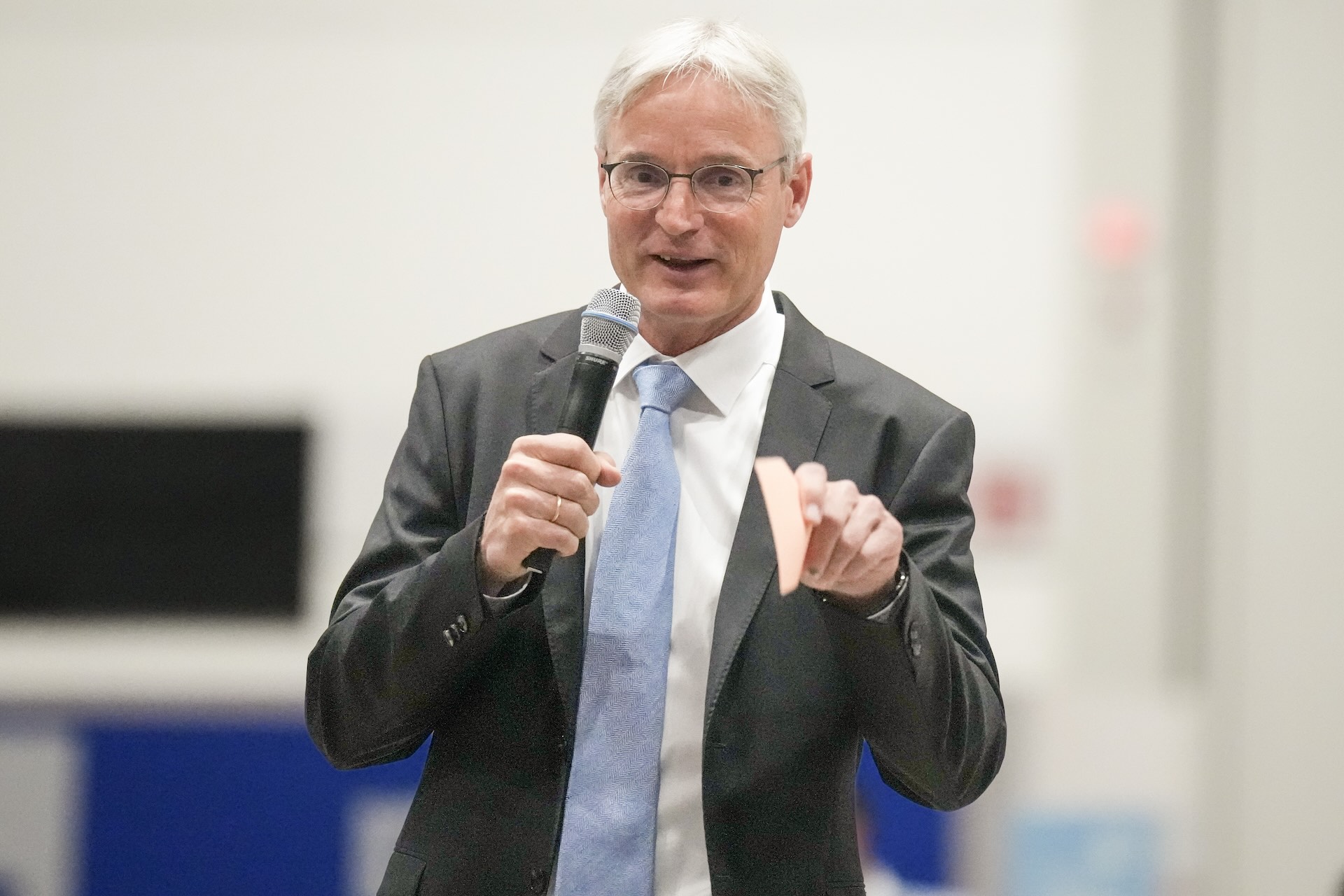
Loblaw CEO Per Bank speaking at the Suppliers Summit in Toronto last May. Photo: The Canadian Press/Chris Young
Per Bank’s description of the inflationary nature of tariffs was a little loose. Tariffs aren’t inherently inflationary, as the Loblaw CEO implied in his post. Border taxes raise the cost of goods and services when they are applied, but that’s a one-time event. Inflation is the rate at which the price level changes, and the rate of change depends on how businesses and consumers respond to the new price.
That’s why the Bank of Canada spends so much time talking about expectations. If households and companies believe inflation will stay at around two per cent, then it probably will. The central bank has successfully leashed inflation after it surged to 8.1 per cent in the summer of 2022. But few have forgotten the cost-of-living shock, which means expectations could be less anchored than they have been in the past. The summary of the central bank’s latest policy discussions shows its leaders are worried a new price shock would cause short-term inflation expectations to jump.
Of course, the prices that households pay are mostly determined by the decisions of companies such as Loblaw. A truly heroic display of patriotism would see corporate leaders pledge to absorb some of those costs. There’s reason to think some could manage it, at least for a little while. Statistics Canada’s most recent data on corporate balance sheets show that aggregate profit margins, as measured by net income’s percentage of total revenue, were 7.1 per cent in the third quarter. The average since the start of 2010 is about six per cent, and margins in 2019 averaged 6.3 per cent.
Alas, the Bank of Canada anticipates no such sacrifice by Canada’s big corporations. During the COVID-19 crisis, some economists thought industry concentration would limit inflation because powerful companies would use their market power to absorb higher costs without raising prices. In Canada, the central bank found that surging inflation made it easier to raise prices, as consumers tended to surrender to the idea that everything was more expensive. “Businesses could quickly pass on higher input costs to their customers,” the summary of deliberations said.
That’s again the most likely scenario. Corporate patriotism has its limits.
Kevin Carmichael is The Logic’s economics columnist and editor-at-large. He has spent more than two decades covering economics, business and finance for outlets including Bloomberg News, The Globe and Mail and the Financial Post, where he also served as editor-in-chief.