Before we get to “Carbon Tax” Carney and Brookfield Asset Management’s proposed superfund, another scoop: federal Liberals and Conservatives have been more aligned over the past couple of decades than you might think.
Skip to content

 Conservative MP Michelle Rempel Garner in the foyer of the House of Commons in Ottawa on Sept. 12. Photo: The Canadian Press/Adrian Wyld

Commentary
Carmichael: Great idea! (Unless it’s the other party’s)
Ignore the puritanical fuss over Brookfield’s $50B pension pitch. Let’s judge it on its merits.
Former Bank of Canada governor Mark Carney arrives at the Liberal caucus retreat in Nanaimo, B.C., on Sept. 10. Photo: The Canadian Press/Darryl Dyck
Before we get to “Carbon Tax” Carney and Brookfield Asset Management’s proposed superfund, another scoop: federal Liberals and Conservatives have been more aligned over the past couple of decades than you might think.
Prime Minister Justin Trudeau’s signature child benefit is an enhanced version of former prime minister Stephen Harper’s signature child benefit.
Former Conservative leader Andrew Scheer vowed in the 2019 election campaign to balance the budget in five years, which might have sounded tough, but would have demanded little more than staying on the fiscal track Trudeau had already set.
Current Conservative Leader Pierre Poilievre tabled a private member’s bill last year that proposed making federal housing money conditional on communities removing barriers to construction. That’s essentially how Trudeau decided to structure his own housing plan.
Related Articles
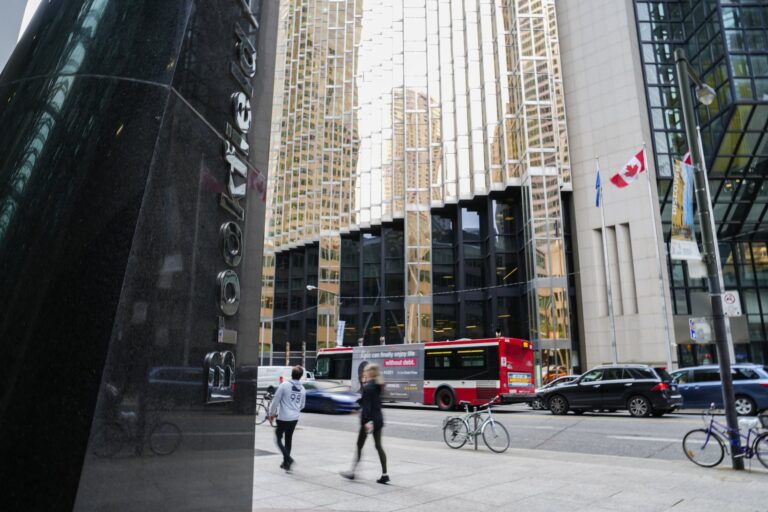

Good ideas have a way of surviving all kinds of weather. That brings us to the Canadian business story of the week—The Logic’s scoop on another promising idea that nonetheless kicked up a storm among Conservatives. The days and weeks ahead could tell us a lot about what’s achievable in the current political environment.
My colleague Catherine McIntyre reported that Brookfield was canvassing the biggest pension funds on creating a $50-billion investment vehicle.
The fund would include $10 billion from the federal government and $4 billion from Brookfield, which would oversee the investments. The inclusion of government money implies the fund would be focused on Canada, as does the timing: at Finance Minister Chrystia Freeland’s behest, former Bank of Canada governor Stephen Poloz spent the summer talking to people about how to encourage the “Maple 8” pension funds—among the biggest and most sophisticated in the world—to invest more of their retirees’ savings in Canada.
Poloz declined to say whether Brookfield’s proposal was linked to his work. A senior government official said the firm was acting on its own, not on behalf of the finance minister. The official added that it would be premature to assume Ottawa was keen on contributing to a privately managed fund, as there are “many ideas” in play.
If one of those ideas is a fund of funds of the type Brookfield is workshopping, then Freeland might have found a winner. It would be an elegant solution to a dilemma that appeared to lack one.
The cost of financing the transition to a green economy will be immense, and taking advantage of the opportunities inherent in artificial intelligence and biotechnology will be equally expensive. Bank of Canada governor Tiff Macklem said earlier this month that inadequate trade infrastructure could limit the country’s export potential. Add Canada’s acute housing shortage, not to mention a troubling slump in entrepreneurship, and it quickly becomes clear that we need to supercharge investment. The big pension funds, which manage some $2 trillion in assets, are an obvious solution.
Raiding those funds is a tempting solution, but forcing them to invest more at home could make it harder for them to earn the returns needed to pay for an aging population’s retirement.
Think of it this way. Apple shares have increased roughly 3,000 per cent since 2010, while Royal Bank of Canada has gained about 200 per cent. The more Apple-like investments the funds add to their portfolios, the less likely they will need to ask for larger contributions in the future.
The odds of finding such payoffs in Canada are low. The business culture here favours stability over growth and innovation: the median year a TSX company was founded is 1931, compared with 1976 for the S&P 500, the U.S.’s main stock benchmark. There’s plenty of potential in infrastructure, but that will require lots of groundwork to overcome regulatory and political barriers.
With easier payoffs elsewhere, a fund manager with limited time and resources isn’t going to exert great effort in Canada. But a fund devoted to doing the hard work of combing for needle-moving investments could be an attractive place for such a manager to park some money, especially if that fund is being run by a firm such as Brookfield, one of the biggest and best at what it does.
Conservatives’ reaction to news of the proposal was troubling, if unsurprising. They said nothing about the idea itself. Instead, they seized on what they see as a conflict of interest: the chair of Brookfield’s board, former Bank of Canada governor Mark Carney, is also chair of a task force created last week to provide the Liberal Party of Canada with new ideas on economic policy. “Trust me, we’ll make sure Brookfield’s shareholder’s [sic] mitts are kept off of (what’s left of) grandma’s pension and out of the wallets of already struggling Canadians,” Michelle Rempel Garner, a Conservative MP from Alberta, wrote in her Substack newsletter.
Conservatives have been taking runs at Carney for a while now, amid chatter that he could be a future contender for the Liberal leadership. It’s fair to ask whether what they really see is an opportunity to smear a potential rival. Canada is a small country, and the community of firms and individuals with the wherewithal to run a multi-billion-dollar investment fund is even smaller. A puritanical conflict-of-interest test could cause Bay Street to retreat.
I assume Brookfield put a fat carrot from Ottawa in its theoretical basket because it knows that would catalyze interest. A sizable public contribution would create an incentive for the government to ensure the fund’s success, while private management would limit the risk of bureaucratic drag and political interference.
The template is the Venture Capital Catalyst Initiative, the Trudeau government program that has seeded various venture firms and fund of funds with hundreds of millions of dollars.
Know where Trudeau got that idea? Stephen Harper.
Kevin Carmichael is The Logic’s economics columnist and editor-at-large. He has spent more than two decades covering economics, business and finance for outlets including Bloomberg News, The Globe and Mail and the Financial Post, where he also served as editor-in-chief.



Loading...
Thanks for sharing!
You have shared 5 articles this month and reached the maximum amount of shares available.
CloseThis account has reached its share limit.
If you would like to purchase a sharing license please contact The Logic support at [email protected].
CloseGift the full article!
You have gifted 0 article(s) this month and have 5 remaining.
Recipients will be able to read the full text of the article after submitting their email address. They will not have access to other articles or subscriber benefits.
Photo: The Canadian Press/Darryl Dyck
Conservative MP Michelle Rempel Garner in the foyer of the House of Commons in Ottawa on Sept. 12.
Most Popular This Week


In-depth, agenda-setting reporting
Great journalism delivered straight to your inbox.
News
Canada’s investment problem isn’t a lack of money, investors say at Milken Institute event
Briefing
Cohere’s Gomez says Silicon Valley giants shouldn’t get to set the rules for AI
TD pledges $150B in new financing and support in key Canadian sectors
Scotiabank commits more than $100B to fund Canadian businesses
Best business newsletter in Canada
Get up to speed in minutes with insights and analysis on the most important stories of the day, every weekday.
Exclusive events
See the bigger picture with reporters and industry experts in subscriber-exclusive events.
Membership in The Logic Council
Membership provides access to our popular Slack channel, participation in subscriber surveys and invitations to exclusive events with our journalists and special guests.