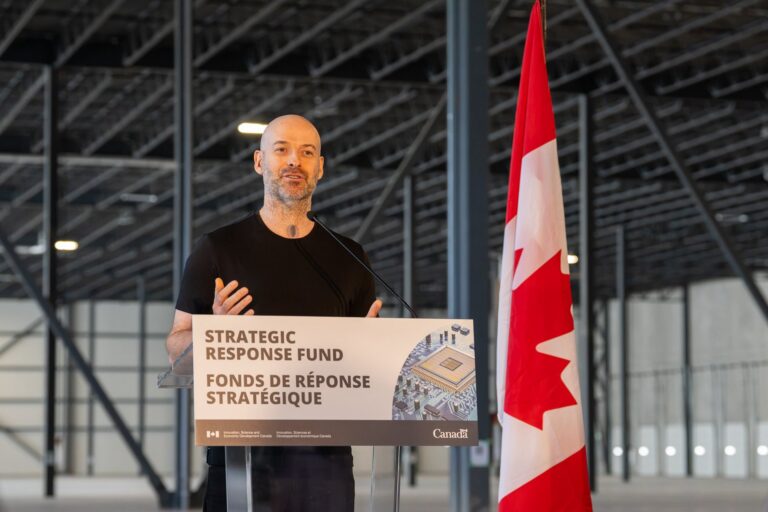
Navdeep Bains thinks he’s found a way to assuage the concerns of Canadian technology companies that don’t qualify for the billions in pandemic relief funding the federal government has announced prior to today.
The innovation minister unveiled funding for two additional programs this afternoon: $250 million for the Industrial Research Assistance Program (IRAP) and $962 million for regional development agencies. The former will be made available to early-stage tech firms in the coming days, and Bains hopes it will help over 1,000 firms protect 10,000 jobs. The latter will fund both loans and grants, and will roll out “as soon as possible.”
Talking Point
Innovation Minister Navdeep Bains has spent the past several weeks fielding calls from tech leaders concerned they’re being left behind in the government’s COVID-19 response. In an interview with The Logic, Bains discusses his answers to those concerns, which come in the shape of two new programs: $250 million for the Industrial Research Assistance Program and $962 million for regional development agencies.
In a Friday afternoon interview with The Logic, Bains argued the two programs would provide a lifeline to tech firms struggling amid COVID-19. He also spoke about a host of other requests from tech companies—including pausing scientific research and experimental development (SR&ED) audits and fintechs’ plan to loan $2 billion to tech firms—and whether he still plans to get telecoms to lower their rates by 25 per cent.
This interview has been edited for length and clarity.
Scale-ups have previously expressed concerns that they don’t qualify for IRAP because it’s only open to companies with 500 or fewer full-time-equivalent employees. Do you plan to lift this cap for this new funding?
The current eligibility criteria [are] focused on small- and medium-sized enterprises, so that does apply to firms of 500 employees or less. We have made changes to the wage subsidy in terms of how we recognize revenue for high-growth firms by making sure that we’ve reduced the revenue threshold, and also the criteria—[comparing] revenues from the previous year, but also from the first few months of this year, as well.
You said IRAP funding will be available next week. When will the funding for regional development agencies be available?
This money will flow as soon as possible. With regard to the IRAP funding, because it’s already in the existing program, and because the development agencies already have existing programming, it enables us to give this money out quickly.
We’re going to evaluate the requests that come in on a case-by-case basis. With IRAP, we have industrial technology advisers, people that are entrepreneurs, that have the technical expertise. So they’ll have a quick turnaround time for evaluating the submissions and making sure that we get the money out.
Will the regional development agency money be loans or grants?
It’ll be a combination of both grants and repayable contributions.
Finance Canada and the Business Development Bank of Canada have met with the Canadian Lenders Association (CLA) several times in recent weeks to discuss a plan for fintechs to loan $2 billion to up to an additional 100,000 firms. Their proposal would make money available to companies that don’t qualify for existing support because staff are paid via dividends instead of payroll, or they have contractors instead of employees. Do you plan to implement the CLA’s proposal?
The measures we’ve taken today deal with some of those pain points. It’s about identifying highly skilled innovators that we want to make sure to stay in Canada. I want to make sure that we focus on startups—pre-revenue or not—high-growth companies, software-as-a-service [SaaS] companies. All these are now eligible under the Industrial Research Assistance Program. And we feel this will address the concerns with regards to keeping highly skilled employees paid and making sure that they stay in Canada.
Does that mean the CLA proposal is off the table?
We are very flexible, very nimble—we keep our ears to the ground. We’re trying to do more, not less. We want to help more Canadians. We want to help more workers; we want to provide more support for our small businesses and we will continue to evaluate proposals.
But at this stage, we feel this initiative does identify the gaps that existed in the wage subsidy and liquidity measures, because there were challenges with that. Our solution is to really focus on these companies that did not necessarily benefit from those initiatives—companies that are in the startup ecosystem, many companies that do not have revenue, are pre-revenue, high-growth firms, as well as SaaS companies. We feel we’ve covered significant ground with today’s proposal.
When the government announced the COVID-19 streams of the Strategic Innovation Fund (SIF) and IRAP, you said at the time that you hoped to have funding out in weeks instead of the months it usually takes. That announcement was almost four weeks ago. Have you signed any contribution agreements yet?
We will be making announcements very shortly.
Two weeks ago, The Logic reported that $200 million in SR&ED funding was on hold because it was being audited. Do you know how much money is on hold now? And are you looking into implementing a pause on SR&ED audits like the tech industry is calling for?
We’re constantly engaged with the tech industry and with technology companies and innovative firms, understanding their concerns, their pain points. I think today’s measures demonstrate that we’re listening to them.
If you look at companies, for instance, that did not get support from BDC or from the banks or don’t get better capital investment, we’ve stepped up in a significant way to provide direct support to protect highly skilled innovators within those companies.
We’ve made changes to the wage subsidy to reflect high-growth firms. We have looked at liquidity measures—we brought in a program called IRAP, which is important to note, because it’s an existing program and enables us to get the money out quickly. We don’t have to build the program from scratch; it has a long history. It’s got hundreds of technical advisers, these industrial technology advisers, that can quickly assess many companies, and they already understand the ecosystem well enough. So we’re in a position to get that money out very quickly and deal with those innovative firms, those technology firms, that have been raising these concerns.
That’s the pitch folks make about SR&ED. It’s an existing program; it’s 34 years old. We’ve got $250 million in IRAP funding today, but there was $200 million in SR&ED funding on hold. Are you looking into getting rid of the audits?
At this moment, there’s nothing official to announce, but we’re constantly looking at different programs and policies we have in place to help these highly skilled innovators that work for the company.
Are you sticking to your requirements for Rogers, Bell and Telus to cut prices for mid-range wireless plans by 25 per cent in two years, and will you still release updated benchmarking this quarter?
Things are very fluid. Things are changing rapidly. But our affordability agenda, we’ve been very clear about making sure that we maintain high-quality networks, and that people get access to these networks at affordable prices. That is still consistent with government policy.
I would underscore that we have seen tremendous work by the frontline field technicians that have kept our networks up and running. And as people need to use these networks for work, for kids that need to do their schoolwork online or for people that are downloading or streaming content, these networks have been very robust. That’s a testament to the fact that we have strong networks. But we also understand that we need to continue to drive the affordability agenda.
Germany recently moved to set up a fund to buy stakes in companies to block foreign takeovers. Do you have any plans for such a program, or to use the Investment Canada Act to prevent Canadian tech companies from being bought out by foreign firms?
We have a robust Investment Canada Act that allows us to examine these transactions. And we will make sure that we always look at what’s in the net benefit for Canadian companies and Canadian workers.
Any plans to block foreign takeovers?
I think at this stage, our focus is on the health and wellbeing of Canadians, providing direct income support to companies, and we’ll reevaluate next steps in terms of what the recovery looks like. But we have the tools in place, including the Investment Canada Act, to protect Canadian companies.