A historic plunge in stock markets deepened Friday, a day after the S&P 500 suffered its worst drop since the 2020 COVID-19 pandemic. U.S. President Donald Trump’s trade offensive has shattered investor confidence, led to growing uncertainty, and threatened to pummel the U.S. economy into a recession.
Here’s what you need to know.
News
Stock market rout deepens after historic plunge
U.S. President Donald Trump’s trade war has stoked recession fears and frozen IPOs as investors seek safe havens
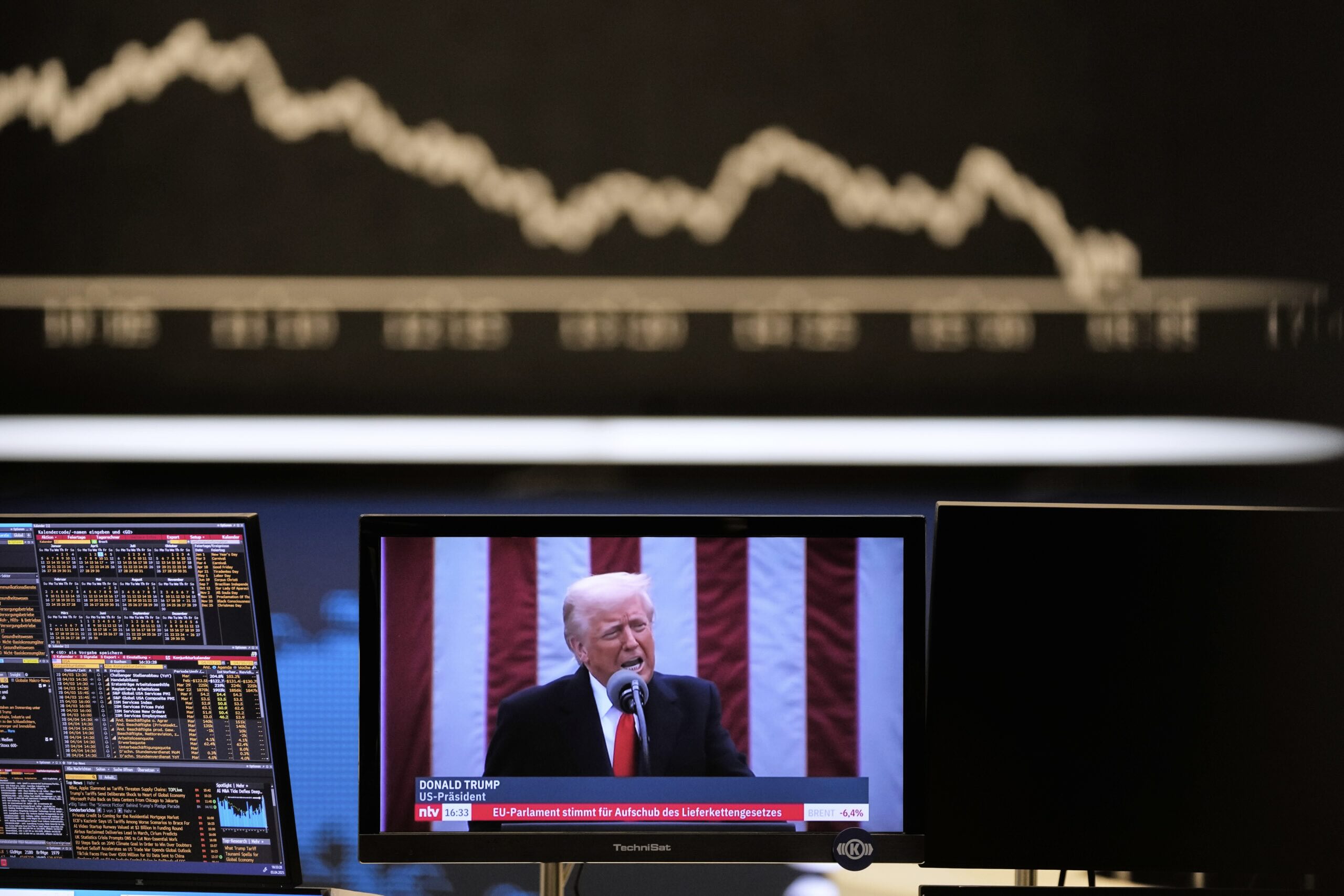
U.S. President Donald Trump appears on a television screen at the stock market in Frankfurt, Germany, on April 3, 2025. Photo: Associated Press/ Michael Probst
A historic plunge in stock markets deepened Friday, a day after the S&P 500 suffered its worst drop since the 2020 COVID-19 pandemic. U.S. President Donald Trump’s trade offensive has shattered investor confidence, led to growing uncertainty, and threatened to pummel the U.S. economy into a recession.
Here’s what you need to know.
Talking Points
Stocks on both sides of the border continued their slump Friday, with traders flocking to safer investments as the U.S. trade war escalates
The tech sector was hit particularly hard, while prospective IPOs have been put hold
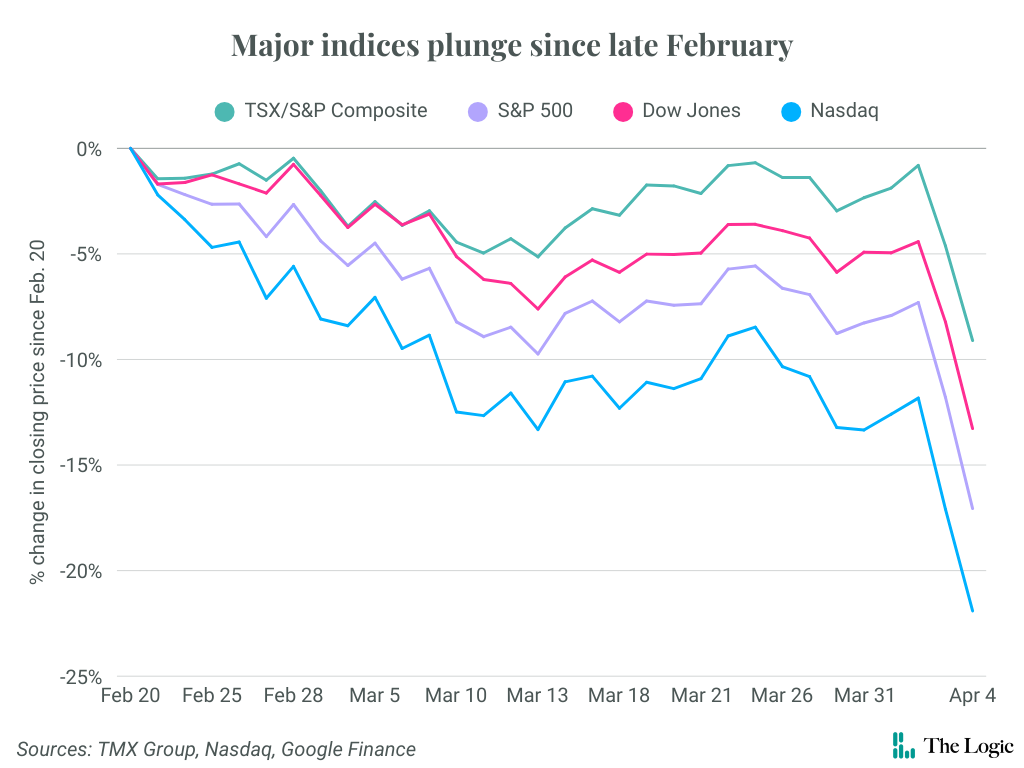
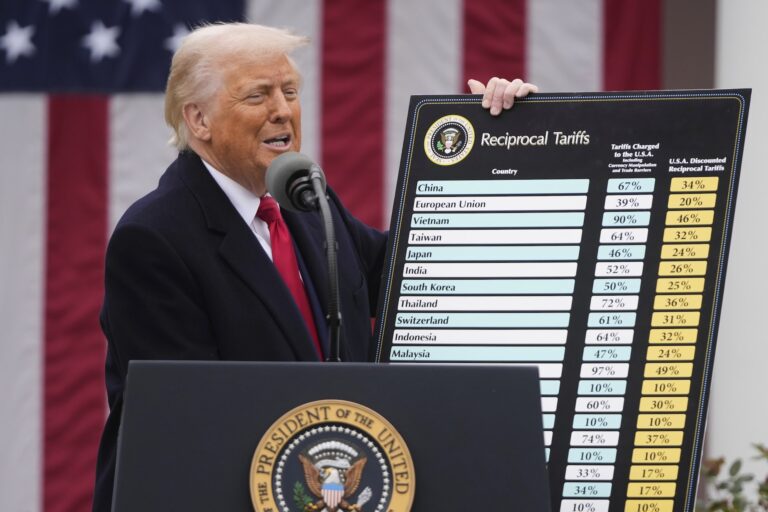
Markets rout: Major U.S. indices fell sharply Thursday after Trump unveiled plans to tariff over 180 countries the previous day. The Nasdaq Composite and S&P 500 tumbled six per cent and five per cent respectively over the day, wiping out about US$3.8 trillion in value.
On Friday, the sell-off continued with the S&P and the Nasdaq both closing down about six per cent. The Nasdaq spiralled into bear market territory, as the tech-heavy index dropped around 20 per cent from its peak.
Canada’s TSX/S&P Composite, meanwhile, dipped toward a correction, closing down 4.7 per cent. The Canadian/U.S. dollar exchange rate has stayed relatively consistent at 0.70, after peaking yesterday at 0.71 when traders learned USMCA-compliant goods from Canada would be spared from tariffs.
Trump maintains that the market’s reaction to his tariff plan is “going very well.”
“You’ll see how it’s going to turn out. Our country is going to boom,” he told reporters.
A sweeping selloff: Few industries have been spared. All 11 sectors of the S&P 500 were down Friday morning, with energy suffering the worst losses, having plunged 8.7 per cent by close. Top Canadian energy stocks were down about the same amount. Financial, industrial, tech and consumer discretionary stocks had also fallen. Shares in the Magnificent 7—a group of major U.S. tech stocks including Alphabet, Amazon and Nvidia—ended the day nearly six per cent lower.
Tesla’s shares, which had already plummeted nearly 40 per cent year to date, saw one of the biggest declines, dropping more than 10 per cent Friday. The company, which has been the target of consumer boycotts, assembles its cars and batteries in the U.S., shielding it from some of the tariffs that have rocked the auto sector. But it imports raw materials and battery components from countries that have been slapped with U.S. import tariffs. Many other U.S. tech firms also rely on these overseas supply chains.
Canadian tech has been hit hard too, with the index of top information technology companies on the Toronto Stock Exchange down about 3.7 per cent. Shopify’s stock was down nearly 5.6 per cent on the TSX and 6.6 per cent on the Nasdaq, extending its more than nine per cent fall Thursday. The decline comes as Bank of America analysts warn that tariffs could spike costs for online merchants that rely on cross-border logistics and customers. E-commerce platforms like Shopify also face risks from Trump scrapping the de minimis exemption, which lets imports under US$800 enter the U.S. without additional fees.
IPO freeze: Companies that had previously announced plans to go public are holding off over tariff uncertainty. Buy-now, pay-later platform Klarna and ticketing firm StubHub have delayed their IPOs, The Wall Street Journal reported, citing unnamed sources, while Canadian Ryan Reynolds’ adtech firm MNTN is reportedly hitting pause, per Bloomberg TV. San Francisco-based fintech company Chime is reportedly also putting its market debut on ice, while Hinge Health is watching the market ahead of its April IPO.
The jobs picture: New data on Friday showed employment declined by 33,000 positions—the biggest drop since 2022—with the jobless rate rising to 6.7 per cent, the first increase since November, according to Statistics Canada. Most of the job losses were in Alberta’s energy sector and Ontario’s auto sector, which rely heavily on U.S. customers.
The U.S., on the other hand, reported strong job numbers for March, adding 228,000 new roles last month, well above the 140,000 economists predicted and nearly double the number of jobs added in February. Still, unemployment ticked up from 4.1 per cent to 4.2 per cent. Trump cited the report as evidence his policies are working.
Gambling with recession: The Federal Reserve is up against a “highly uncertain outlook” due to Trump’s tariffs, chairman Jerome Powell said Friday morning. The president’s levies were “significantly larger than expected,” Powell added, predicting higher inflation and slower economic growth as a result.
RBC economists Mike Reid and Carrie Freestone modelled out two scenarios—10 and 20 per cent tariffs across the board, including USMCA exemptions. Both scenarios indicated slowing U.S. growth, while the 20 per cent tariff scenario “significantly increases the odds of a technical recession” in America this year.
There are still lingering effects of a more than 20 per cent price increase since 2020 due to the COVID-19 pandemic, RBC’s chief economist Frances Donald pointed out. Businesses and households will be limited in their capacity to endure another bout of inflation in the short time frame, she wrote. And now, the trade war is “global and without borders,” she adds.
Safe havens: Investors globally are flocking to safer assets as the yield on 10-year U.S. Treasury bonds fell sharply on Friday. Flows out of stocks and into bonds have been a “defensive” move from traders, Bank of America analyst Yuri Seliger wrote in a report. European bonds, such as the 10-year German Bund which fell below 2.5 per cent, have mirrored the trend.
Recipients will be able to read the full text of the article after submitting their email address. They will not have access to other articles or subscriber benefits.
Great journalism delivered straight to your inbox.
News
Cenovus announces $5.7B takeover of Athabasca, with a nod to Carney’s Mega Deduction
By
Meghan Potkins
Briefing
Defence minister picks longtime CCI executive as new chief of staff
By Murad Hemmadi |
U of T launches $100M program to draw top-tier PhD students to focus on key social issues
By David Reevely |
Brookfield says there’s ‘enough to go around’ as it partners with rivals on AI investments
By Anita Balakrishnan |
Best business newsletter in Canada
Get up to speed in minutes with insights and analysis on the most important stories of the day, every weekday.
Exclusive events
See the bigger picture with reporters and industry experts in subscriber-exclusive events.
Membership in The Logic Council
Membership provides access to our popular Slack channel, participation in subscriber surveys and invitations to exclusive events with our journalists and special guests.