Nicholas Lamp is one of many Tesla drivers around the world, and especially in Canada, whose vehicles have become the targets of pedestrians’ curbside commentary—not on electrification or the aesthetics of the cars, but on the tech impresario who brought them into existence.
Skip to content

 Musk's Nazi-style salute at Trump's inauguration made Tesla a target of revulsion around the world. Photo: AFP via Getty Images/Angela Weiss
 From left to right: Demonstrators outside of a Tesla showroom in New York in early March; workers scrub away a spray-painted swastika near a Tesla dealership in Vancouver; an anti-Musk poster on a bus shelter in London, U.K., installed by the “Everyone Hates Elon Musk” collective. Photo: First image—AP Photo/Adam Gray; Second image—Reddit; Third image—Leon Neal/Getty Images

The Big Read
Canada has a Tesla problem
Before he became Trump’s hatchet man, Elon Musk and his company helped shape Canada’s EV ecosystem. Untangling things won’t be easy
Photo: Illustration by Sumaiya Kamani; Photo of Elon Musk: Pool via AP/Brandon Bell; Photo of Tesla charging station: Media News Group via Getty Images/Jeff Gritchen
Photo: Illustration by Sumaiya Kamani; Photo of Elon Musk: Pool via AP/Brandon Bell; Photo of Tesla charging station: Media News Group via Getty Images/Jeff Gritchen
Nicholas Lamp is one of many Tesla drivers around the world, and especially in Canada, whose vehicles have become the targets of pedestrians’ curbside commentary—not on electrification or the aesthetics of the cars, but on the tech impresario who brought them into existence.
“When I see colleagues and friends, they react to it,” says Lamp of the Model X he bought second-hand last year for a road trip. Some have suggested he put one of the newly popular stickers on the car that reads, “I bought this before Elon went crazy,” so it doesn’t get vandalized.
Talking Points
- Canada’s fight against the White House’s tariff policy is feeding into a global backlash against Tesla, and pressure is rising for the country to cut ties with a company that shaped its lauded EV ecosystem
- Hanging in the balance: more than 1,000 jobs, expansive infrastructure and billions in stock held by pension funds, all of which rely on Tesla’s fortunes
Lamp, a legal scholar who researches international trade law at Queen’s University, has a unique perspective as pressure grows for Canada to consider heavy tariffs on Tesla to punish its CEO, Elon Musk, and by extension Donald Trump’s administration. For him, how to resolve the trade war is a matter of both professional and personal interest. But he is far from the only driver feeling caught in the middle.
“What Trump is doing is illegal,” he says. “[But] trying to piss off Elon Musk as much as possible? I’m not sure it’s conducive to creating an off-ramp.”
Lamp has put his finger on a dilemma for Canadians as Donald Trump’s trade war morphs into an existential crisis for their country. Musk and his companies appear to be juicy targets for retaliation and consumer action, given the CEO’s central role in the U.S. president’s administration.
There could be consequences, though, for a country that bills itself as a top destination of electric-vehicle industry investments, and until recently embraced Tesla’s pivotal role in the shift to zero-emissions vehicles. While it does not have a factory on Canadian soil, Tesla’s investments and business ties within the country’s EV ecosystem run deep. It remains Canada’s top-selling EV maker, and has invested in at least 4,000 charging ports across the country. It buys critical minerals, funds university research and has acquired Canadian startups advancing technology in the space. With billions worth of Tesla stock in their pension fund holdings, many Canadians have a financial interest in the company’s fortunes.
Related Articles

Driving Tesla out of Canada—through any combination of trade action, insults to Elon Musk or grassroots movements to ostracize Tesla owners—is likely to cost jobs, and set back an industry that business and political leaders until recently touted as key to Canada’s industrial future.
“People realize clean air, clean water, reduced health-care costs are what EVs bring to the table,” says Stephen Bieda, a board member of the EV Society, a non-profit association of Canadian electric-vehicle owners working to speed the energy transition. Putting “short-term economic interests” ahead of the climate, he says, “would be shooting ourselves in the foot in the long term.”
For now at least, the anti-Musk movement is ascendent. About 75 per cent of 1,450 Canadians surveyed in November had “low trust” in Musk’s opinions on Canadian politics, according to the Canadian Digital Media Research Network, an antipathy that seemed to deepen after Musk published an X post saying Canada is “not a real country.” (It was deleted soon after.)
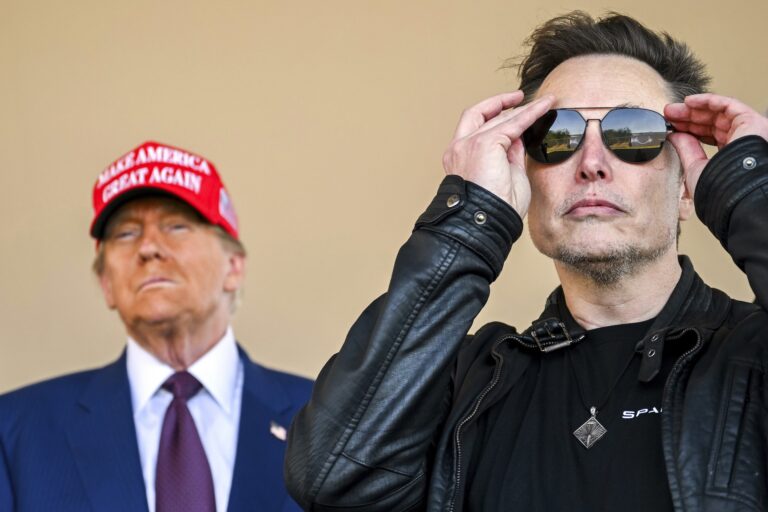
On one level, the Canadian anger is part of a global protest movement that took off after Musk threw up a “heil”-style salute at U.S. President Donald Trump’s inauguration. In the days and weeks that followed, swastikas and anti-Musk obscenities were spray-painted onto Tesla vehicles, chargers and dealership buildings in several countries, among other acts of vandalism. In Germany, anti-fascist activists projected the word “Heil” next to the Tesla logo on the side of the company’s factory.
In this country, the spontaneous acts of protest have included anti-fascist graffiti on the wall of one of the company’s dealerships in Vancouver, and random insults and comments of the sort Lamp describes. A Tesla owners’ group in Quebec has gone so far as to issue bumper stickers trying to distinguish the brand from the man behind it. They feature Tesla’s logo; next to it is Musk’s first name with a red line through it.
So it was probably a matter of time before the outrage made its way into the political sphere. In recent weeks, politicians from former Liberal leadership candidate Chrystia Freeland to NDP Leader Jagmeet Singh to Toronto Mayor Olivia Chow have threatened retaliation against Tesla, through doubling the price with 100 per cent tariffs, excluding it from incentive programs, or both.
So far those threats have translated into little meaningful action. Freeland lost the Liberal leadership to Mark Carney, and Singh’s party is running a distant third in public opinion polls. Chow’s motion to exclude Teslas from the city’s EV taxi subsidies will have no effect, says Rita Smith of the Canadian Taxi Association, because insurance issues currently prevent fleet owners from using Teslas. Tesla vehicles not only qualified for federal purchase incentives until the last day of the program, they received an outsized amount.
Still, the Liberal government has said it will consider trade actions on vehicles as its second line of defence, after public consultations. And it’s hard to imagine a trade target more likely to get the U.S. administration’s attention than Tesla. What’s more, financially speaking, Tesla is on the back foot, grappling with increasing competition, plunging global sales and heavy North American tariffs on cars made in its Chinese factories.
To date, the company has avoided Canada’s version of those tariffs, and its sales here continue to grow. EV data firm Rho Motion estimates the automaker sold 46,000 vehicles in Canada last year, up from 44,000 in 2023. That’s about 2.5 per cent of the 1,789,226 Teslas sold worldwide, even though Canada has about 0.5 per cent of the global population.
“Tesla is the best example of a brand where people are going to vote with their wallets. It’s unnecessary to intervene.”
So steep tariffs like those Canada has imposed on Chinese-made cars would make a mark, and Tesla’s options to challenge them would be limited, says Gil Lan, who teaches trade law at Toronto Metropolitan University. He points out that the U.S. itself has paralyzed the appeals process at the World Trade Organization, halting the process it would otherwise use to argue against tariffs on Tesla.
In media briefings, a Canadian official has said the government will focus on categories of goods, not specific companies. Still, there are many legal routes to levy tariffs on specific companies. Lamp, the Queen’s law professor, notes that the Auto Pact negotiated in the 1960s did essentially that, as do some anti-dumping trade remedies. Section 53 of Canada’s Customs Act, he says, makes Ottawa a “judge, jury and executioner” when it comes to fashioning and implementing tariffs. Lan notes that the government can target a category of goods where one company is the dominant manufacturer.
As for consumer backlash, Tesla’s business strategy makes it particularly vulnerable, says Zhe Zhang, a marketing professor at Western University’s Ivey Business School. As major purchases, cars are highly influenced by stereotypes related to their countries of origin, and are often viewed as extensions of the consumer’s identity, Zhang says. In Tesla’s early years, that worked in its favour, as its cars became the unofficial vehicles of the successful-but-enlightened.
Even as it grew, it mostly eschewed traditional advertising, public relations and dealership networks, building its brand instead through Musk’s social network on X. That has left consumers to fill in the blanks—lately with images of Musk wielding a chainsaw at a conference of political conservatives.
“When you have a public crisis, the CEO is the one to give an explanation to make the situation better. In this case, Elon Musk is the centre of this controversy,” says Zhang. “Once you get to this point, I feel like it’s going to take a long time for the company to recover.”
As with every action in a trade war, though, backlash carries costs. Bieda, of the EV Society, notes that prices of other EVs are rising, and worries that an unintended consequence of the rhetoric will be to deter people from adopting EVs. Canada’s recent policies to cut incentives on EV purchases do little to help. With no homegrown automaker to turn to, he asks, “Where do we pivot, and how do we pivot?”
There’s also the company’s sizable footprint in Canada, which is likely to shrink in the face of trade action.
Its network of DC fast chargers represents over a third of such ports in the country, and the federal government was relying on Tesla’s decision to open up these stations to other vehicles as a way to encourage Canadians to adopt EVs. Last year, it awarded the company nearly $3.3 million.
On Thursday, B.C. moved to limit incentives for Tesla chargers, and Musk quickly responded, calling the move “crazy” on X, and retweeting a post suggesting he cut Canada off from two of his other companies, Starlink and SpaceX.
Doug George, an Ottawa resident who has driven a Tesla for 15 years, spells out the quandary: “I don’t feel all that inclined to buy another Tesla in the future, but I also recognize that the Supercharger network is right now, the only thing that really, really works,” he says. “My feelings are complicated.”
The economic complications are no less daunting. At least 10 major Canadian pension funds reported Tesla holdings as of Dec. 31, totalling about US$2.2 billion. Those holdings have already taken a hit—the stock is down 38 per cent since then. Trade action aimed at the company would only add to the forces weighing it down.
Tesla has also acquired or acqui-hired Canadian startups like Hibar, Springpower and Genesis Motion Solutions. It has continued to fund Dalhousie University’s battery lab and recruit from the University of Waterloo. From 2018 to 2022, Tesla estimated its 1,300 employees in Canada made direct and indirect economic contributions to the country’s economy to the tune of $830 million. Quebec lithium mines and Vale’s nickel mines in Canada sell to Tesla.
Tesla warned U.S. trade officials last week it is at risk in a trade war. It has previously smelted aluminum in Canada, and the metal is now the subject of steep tariffs.
Lamp, for one, thinks Ottawa should leave the anti-Tesla offensive to consumers. Lashing out against a single company “sets an awful precedent” for investors looking at Canada, he says. The government could achieve more with other trade measures, he adds, like lifting intellectual property rules that favour Disney, or allowing alternative app stores to Apple and Google in the country.
“Tesla is the best example of a brand where people are going to vote with their wallets, so it’s unnecessary to intervene,” Lamp says.
Bieda, too, is wary of measures that would escalate the dispute, arguing that restoring EV purchase incentives or investing in charging infrastructure for non-Tesla EVs would benefit consumers while sending the desired message.
“I’m not sure that we want to poke the bear,” he says, “or poke the eagle.”



Loading...
Thanks for sharing!
You have shared 5 articles this month and reached the maximum amount of shares available.
CloseThis account has reached its share limit.
If you would like to purchase a sharing license please contact The Logic support at [email protected].
CloseGift the full article!
You have gifted 0 article(s) this month and have 5 remaining.
Recipients will be able to read the full text of the article after submitting their email address. They will not have access to other articles or subscriber benefits.
Photo: Illustration by Sumaiya Kamani; Photo of Elon Musk: Pool via AP/Brandon Bell; Photo of Tesla charging station: Media News Group via Getty Images/Jeff Gritchen
Musk's Nazi-style salute at Trump's inauguration made Tesla a target of revulsion around the world.
From left to right: Demonstrators outside of a Tesla showroom in New York in early March; workers scrub away a spray-painted swastika near a Tesla dealership in Vancouver; an anti-Musk poster on a bus shelter in London, U.K., installed by the “Everyone Hates Elon Musk” collective.
Most Popular This Week



In-depth, agenda-setting reporting
Great journalism delivered straight to your inbox.
News
Anthropic revealed as client for EverWind’s $10B Nova Scotia data centre
Briefing
EverWind plans $10B data centre and wind development in Nova Scotia
Canada ready to force Stelco to sell its Canadian operations, Joly says
Feds plan a 60 MW defence-oriented data centre for Ottawa
Best business newsletter in Canada
Get up to speed in minutes with insights and analysis on the most important stories of the day, every weekday.
Exclusive events
See the bigger picture with reporters and industry experts in subscriber-exclusive events.
Membership in The Logic Council
Membership provides access to our popular Slack channel, participation in subscriber surveys and invitations to exclusive events with our journalists and special guests.






