OTTAWA — Canadians want to keep some of the big social programs Prime Minister Justin Trudeau ushered in during his last few years in office, but would prefer to reverse the capital gains tax hike that was meant to help pay for them, a new The Logic poll conducted by Abacus Data suggests.
Skip to content


News
Canadians ready to ditch capital gains tax hike but not dental care
New poll finds support for key Liberal programs even as Trudeau heads for the exit
Prime Minister Justin Trudeau emerges from Rideau Cottage in Ottawa on Jan. 6, 2025 to announce his resignation as Liberal leader and prime minister. Photo: The Canadian Press/Sean Kilpatrick
OTTAWA — Canadians want to keep some of the big social programs Prime Minister Justin Trudeau ushered in during his last few years in office, but would prefer to reverse the capital gains tax hike that was meant to help pay for them, a new The Logic poll conducted by Abacus Data suggests.
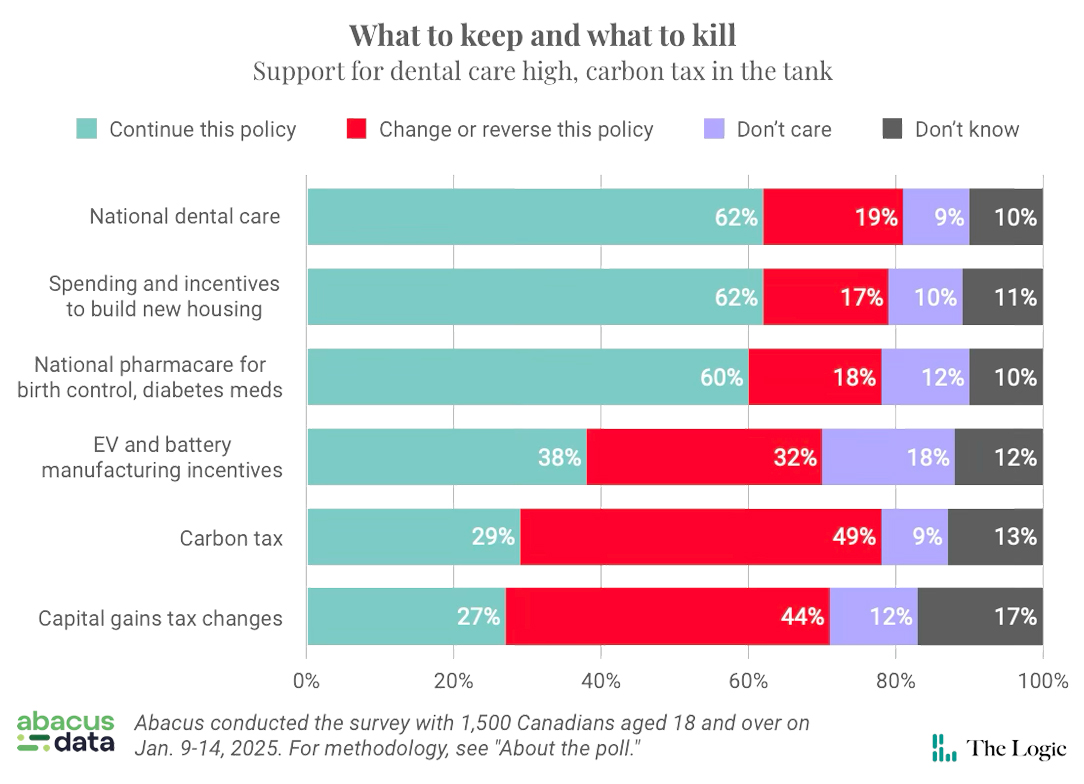
Sixty-two per cent of Canadians surveyed said they want the government’s national dental-care program to last, and 60 per cent said they still support federal drug coverage for diabetes and birth control medication.
Talking Points
- Canadians appear attached to some of the Liberal government’s policies, including dental care and pharmacare, even if their affinity for the party has waned
- Many would like to see the next government roll back the carbon tax and capital gains tax changes
Among the least-loved Liberal policies: the recent hike to the capital gains inclusion rate, which 44 per cent of respondents would like to scrap. Twenty-seven per cent said they’d like to keep it in place, and 29 per cent said they either didn’t know or didn’t care.
Half would do away with the carbon tax—the policy with the least support of all.
“Here’s another indicator that the overall agenda of the Trudeau government was not rejected. In fact, there’s large parts of it that people like,” Abacus CEO David Coletto told The Logic.
Trudeau announced earlier this month he was resigning after watching his personal and party poll numbers sink for more than a year. The Conservatives are now heavily favoured to win the next election and the Liberals are searching for a new leader and a policy vision to reinvigorate the party.
Related Articles

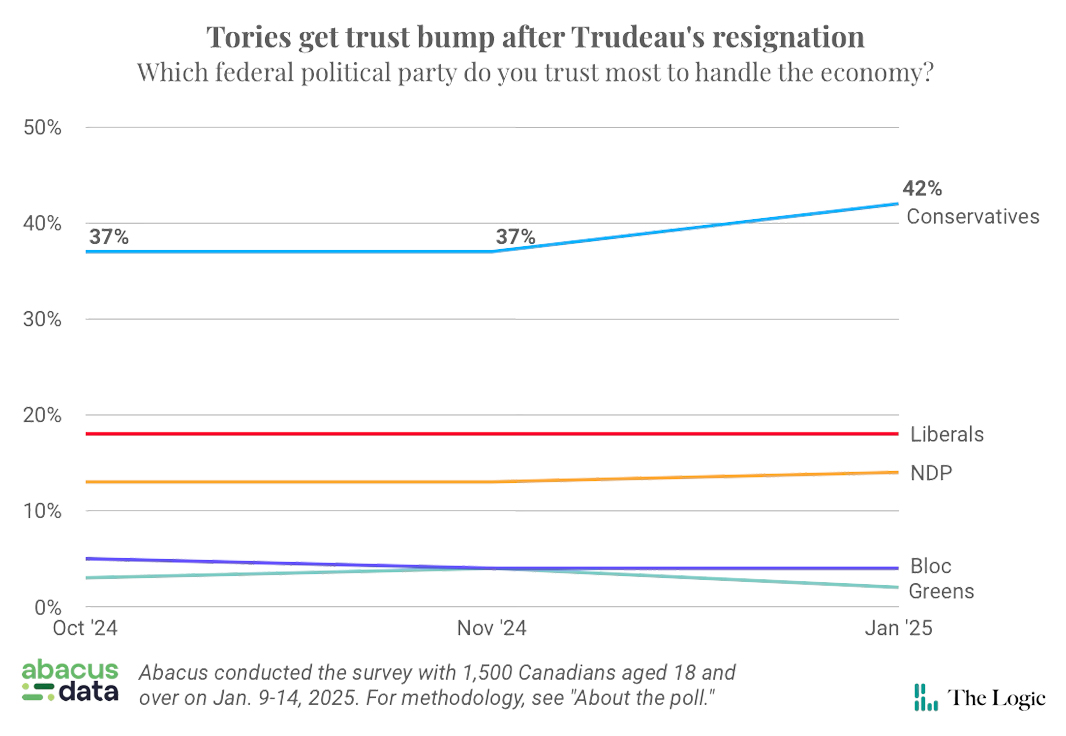
This latest poll finds faith in the Conservatives to handle the economy is up: 42 per cent of respondents said they trust the Tories most, compared to 37 per cent in The Logic’s previous poll with Abacus in December.
Trust in the Liberals, meanwhile, has dropped two percentage points, to 16 per cent, since the previous poll, which was done before Trudeau’s finance minister Chrystia Freeland resigned in protest and Trudeau himself threw in the towel.
“I think Freeland leaving was a body blow to the economic credibility of the Trudeau government, and I think it’s reflected in these numbers,” Coletto said. Anxieties about tariff threats from U.S. president-elect Donald Trump could also be a factor, he said.
The government’s dental and pharmacare programs were born out of a political pact between the Liberals and NDP, who demanded the coverage in exchange for their support on key votes in the House of Commons.
The parliamentary budget officer estimates that dental care will cost the government $10 billion over five years, and the Finance Department expects pharmacare to cost an additional $1.5 billion over a five-year span.
The Conservatives opposed both programs as costly threats to personal and employer-provided insurance coverage. Yet The Logic poll suggests that half of the people who plan to vote for the Conservatives want the party to maintain those programs.
Abacus found 62 per cent of respondents would also like to hold onto spending and initiatives aimed at municipalities to spur housing development, like the housing accelerator fund.
The Conservatives have promised to scrap that program, which offers funds to cities that adjust their bylaws in favour of homebuilding; and the $5-billion housing infrastructure fund, which goes to provinces who adopt certain housing policies.
Poilievre said he would use the savings to cut GST on newly built homes sold for less than $1 million.
About the poll
The Logic and Abacus Data have partnered to poll Canadians on key economic issues as the federal political parties prepare for the next election. The surveys take stock of voters’ priorities and their views of the parties’ policies on matters ranging from affordability to making Canada more competitive. On questions of economic stewardship, we are tracking attitudes over time. We will also seek responses on other issues as they emerge in the public conversation. For today’s story, Abacus surveyed 1,500 Canadians aged 18 and over from Jan. 9 to 14 through an online panel. The margin of error for a comparable probability-based random sample of the same size would be 2.3 per cent, 19 times out of 20.
“For the Conservatives, if they were to form a government after the next election, the question is, what can they cut that wouldn’t create some backlash,” Coletto said.
The party’s leader, Pierre Poillievre, has long campaigned on a promise to “axe” the carbon tax and earlier this week his party reiterated its opposition to the capital gains tax hike in a letter to the finance minister.
The Liberals pitched a plan to increase the inclusion rate on capital gains taxes in the last budget as a way to increase revenue drawn from the country’s highest earners and use the money for younger, less-well-off Canadians.
The enabling legislation was stalled for months and still hadn’t made it across the finish line when Trudeau prorogued Parliament, sending the process back to square one. The Canada Revenue Agency plans to continue to collect capital gains at the higher rate until the government tells them not to.
“The perception that it affected far more people than it actually did, I think, turned people against it,” Coletto said of results on capital gains.
There’s still some support for the tax policy, particularly among progressives, he noted.
If the next Liberal leader were to do away with capital gains and the carbon tax, however, it could signal a move away from signature Trudeau policies while still allowing voters to reflect on the programs they appreciated, Coletto said.
For the Liberals, “I think there’s an indication here that all is not lost,” he said.



Loading...
Thanks for sharing!
You have shared 5 articles this month and reached the maximum amount of shares available.
CloseThis account has reached its share limit.
If you would like to purchase a sharing license please contact The Logic support at [email protected].
CloseGift the full article!
You have gifted 0 article(s) this month and have 5 remaining.
Recipients will be able to read the full text of the article after submitting their email address. They will not have access to other articles or subscriber benefits.
Photo: The Canadian Press/Sean Kilpatrick
Most Popular This Week




In-depth, agenda-setting reporting
Great journalism delivered straight to your inbox.
News
Panel decries Canada’s chaotic way of funding world-class science
Briefing
AI is pushing insurers to become asset managers, Canadian CEOs say
Trump administration faces lawsuit over 50% tariffs on Canadian goods
Canada-U.S. trade war to reduce real GDP by 1.4% over 2024 levels after five years: PBO
Best business newsletter in Canada
Get up to speed in minutes with insights and analysis on the most important stories of the day, every weekday.
Exclusive events
See the bigger picture with reporters and industry experts in subscriber-exclusive events.
Membership in The Logic Council
Membership provides access to our popular Slack channel, participation in subscriber surveys and invitations to exclusive events with our journalists and special guests.





