Skip to content

Canada's Business and Tech Newsroom

  • Professional Subscription
  • Partnerships & Advertising
  • Licensing & Syndication
Log In Subscribe
Welcome,
  • My Account
  • Log Out
  • Business
  • Tech
  • National
  • The Big Read
  • Briefings
  • Commentary
Search
Log In Subscribe
Welcome,
  • My Account
  • Log Out
News

How Trump’s tariff threats could become reality

The U.S. president has wide—but not unlimited—powers to tax imports

By David Reevely
A head-and-shoulders shot of a smiling Donald Trump holding open a large black document cover bearing papers printed with a presidential executive order.
Donald Trump wields an executive order at a photo opportunity in Kenosha, Wis., in April 2017. The order to revamp visa rules for guest workers was one of several executive directives Trump signed during his first term as U.S. president. Photo: Getty Images/Scott Olson
Nov 26, 2024
A A
A Small A Medium A Large
Share

Share

A head-and-shoulders shot of a smiling Donald Trump holding open a large black document cover bearing papers printed with a presidential executive order.
Donald Trump wields an executive order at a photo opportunity in Kenosha, Wis., in April 2017. The order to revamp visa rules for guest workers was one of several executive directives Trump signed during his first term as U.S. president. Photo: Getty Images/Scott Olson

U.S. president-elect Donald Trump abruptly announced Monday evening that immediately after his January inauguration, he’ll put 25 per cent tariffs on all imports from Canada and Mexico. He cited the flows of fentanyl and migrants into the United States as his reasons.

Here’s how the tariffs could work.

Can the president just do that?

The U.S. Constitution gives Congress, not the president, the power “to lay and collect taxes, duties, imposts and excises,” but Congress has passed laws over the years that delegate a lot of that authority to the president.

Which power would Trump use?

He hasn’t specified. His biggest gun is the International Emergency Economic Powers Act of 1977, which gives the president sweeping authority to control financial transactions to deal with national emergencies. Trump’s stated concerns about drugs and an “invasion” by “illegal aliens” seem as though they’d qualify.

Related Articles

Multicoloured cargo containers are seen at the Port of New York and New Jersey, with numerous cranes and the estuary seen in the background.

What Trump’s 25% tariff would mean for Canadian business

By Catherine McIntyre, Anita Balakrishnan and Claire Brownell

The real numbers behind Trump’s Canada tariff threat

By Aimée Look and Martin Patriquin

According to the official U.S. Congressional Research Service, no president has used that law to tariff goods from a specific country, but it has been used to ban specific imports and exports, so Trump probably could.

The bar for a “national emergency” is low. The agency reported that as of Jan. 15, the U.S. was in 39 ongoing national emergencies under the act—including the first one, declared when Iran took U.S. embassy staff hostage in 1979.

How did Trump tariff Canadian goods last time he was president?

His harshest move was taxing imports of steel and aluminum from numerous countries, including Canada, in 2018. He used power Congress gave the president in 1962’s Trade Expansion Act to tariff imports that, in his view, would “threaten to impair” U.S. national security. These are called “Section 232” tariffs.

Trump’s argument was that the United States needed a metals industry to supply critical industries and defence needs, and imports were undermining the domestic sector.

The tariffs on Canadian steel and aluminum kicked in on July 1, despite Canadian objections.

Trump made a new proclamation in May 2019 that the U.S. industry was healthy again and that he had determined that Canadian and Mexican metals were no longer a security threat, so he was removing the extra tariffs.

Are there other tariff mechanisms he could use?

Yes. The U.S. Trade Act of 1974 gave the president broad power to use tariffs to fight other countries that violate trade agreements with the U.S. or do anything that’s “unjustifiable” or “unreasonable” and burdens U.S. commerce. President Joe Biden used that power this year to tariff some high-tech imports from China, including solar cells and electric vehicles. These are called “Section 301” tariffs.

And there are “Section 201” tariffs, which are meant to stop goods flooding the U.S. market and imperilling domestic producers. These are more general but require a time-consuming investigation by the U.S. government’s trade commission, and they’re meant to be temporary. 

Could tariffs be fought in court?

Yes. The president’s authority isn’t absolute. The key question would be whether a particular tariff was a proper use of the authority Congress has delegated to the president, and then whether Trump’s actions matched his stated reasoning. Such a challenge probably would not zip through the courts.

Congress could also, in theory, pass a law invalidating some or all of the president’s tariff moves, or repealing its delegation of authority entirely—the House of Representatives and the Senate gave the president these powers, and they can take the powers back. By Trump’s inauguration, though, both houses of Congress will be controlled by the president’s party, making that unlikely.

Join The Logic’s newsroom tomorrow, Wednesday, Nov. 27 at 2 p.m. ET, for a special virtual event on what U.S. president-elect Donald Trump’s tariff threat could mean for the Canadian economy. Register here.

#Donald Trump #economy #immigration #trade

Sponsored Content

The road to risk-smart regulation

By Deborah Aarts

Why cybersecurity needs to match pace with AI

By Jessica Aftimus Rosa

How to shift your workforce from AI experimentation to adoption

By Jessica Aftimus Rosa
Paid promotional content

Loading...

Thanks for sharing!

You have shared 5 articles this month and reached the maximum amount of shares available.

Close
This account has reached its share limit.

If you would like to purchase a sharing license please contact The Logic support at [email protected].

Close
Want to share this article?

Upgrade to all-access now

Close
Gift the full article!

You have gifted 0 article(s) this month and have 5 remaining.

Copy link and gift
Copy Link
Email to a friend
Send Email
Gift on Social Media

Recipients will be able to read the full text of the article after submitting their email address. They will not have access to other articles or subscriber benefits.

A head-and-shoulders shot of a smiling Donald Trump holding open a large black document cover bearing papers printed with a presidential executive order.

Photo: Getty Images/Scott Olson

Most Popular This Week

A side shot of Annie Andrews passing a cluster of supporters with a hand outstretched and a joyful look on her face.
News

What the Democrats’ midterm sweep means for Canadian business

By Joanna Smith
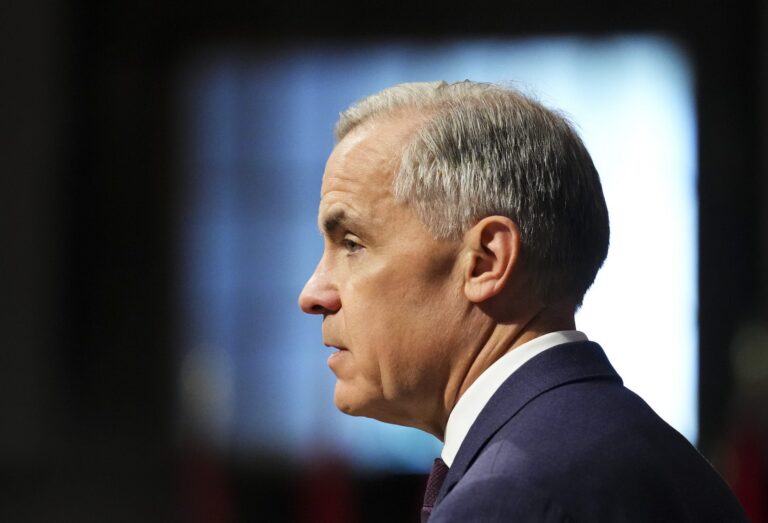
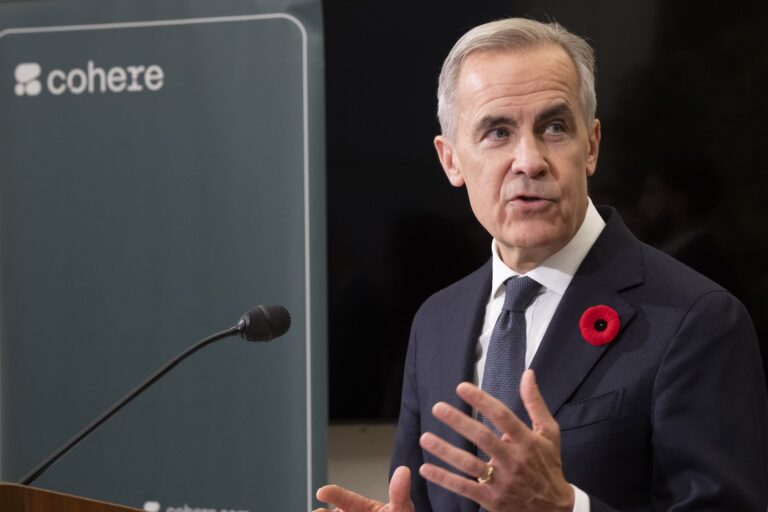
An image of Prime Minister Mark Carney, standing in front of a microphone and speaking. He is wearing a blue suit and tie, while looking away from the camera. He is standing in front of a dark background. The Cohere logo is visible in the background.
News

Conservatives challenge Ottawa to justify its $1.6B Cohere investment

By Catherine McIntyre
U.S. President Donald Trump and Canadian Prime Minister Mark Carney in suits, sitting and talking in the Oval Office with gold decor.
News

Canadians have given up on the old America. They feel fine about it

By David Reevely
A logo that reads AI in blue lettering against a light yellow background.
News

BDC launches programs to test Canadian AI tools in small businesses

By Catherine McIntyre

In-depth, agenda-setting reporting

Great journalism delivered straight to your inbox.

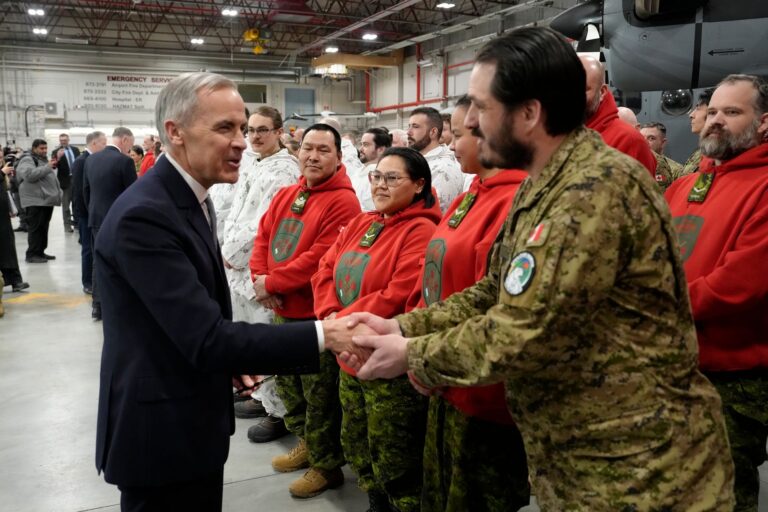
Prime Minister Mark Carney, wearing a suit suit jacket, smiles and shakes hands with an Armed Forces member. Several rows of people stand behind them, wearing camouflage pants and red or white sweaters.
News

Canada’s Arctic defence push is overwhelming communities in the North

By David Reevely

Briefing

Stellantis goes ahead with sale of Ontario auto plant to defence company Roshel

By Joanna Smith   |   Nov 9, 2026 | 4:42 PM ET

Nvidia sheds billions in value amid probe of Huang’s affair with suspected Chinese spy

By Catherine McIntyre   |   Nov 9, 2026 | 4:19 PM ET

PSP Investments to buy 50% of Brookfield’s Enercare for $1.6B

By Chaimae Chouiekh   |   Nov 9, 2026 | 4:17 PM ET

Best business newsletter in Canada

Get up to speed in minutes with insights and analysis on the most important stories of the day, every weekday.

Exclusive events

See the bigger picture with reporters and industry experts in subscriber-exclusive events.

Membership in The Logic Council

Membership provides access to our popular Slack channel, participation in subscriber surveys and invitations to exclusive events with our journalists and special guests.

Recent Popular Stories

News

Wealthsimple launches AI assistant as Canada’s big banks block third-party agents

By Chaimae Chouiekh   |   Nov 5, 2026
News

Former Ciena employee claims she was fired for reporting sexual assault by executive

By Catherine McIntyre   |   Nov 3, 2026
An exterior of a five-storey office building with two Canadian flags out front. Above the entrance is a four-storey window with Ciena's logotype written sideways.
Commentary

Carmichael: Carney and Champagne’s budget sends the bond market a message

By Kevin Carmichael   |   Nov 5, 2026
An image of Mark Carney against a light and dark background.
News

Ottawa extends open banking principles to other sectors—but continues to delay original framework

By Claire Brownell   |   Nov 5, 2026
News

Canada is buying military gear for a world where ‘pretty much everything’ changed

By David Reevely   |   Nov 2, 2026
Three people, wearing business clothing and red poppy pins, sit on chairs on a stage. The person in the middle is speaking. A blue background is visible behind them.
News

Conservatives challenge Ottawa to justify its $1.6B Cohere investment

By Catherine McIntyre   |   Nov 2, 2026
An image of Prime Minister Mark Carney, standing in front of a microphone and speaking. He is wearing a blue suit and tie, while looking away from the camera. He is standing in front of a dark background. The Cohere logo is visible in the background.

Canada's most influential executives and policymakers are reading The Logic

  • CPP Investments
  • Sun Life Financial
  • C100
  • Amazon
  • Telus
  • Mastercard
  • bdc
  • Shopify
  • Rogers
  • RBC
  • General Motors
  • MaRS
  • Government of Canada
  • Uber
  • Loblaw Companies Limited
logic-logo

Canada's Business and Tech Newsroom

100% human-crafted journalism

Newsroom

  • News Tips
  • AI Policy
  • Editorial Disclosures
  • Story Pitches

Company

  • About Us
  • Terms of Service
  • Privacy Statement
  • Corporate Information

Contact

  • Contact Us
  • Advertise
  • FAQs
  • Work at The Logic

© 2026 The Logic Inc. All Rights Reserved.

Trusted by leaders

Error

Account creation failed.

Please email us at [email protected].

Create Account

[wppb-register form_name=”cozmo-registration-form-for-modal”]

I do have an account
Login
or

[wppb-login]

I don’t have an account