Talent Quarterly is The Logic’s regular series on the Canadian job market, focusing on workforce trends and the talent challenges that managers face.
Canadian workers are just plain worn out.
Around one in every four employees, or 24 per cent, struggles with burnout, according to a recent survey by Pollara Strategic Insights, up from 21 per cent a year earlier. Many of the 3,213 people surveyed reported feelings of fatigue (40 per cent), low motivation (38 per cent) and declining efficiency (29 per cent). Another survey from consultancy firm Robert Half earlier this year had similar findings.
Talking Points
- Around one in every four Canadian workers feels burnt out, reporting higher levels of work-related stress and diminished morale
- The problem, while not as visible as other trends, could influence everything from Canada’s productivity rates to the adoption of next-generation tech like generative AI
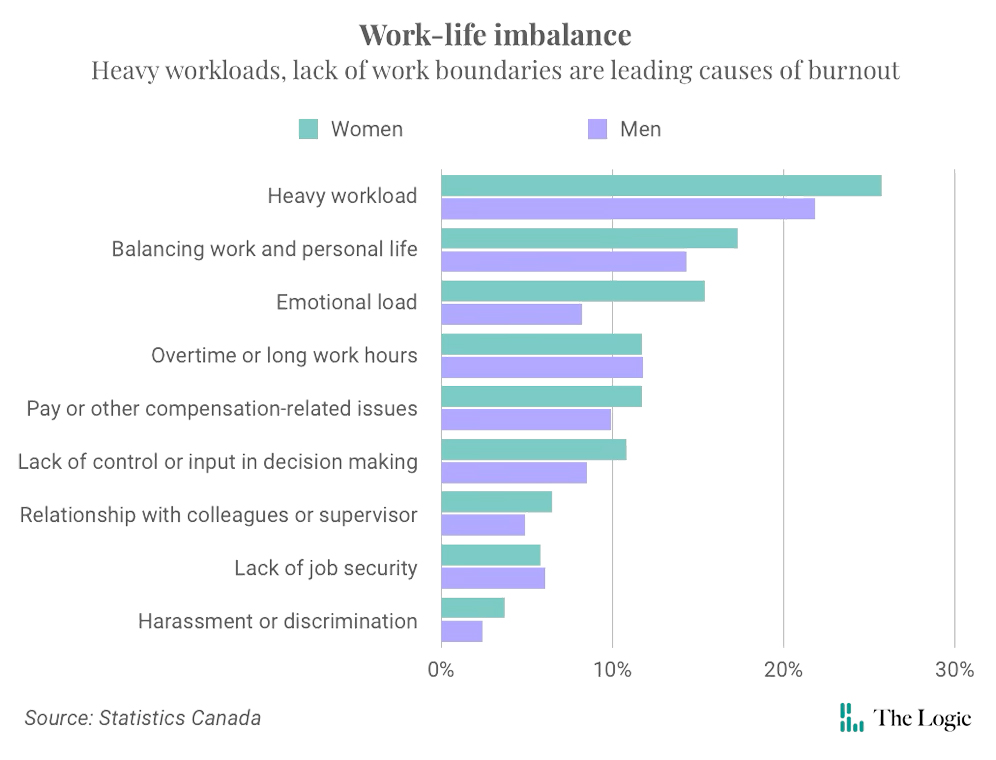
It’s not because employees are working longer days. Working hours have remained mostly flat over the last few decades, according to Statistics Canada, while the proportion of employees working 45 hours or more has fallen markedly. Experts instead attribute rising fatigue to other reasons, from technological advancements to working from home to Canada’s affordability crisis.
Burnout—characterized by feelings of exhaustion, low morale or immense stress—is inherently hard to quantify, and therefore isn’t tracked in the same way that macro labour trends like employment levels are.
While not as visible, however, burnout could carry far-reaching consequences, HR consultants told The Logic. High exhaustion rates could be “the tip of the iceberg” for a much larger problem, said Silvia Gonzalez-Zamora, a partner at KPMG. A less efficient workforce would compound Canada’s productivity crisis, for example, while rising rates of fatigue could influence the structure of hybrid work arrangements or the adoption of efficiency-improving technologies like AI.
Rising burnout rates over the last year suggest the current trend could be the “new normal” in Canada’s labour market, according to Michael Cooper, a vice-president at the charity organization Mental Health Research Canada, which commissioned the Pollara study.
Your GenAI is bumming me out: KPMG’s Gonzalez-Zamora believes part of the burnout problem is due to the rapid shift toward new technologies, which accelerated during the pandemic.
By the numbers:
6.5% – Canada’s unemployment rate as of September 2024. Unemployment rates have been gradually rising as the labour market cools, but remained mostly flat in the third quarter, declining 0.1 per cent in September and increasing 0.2 per cent in August.
544,335 – Number of job openings in Canada as of July 2024. The country’s job vacancies peaked in the second quarter of 2024, but started to tick down in July, signalling a return to a tightening labour market after it slackened in the first half of the year.
19.7% – Respondents who use regional pay rates to determine salaries in different parts of the country, according to the Conference Board of Canada’s latest compensation outlook survey. Remote work arrangements have led to more dispersed workforces.
As companies automate systems, introduce generative AI, consolidate their data or install new cybersecurity protocols, employees are able to detect and solve problems faster. That raises efficiency, but it also forces employees to handle many more problems in a shorter timeframe, which can feel unnatural or overwhelming.
“This is a massive change from doing things at a traditional pace,” Gonzalez-Zamora said.
My dollar goes nowhere: Another cause of burnout is Canada’s affordability crisis, according to the Mental Health Research Canada’s Cooper.
When people are priced out of buying a home, struggling to buy basic amenities, or generally feeling like they can’t get financially ahead, their motivation to work tends to erode quickly. Unsurprising, then, that the highest rates of fatigue and lacking motivation are among Canada’s lower-income workers.
“We see more burnout in those struggling to pay bills,” Cooper said. “So they’re bringing the stress of their experience to their workplace. They’re coming to their workplaces with less charge, with less battery, and they’re burning out faster.”
Hear me out: With burnout rates high, managers and executives need to be more attuned to the concerns and needs of their workforces, said Michael French, regional director at HR consultancy Robert Half.
People on the move:
- Bitfarms named Ben Gagnon as CEO.
- Ruth Casselman was named CEO at the Kitchener-Waterloo, Ont.-based Accelerator Centre.
- Kinaxis CEO John Sicard will retire from his role at the end of 2024.
- Fintech lender Goeasy’s CEO Jason Mullins will leave his role at the end of the year, but remain a board director.
- Marissa West left her role as president of GM North America, just eight months after she began.
- MDA’s CFO Vito Culmone stepped down, with Janet McEachern to serve as interim.
- Tim Foote was appointed as Blackberry’s CFO.
- Hut 8 hired Sean Glennan as CFO.
- The Ontario Teachers’ Pension Plan appointed Mabel Wong as CFO.
- Power Corp.’s Sagard hired Parinaz Sobhani as its new head of AI.
- Pierre-Jules Tremblay was appointed managing director of Ubisoft Montréal.
In its latest research on burnout rates, the firm found that many companies were diligent about monitoring employees’ mental states during the peak of the pandemic, but those efforts have since tapered off.
“We know that leaders need to communicate and do continual one-on-ones with their teams,” French said.
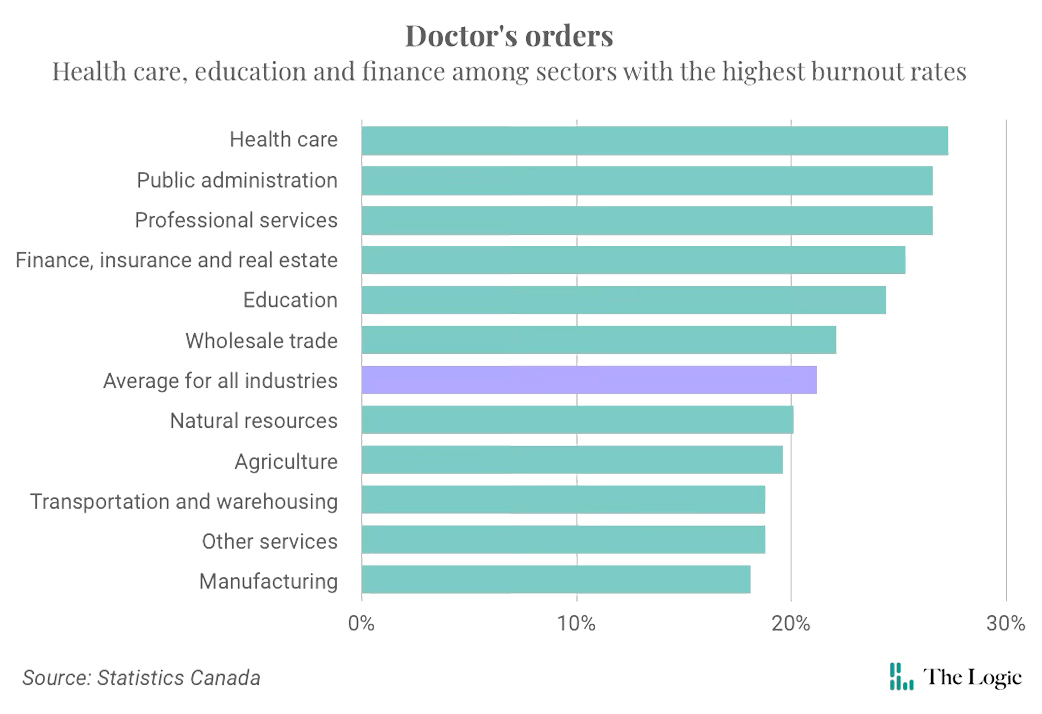
Other problems simply stem from understaffing and overwork, French added. The creative and marketing industries had the highest rates of burnout according to Robert Half’s research, at around 60 per cent. The legal, health-care and education sectors also had higher rates of work-related fatigue.
No office is a (kitchen) island: Burnout may also be linked to remote work, a topic that was hotly debated over the third quarter. Amazon CEO Andy Jassy is forcing workers to return to the office, joining a long list of other corporations including Canadian lenders RBC and TD Bank. Other CEOs, from Shopify’s Tobias Lütke to heads of smaller companies like Toronto fintech Koho, have embraced hybrid work.
Remote work can give workers greater flexibility and eliminate stressful commutes, but working from home can also blur the lines between the office and the rest of life, French said.
“When your computer sits on your desk or on the kitchen island and never closes, you never actually finish the work day, because you keep being pulled back into it,” he said. “When you left the office, you actually closed your computer and you left.”
Executives would do well to spell out exactly what is required from remote workers, French said. In his firm’s research, they found employees struggled more with work-from-home arrangements when they were unsure about their employers’ expectations.
“The more iffiness there was, the more anxiety,” he said.