Talent Quarterly is The Logic’s regular series on employment trends.
Judging by the data, Canada’s labour market took an icy bath in the second quarter.
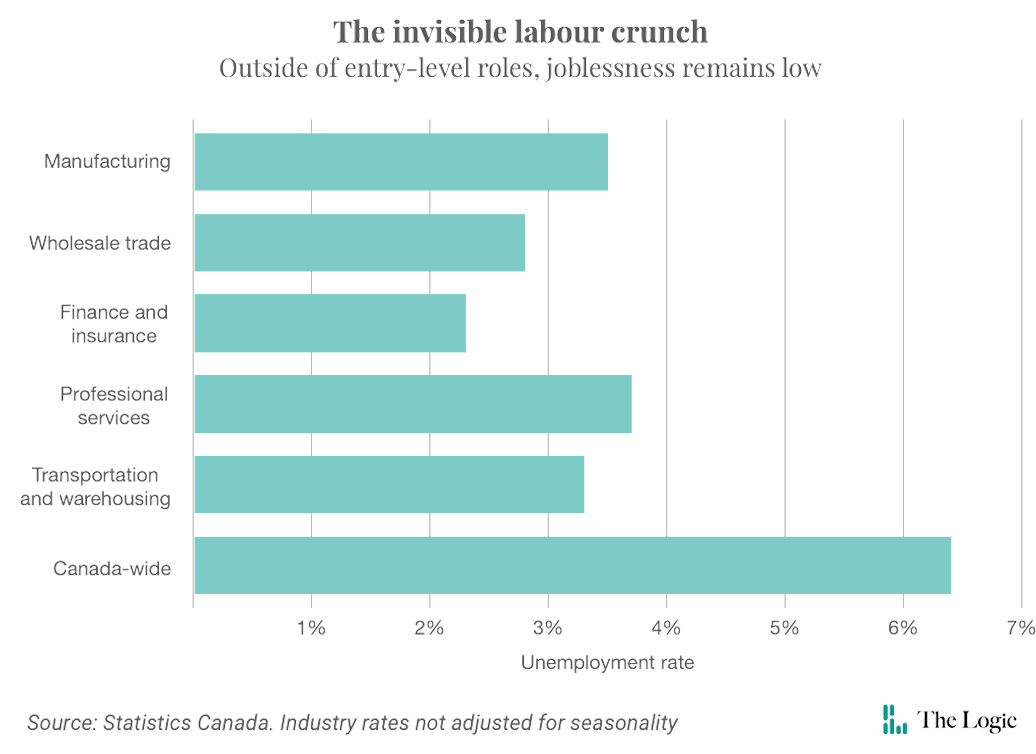
Unemployment rates gradually climbed between April and June, peaking at 6.4 per cent. That put Canada’s jobless rate at its highest since January 2022, when the country was still staggering out of the global pandemic, and capped off a steady two-year increase in unemployment levels. As far back as the 1970s, a rise in joblessness this sharp and this long has always corresponded with economic recession, RBC analysts recently noted. The Bank of Canada on Wednesday cited unemployment and the slackening labour market as one of the reasons for its latest interest rate cut.
Talking Points
- Canada’s growing overall unemployment rate is a major focus in labour market circles
- But beneath the data, recruiters and hiring managers face a persistent talent crunch to find workers in tech, legal and business fields—leading to higher employee turnover
But those data only tell part of the story. Beneath the headline numbers, labour markets feel as hot as ever for companies seeking skilled workers in areas like tech, legal and finance. For employers in those fields, that’s meant a rising tide of turnover among white-collar workers in recent months.
“It’s a little bit of a hidden labour crunch,” Cal Jungwirth, workplace expert at recruitment firm Robert Half, said.
According to RBC, about 40 per cent of the unemployment growth since the end of the pandemic is among students and new graduates struggling to find work. Layoffs are up 20 per cent since last year, resulting in almost half the unemployment growth.
But across technical fields, labour markets are tight and Canada’s longer-term talent shortage persists. Unemployment as of June remained low in business, finance and administration (3.5 per cent), technology (2.9 per cent) and legal (1.9 per cent), according to Statistics Canada.
The trend has nudged wages higher and prompted more turnover as white-collar workers pursue new work opportunities, despite the threat of slackening labour markets and economic uncertainty.
“The [unemployment] numbers are ticking up a little bit higher,” he said. “But when we peel back the layers a little bit, and you look at different specialties, talent is still really tough to find.”
By the numbers:
5.4%: The increase in average hourly wages across Canada’s working population in June. Wages grew gradually over the second quarter on a seasonally adjusted basis as labour markets remained tight in industries requiring skilled workers.
8,800: The number of jobs lost in the public administration sector in June. The loss marked the first sector decline in nearly a year, as eight out of 16 industrial categories encountered job losses in the last month of the quarter.
13.5%: The overall unemployment rate in June for youth aged 15 to 24. Youth unemployment grew 0.9 per cent in the final month of the quarter, as young people and entry-level workers struggled to find work, which continued to nudge overall unemployment higher.
Thank you, next
A recent Robert Half survey found 50 per cent of Canadian workers plan to look for another job in the second half of 2024, up from 41 per cent a year earlier. While the highest proportion of people with those intentions are among Gen Z talent (69 per cent), the most pronounced shift is among the older cohort. Forty-four per cent of Gen Xers plan to seek out new work, up from 39 per cent last year, while Baby Boomers’ job-changing intentions rose from 22 per cent to 40 per cent.
“There are more revolving doors, and it’s because we are facing not just a shortage of people, but a shortage of skills,” said Silvia Gonzalez-Zamora, an HR expert at KPMG.
That seems to run counter to the U.S. talent market, where job-hunting activity has reportedly waned as more people find workplace satisfaction—a trend some economists are calling the “big stay.”
People on the move:
- Christian Settano was named interim head of BDC Capital, while Paula Cruickshank was appointed as senior vice-president of fund investments.
- Former Lightspeed CEO J.P. Chauvet joined Montreal’s Inovia Capital as an executive-in-residence.
- Laura Kilcrease departed as CEO of Alberta Innovates, along with executive vice-president of impact Rollie Dykstra.
- Stacy Kauk left her role as Shopify’s head of sustainability. She is now head of science at U.K.-based Isometric.
- Stephan Rupert was appointed as the inaugural chief information officer for Canada Growth Fund Investment Management.
- Corus announced that CEO Doug Murphy was retiring. Troy Reeb and John Gossling replaced him immediately as co-chief executives.
- KPMG Canada named Benjie Thomas as its next CEO.
- EY Canada appointed Alycia Calvert as its chair and CEO. She’s the first woman CEO in Canada at the Big Four global accounting firms.
- Shawn Malhotra, former head of engineering and product development at Thomson Reuters, will be chief technology officer at Rocket Cos.
- Sean Murphy was hired as manager of government affairs and public policy at Google.
Turnover rates in Canada have meanwhile crept up from 12.4 per cent in 2022 to 15.5 per cent last year, according to Statistics Canada. The attrition is mostly in areas like healthcare, retail and logistics (chemicals and energy has had some of the lowest rates) as workers have sought out greener pastures.
“They are silently looking for another job,” Gonzalez-Zamora said. “Maybe they’re wanting to change, they want to find a purpose in their careers. That’s also not just in Canada, but in general, happening after the pandemic. We still have a lot of people questioning their career choices.”
A pandemic hangover
Robert Half’s Jungwirth said rising unemployment is a natural result of the pandemic, which caused employment rates to collapse followed by a sharp return to normal.
“If we think back to two years ago, we were still in that recovery space,” he said. “Now, I think what we’re seeing is the numbers reflecting the true economy.”
While that has translated into higher unemployment rates, wages continue to climb. Average hourly wages increased 5.4 per cent in June on a year-over-year basis, 5.1 per cent in May and 4.7 per cent in April. Year-over-year wage growth as of June was most pronounced in forestry and mining (8.8 per cent), wholesale trade (5.4 per cent), insurance and real estate (4.9 per cent) and transportation and warehousing (4.2 per cent).
Correction: This story has been updated to clarify that about half of the unemployment growth since the end of the pandemic is due to layoffs, which are up 20 per cent since last year, according to RBC.