I’m terrified of black holes. Lightspeed founder and CEO Dax Dasilva finds them relaxing. With the help of artist Kelly Nunes, he created one in a downstairs storage room at his house. When Dasilva meditates, instead of closing his eyes, he focuses on a dot of organic black paint at the end of an illusory tunnel of swirling light.
Skip to content
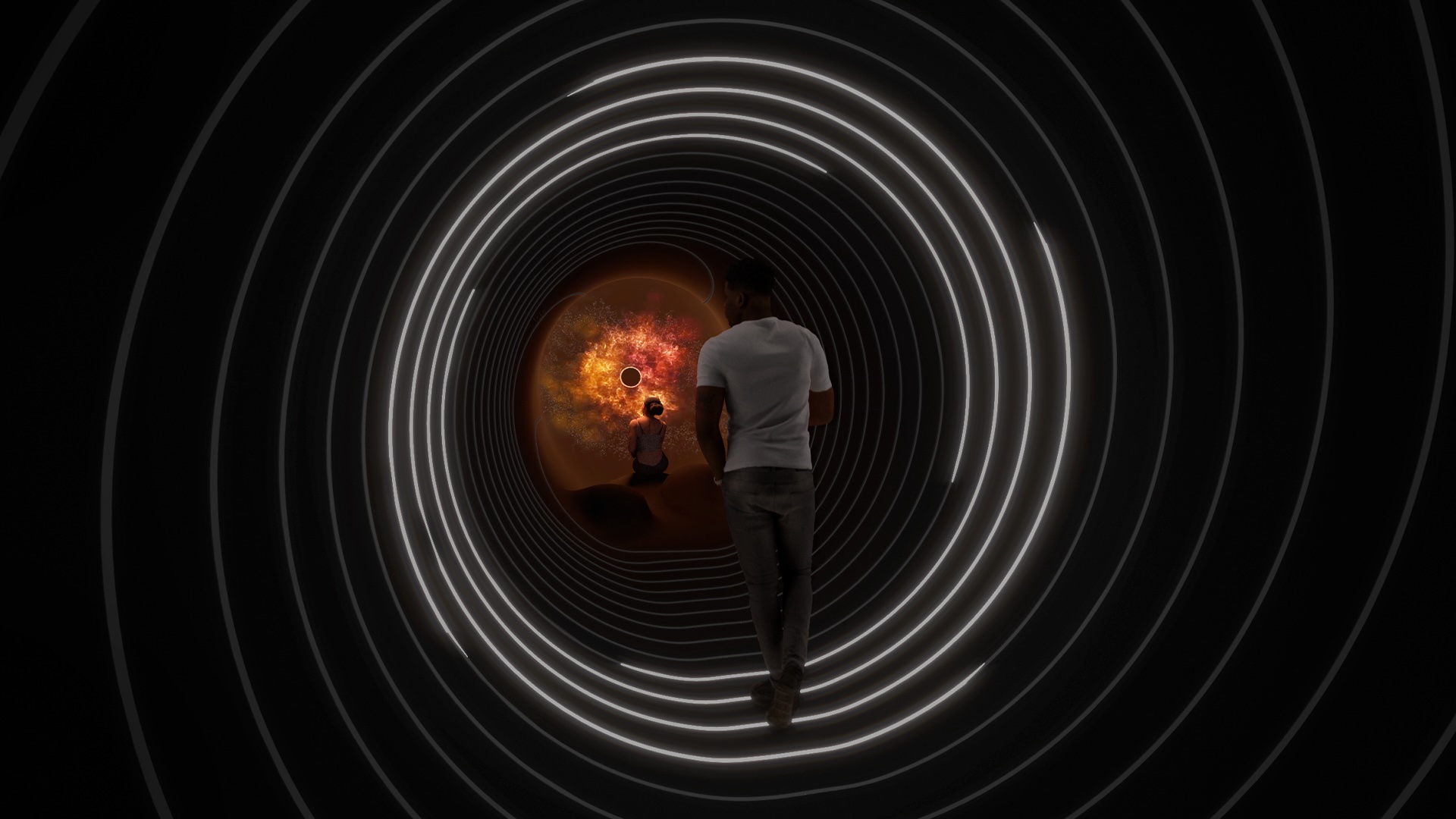 A handout photo shows the interior of Dasilva’s Black Hole Experience, which will pop up at a series of festivals in Canada and the U.S. this summer. Photo: Handout
Commentary
Carmichael: Dax Dasilva’s guide to the galaxy
He’s back in charge at Lightspeed, but he’s still searching for something bigger
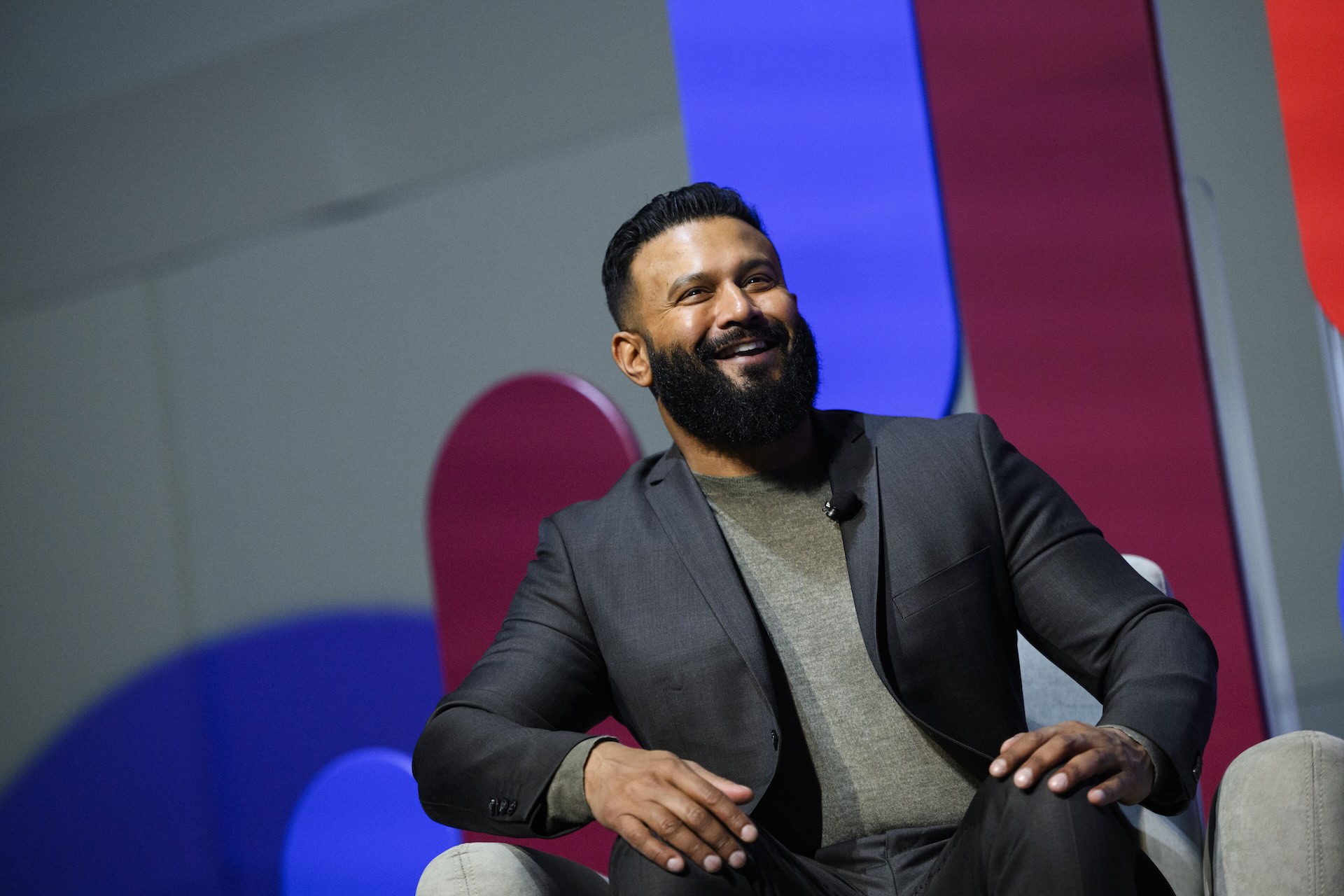
Lightspeed CEO Dax Dasilva in Toronto in March 2024. Photo: Christopher Katsarov Luna for The Logic
I’m terrified of black holes. Lightspeed founder and CEO Dax Dasilva finds them relaxing. With the help of artist Kelly Nunes, he created one in a downstairs storage room at his house. When Dasilva meditates, instead of closing his eyes, he focuses on a dot of organic black paint at the end of an illusory tunnel of swirling light.
“It’s a little room just off my garage,” Dasilva said. “My contractors had painted the staircase down to it all black. So I felt like I was going into a German techno club, you know, like going down the stairs. So, obviously it wasn’t going to be the ‘forest room,’ it was going to be something a little bit more … um … a little bit more … a little darker.”
This week, a touring version of Dasilva’s cosmic escape room housed in a trailer was parked at the C2 conference in Montreal. The Black Hole Experience has three stages. The first features silhouettes of animals, and at least one human, that are illuminated by motion lights; what Dasilva described as the “particle stream.” You enter the “black hole” itself through a tunnel that’s ringed with thin white lights. The ultimate experience takes place while sitting on a beanbag chair. Multiple projectors create the illusion of a tunnel, but one where the walls are made of swirling light—and the end is nothing but a black dot, swallowing all oranges, reds and yellows.
At one point in the loop, there’s an explosion—but thanks to my guide, I was ready for it. “Here comes the Big Bang,” Dasiliva warned me.
Related Articles


“A big challenge in our society right now is we are disconnected from nature, we’re disconnected from spirituality,” Dasilva said later, in an interview. “What’s interesting about spirituality is … people are always like, ‘Go to the light! Go to the light!’ We don’t get to explore the mystery of darkness, and I think that’s what spirituality is ultimately, the unknown—and finding inspiration from not knowing.”
I’ve spoken to Dasiliva numerous times since Lightspeed’s IPO in 2019. He’s a rare leader of a big Canadian publicly traded company who is willing to speak in uncontrolled environments. It would be harder for Conservative Leader Pierre Poilievre to smear corporate leaders as “have-yachts,” and for Prime Minister Justin Trudeau to dismiss critiques of his plan to raise capital-gains taxes, if more CEOs were willing to tell their stories. It’s difficult to villainize someone the public already knows.
But at least there’s Dasilva, who returned from a two-year hiatus in May to take back his job as CEO. He told me in our first interview in 2019 that he thought being the head of a successful company meant he had a responsibility to be a “thought leader.” He’s done that by nudging us to think, most often by trying to set an example.
When he left Lightspeed in February 2022, Dasilva might have joined a venture fund or dabbled in angel investing like so many other tech millionaires. Instead, he focused on his environmental non-profit, Age of Union, which he seeded with $40 million in the autumn of 2021. That meant getting “scrappy” again. “It felt like the very early days at Lightspeed, so it was fun,” he said. Age of Union has now funded 10 conservation projects and produced numerous films, including “Wildcat”, which won an Emmy. In February, he was in Haiti not long before the country was effectively taken over by gangs, to do some work with Sean Penn’s foundation.
“Not the safest place to go,” Dasilva said.
Amidst all that, Dasilva also decided to finish his liberal arts degree. Lots of successful entrepreneurs donate millions to charitable causes, but the degrees they collect in retirement tend to be honorary ones. He didn’t come out and say that budding entrepreneurs should stay in school, but he advised youngsters to choose degrees that match their passions.
“Some nice people say, ‘Oh, there’s no value in a liberal arts degree,’” Dasilva said. “I disagree. It let me explore everything that was meaningful to me. It relates to so many projects that had their different seasons in my life. The art project. The Age of Union project. My conversion to Judaism. The Black Hole project. Lightspeed.”
A couple of years ago, Dasilva thought he was mostly finished with the last item on that list—the point-of-sale software provider that he bootstrapped and turned into a unicorn. He kept a place on the board, but was happy to let others take a turn at running the company day-to-day. “I was there 17 years and I did have to leave,”
he said. “And I guess I did have to come back to bring that fresh perspective back.”
Lightspeed’s stock was in decline when Dasilva left, but things didn’t get better under different management. A pandemic-era buying spree was good for growth, but Dasilva’s replacement, Jean Paul Chauvet, failed to convince shareholders that he had a plan to make Lightspeed profitable.
Dasilva said the company has become too difficult to understand, and that he intends to make it “nice and clean.” He’s already reduced headcount, and he said a refreshed vision for the company will be coming in the fall. The vision will include profits, but he’s not yet ready to set a target. “We’re watching that,” he said. “We’re bonusing our execs on cash flow as well. So, we’ll get there.”
I thought I’d include that last comment for anyone who thinks Dasilva’s personal interests mean he’s lost in space. He might be willing to explore the secrets of the universe, but he knows how things get done here on Earth.
Kevin Carmichael is The Logic’s economics columnist and editor-at-large. He has spent more than two decades covering economics, business and finance for outlets including Bloomberg News, The Globe and Mail and the Financial Post, where he also served as editor-in-chief.



Loading...
Thanks for sharing!
You have shared 5 articles this month and reached the maximum amount of shares available.
CloseThis account has reached its share limit.
If you would like to purchase a sharing license please contact The Logic support at [email protected].
CloseGift the full article!
You have gifted 0 article(s) this month and have 5 remaining.
Recipients will be able to read the full text of the article after submitting their email address. They will not have access to other articles or subscriber benefits.
Photo: Christopher Katsarov Luna for The Logic
A handout photo shows the interior of Dasilva’s Black Hole Experience, which will pop up at a series of festivals in Canada and the U.S. this summer.
Most Popular This Week

In-depth, agenda-setting reporting
Great journalism delivered straight to your inbox.
Special Report
Carney courts trillions in capital with airport privatization, tax breaks and faster approvals
Briefing
Coinbase lets Canadians lend stablecoins out through DeFi protocol
Cohere’s Gomez says Silicon Valley giants shouldn’t get to set the rules for AI
TD pledges $150B in new financing and support in key Canadian sectors
Best business newsletter in Canada
Get up to speed in minutes with insights and analysis on the most important stories of the day, every weekday.
Exclusive events
See the bigger picture with reporters and industry experts in subscriber-exclusive events.
Membership in The Logic Council
Membership provides access to our popular Slack channel, participation in subscriber surveys and invitations to exclusive events with our journalists and special guests.