MONTREAL — The man strolls on stage in jeans and a Henley shirt rolled to the elbows, a wireless mic hovering at the left corner of his mouth. “Hi, everybody I’m Fred,” he says to attendees of the Quebec Climate Solutions Festival, held in 2023. Pacing between two halos of white light, Fred—Frederic Lalonde—rattles off his credentials, notably as co-founder of the app-based travel company Hopper.
He then launches into what he warns will be “the single worst keynote you will ever hear in your life.” The next 15 minutes are a sort of Ted Talk meets environmental doomscroll, in which he outlines the myriad calamities awaiting humankind as a result of its carbon-emitting indulgence. Agricultural collapse. A 58-metre rise in sea levels. More forest fires, more disastrous storms. Pitch deck-style graphs whizz by behind him, all spiking upwards toward catastrophe. “Have we broken the carbon cycle?” Lalonde asks, referring to the process by which carbon circulates in various forms through nature. “Probably.”
Talking Points
- Hopper co-founder and travel entrepreneur Fred Lalonde has reinvented himself as a climate saviour, garnering a following in the cleantech world. Deep Sky, his Quebec-based direct carbon-capture startup, has so far raised $75 million
- Some of Lalonde’s claims don’t align with the facts, such as his assertions about the availability of clean power in central Canada and the scalability of Deep Sky
- His defenders remain unfazed, arguing Lalonde’s mission requires the ability to think big and sell ideas
It isn’t enough to just capture the carbon we’re creating now, Lalonde says. We have to remove the stuff we’ve already emitted over the last century or so. Doing so means sucking carbon out of the air and oceans.
This is where Deep Sky comes in.
The Montreal-based firm Lalonde co-founded in September 2022 specializes (or at least plans to specialize) in direct-air and -ocean capture. Essentially, he proposes putting Deep Sky facilities in places with ample electricity and favourable geology, which would draw carbon from the air or water then pipe it underground, thereby turning back the carbon clock. “The technology exists, we’ve already pre-purchased the licences,” Lalonde says.
If the first two thirds of Lalonde’s pitch is a catalogue of nightmares, its last five minutes are a way out. Pitch deck slides go from stark black and red to pink, green and sky blue, culminating in a rendering of Deep Sky One, a space station-like complex of conjoined circular structures plunked onto a piece of hinterland. Lalonde wants Deep Sky One in Quebec, land of vast geography and abundant electric power, where there is “enough energy to power millions of tonnes of removal,” he says.
The world will need 2,000 Deep Sky Ones, each pulling out 200,000 tonnes of carbon per year, to reach what Lalonde says is the ultimate goal: recapturing and storing underground a significant amount of the carbon that humanity has released into the atmosphere over the last 150 years. To do this, the direct-ocean and -air capture industry must become what Lalonde has described as “an oil and gas company in reverse”—a massive, multinational, well-capitalized industry undoing the sins of the fossil-fuel age.
“This will be without a doubt the largest endeavour that humanity’s ever undertaken if we decide to do this,” he says, thus setting up what you might call the Lalondian trifecta of big dreams, long odds and the redemptive power of technology. The crowd, until then grim-faced and silent, erupts into applause.
The pitch—succinct, dramatic, crammed with data—is quintessential Lalonde. Hopper, which went from wonky concept to Expedia competitor in the space of a decade, is a testament to Lalonde’s ability to digest reams of data, then package and sell what he finds. “He’s one of the smartest people I’ve ever met,” says Sophie Forest, a partner at Brightspark Ventures, an investor in both Hopper and Deep Sky.
While the treatment is familiar, Lalonde’s Deep Sky pitch points to greater stakes than cut rate airline tickets and rental cars. He has reinvented himself as a climate saviour, a man who has turned his gaze from the business of travel to saving the planet. How he got here is an odyssey in its own right. Suffice to say, the market has so far responded in kind to Lalonde’s zeal, with Deep Sky raising $75 million. “He’s such a passionate and impressive guy. First meeting, first pitch, I was sold,” said Pascal Lanctot, a partner in the Business Development Bank (BDC) Climate Tech Fund, a Deep Sky investor. “I have a PhD. I like evidence to support the facts and I like well-supported presentations. And he did exactly that.” Last August, Deep Sky appointed former OMERS Ventures head Damien Steel as CEO, presumably to raise the mind-bending amount of capital it will require to install Deep Sky’s technology on the landscape.
A rendering of Deep Sky's proposed direct removal and storage project, Deep Sky One. Photo: Deep Sky/Handout
Yet the data Lalonde cites in selling Deep Sky to a rapidly warming world don’t always add up.
Sometimes it’s little things, like when he said China is currently building 192 nuclear power plants; in fact it’s building 27, according to the World Nuclear Association. Other times it’s more fundamental, as when he claimed Quebec is investing in nuclear power. (It isn’t.) Or that Deep Sky can tap into a collective 10-year electricity surplus from Quebec and Ontario. (Quebec and Ontario have no such surplus.) Or that Ontario loses money when it sells power to the U.S. (It doesn’t.) Or, indeed, that direct-air and -ocean capture technology is currently scalable, and Deep Sky has pre-purchased the licences. “We haven’t pre-purchased the licences yet,” Deep Sky chief carbon scientist Phil De Luna told me, adding that the tech isn’t currently scalable.
These details are important, and not only because Lalonde plans to locate a number of Deep Sky carbon-removal operations in Quebec and Ontario. Lalonde has a lot of public money riding on the strength of his data. The federal government, through the BDC, has invested $5 million in Deep Sky. Ontario, through public pension manager OMERS, put in an undisclosed amount to foster Deep Sky’s “highly scalable” technology. The Quebec government is in for $25 million through its investment arm—with the potential to plow in hundreds of millions more, according to Innovation Minister Pierre Fitzgibbon, who calls Lalonde “our Bill Gates.”
Lalonde declined repeated requests to be interviewed for this story, citing past coverage of Hopper by The Logic, though he didn’t provide specifics. Deep Sky’s vice-president of communications Brooks Wallace didn’t respond to emailed questions.
Lalonde’s defenders, however, downplay his elasticity with certain facts. Climate change is a problem in need of champions—people who can not only master the vexing business of removing carbon from the air, but wring dollars from the process as well. It wasn’t part of his pitch, but the crisis Lalonde spoke about so passionately onstage in Montreal is also an untapped business opportunity rich with potential “outsized returns” for first-to-market entrepreneurs who land the carbon-capture moonshot, Forest told me.
If that’s the case, then maybe certain facts aren’t important so much as the will and the means to fix the problem. Fred Lalonde wants to save the planet. For now, everything else is just data points and noise.
Lalonde’s love affair with data began in the 1990s when, freshly dropped out of college, he began to ponder the market inefficiencies of online hotel reservations. His first company, Newtrade, allowed hotels to better deliver rate and availability information. Expedia acquired the company in 2002, and Lalonde worked at the Seattle-based online travel giant for the next five years. “He was the classic sort of guy who could be the translator between the tech world and the business world,” former Expedia CEO Erik Blachford told me.
Lalonde left Expedia in 2006 to start Hopper with former Newtrade software architect Joost Ouwerkerk. The pair began hoovering up data, mostly old flight manifests and price listings from airlines, when few others were doing so.
Hopper started as an experiential travel site where you could plan a trip in its entirety. Soon, though, Lalonde saw that people focused less on the day-by-day itinerary of a trip than its bottom line. “They realized people really, really cared about the transaction and the price, and it was mostly on flight and hotels,” said Forest of Brightspark, one of Hopper’s first investors. “People really wanted to know how much it’s going to cost them to fly, and they want to save $5 on a flight. So that’s where everything shifted.” Hopper’s key selling point: its price prediction tool, which uses historical flight data to forecast when tickets will be at their cheapest, then alert users of the best time to buy.
As Lalonde told me when I interviewed him in 2019, Hopper’s success validated a piece of business advice he gleaned from Expedia founder Richard Barton: find an anxiety-inducing consumer problem—like, say, booking flights—use data to fix it, then monetize the solution. Hopper, which is private, was last valued at US$5 billion. I asked Forest if the company is profitable. “They’re getting there,” she said, before adding, “I’ve made a lot of money.”
Lalonde’s defenders downplay his elasticity with certain facts. Fighting climate change, they say, requires champions who can master removing carbon from the air while wringing dollars from the process.
In climate change, Lalonde alighted on the defining anxiety-inducing issue of our time. It was evidently weighing heavily on him in 2020, the year Hopper launched Hopper Trees, an initiative that aimed to offset the company’s travel-associated emissions by funding reforestation. In an interview with the travel industry trade site PhocusWire, Lalonde said Hopper’s growth and success was bittersweet, because it meant the company was contributing incrementally more to the climate crisis.
A ticker on the Hopper website says the company has planted more than 35 million trees. Yet Lalonde wasn’t satisfied with the carbon offsets, according to fellow tech entrepreneur Adrian Schauer. “He saw that there were big players in the carbon offset space, but that when you actually track it to see what they’ve done, it’s literally nothing. It’s often just a shell game,” Schauer, who has known Lalonde for about 10 years, told me in February. In theory, credits purchased by polluters are meant to fund new clean energy projects. According to a Wall Street Journal report in 2022, though, many of the established greentech companies selling them use the proceeds not to expand carbon reduction but to pad their bottom lines.
Deep Sky was Lalonde’s response. The company isn’t developing its own carbon-capture technology, per se. Rather, it seeks out emerging technologies and signs partnership deals to help develop the technology. In Lalonde’s telling, this acquisition process has been comprehensive—“We visited every lab, every startup that was building a carbon-capture reactor,” he said on a podcast last year—and occasionally audacious.
“We snuck into a trailer at the Carbon Engineering site because they wouldn’t let us in,” he said, referencing the direct-air capture company based in Squamish, B.C. “We talked our way into university campuses, basements at UCLA, a bridge in London with these kids building this amazing rig where they push carbon into water and take it out with electricity.”
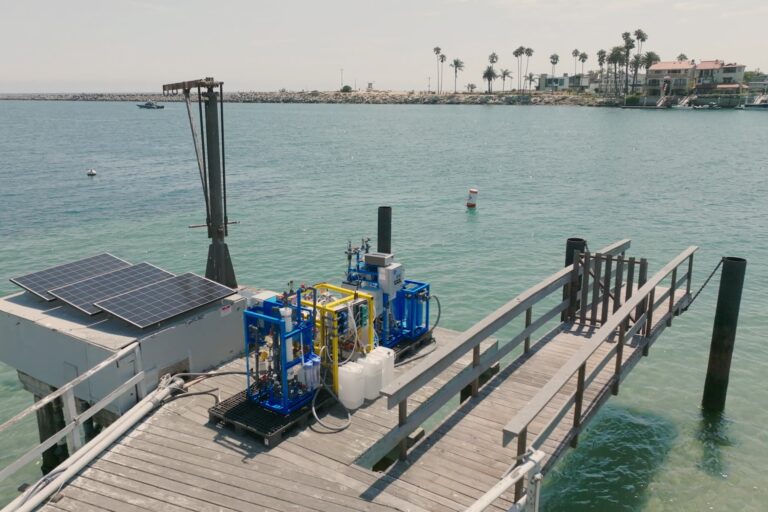
Deep Sky has inked partnerships with North America-based Captura, Svante and Equatic, as well as U.K.-based direct-air capture startup Mission Zero. Last November, the company announced it was working on potential direct-air capture and storage projects in Canada with Swiss firm Climeworks, which operates a large-scale carbon dioxide removal plant. The goal of these partnerships, says De Luna, is to suss out the most viable technologies, then help them scale into commercial products.
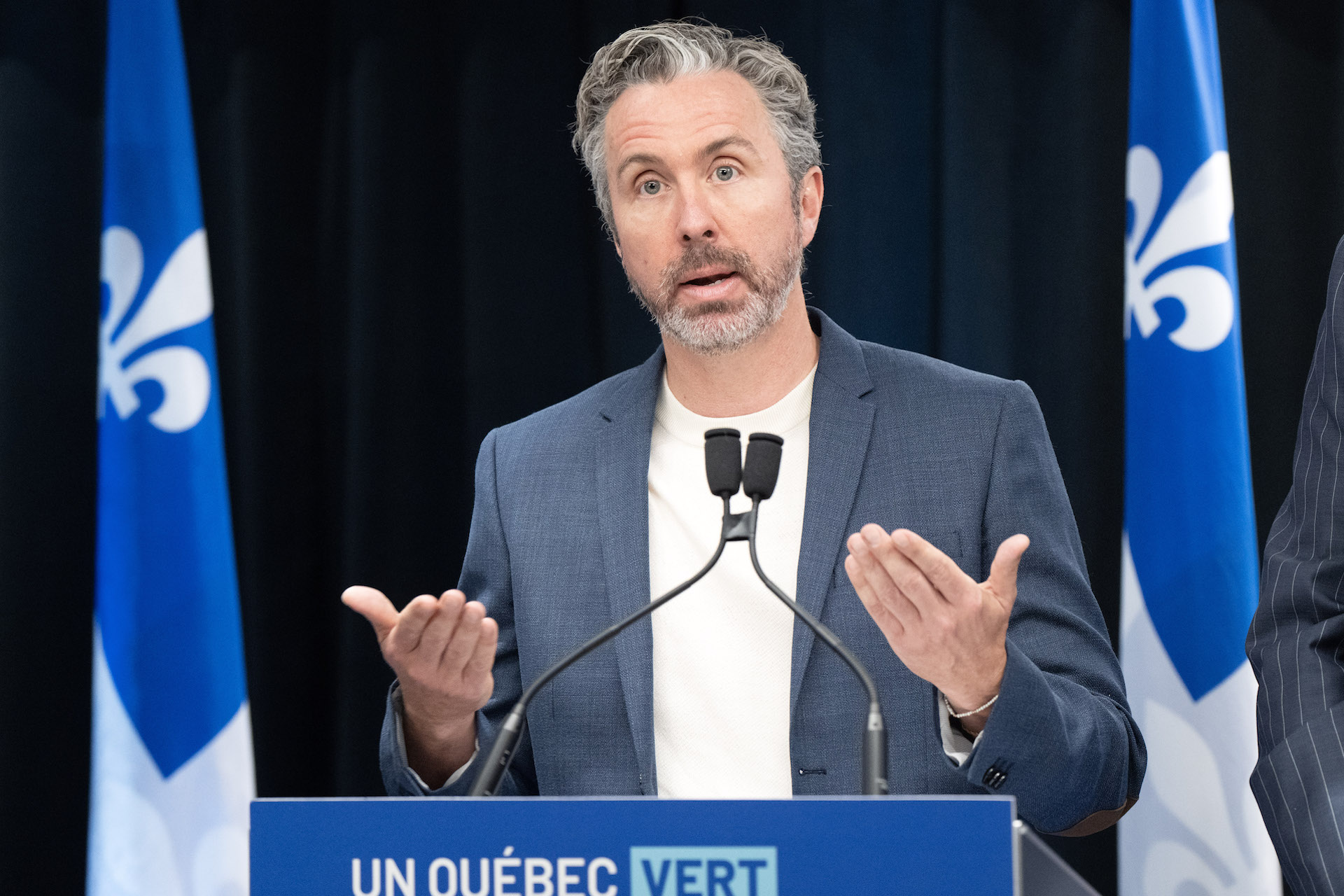
Lalonde at a Montreal news conference with Quebec government ministers in November 2023. Photo: The Canadian Press/Ryan Remiorz
The potential market for Deep Sky’s services is vast and largely untapped. In their quest for carbon neutrality, countries and companies around the world are clamouring for a place to stuff their emissions. The market delivering gigatonne-scale carbon removals of the type Deep Sky aspires to could be worth as much as US$1.2 trillion by 2050, according to a December 2023 McKinsey report.
Carbon dioxide removal purchases increased 437 per cent in the first half of 2023 compared to all of 2022, due largely to the spending of companies like Microsoft and Airbus, according to a Carboncredits.com report. Yet the amount of carbon actually removed was just 2.6 per cent of what these companies purchased. That’s because there were fewer than 20 direct-air capture plants in the world, all of which removed less than 10,000 tonnes of CO2 per year, according to a 2023 Harvard Kennedy School report. Deep Sky, De Luna says, can make money by serving this yawning supply-and-demand gap.
This market remains vulnerable to all sorts of things, like changes in government, the pace of technology and, above all, the availability of power. But that’s precisely the type of high-risk, high-reward prospect that makes venture capitalists drool. “If you only focus on the current ways of making money, usually you don’t create the outsized return,” says Forest, the Brightspark partner. “Think about AirBnb. Nobody thought you could ever make money by renting a room in your house. Think about Tesla, nobody ever thought you could actually build an electric car and a VC could make money from it.”
Carbon removal is underpinned, of course, by arguably the most compelling market force of all: avoiding global environmental catastrophe. But saving the planet, Forest acknowledges, “is not necessarily the job of a VC.” Rather, Forest sees in Deep Sky a typical venture play: make outsized investments in an emerging field to spur rapid growth. Brightspark has invested about $11 million in Deep Sky. “You can’t save the planet if you don’t make it a commercial endeavour. That’s why it’s all about making money, ” Forest said. “You need to make something that will stand on its own and make money, because you need to compete with oil and gas.”
Deep Sky is proudly Quebec-based, and De Luna says the company “absolutely” plans to build commercial facilities in the province. The company is also exploring two carbon-storage sites in the province, one in the Bécancour region—the province’s burgeoning EV battery production hub—and another in Thetford Mines, the one-time asbestos mining capital of the world until operations shut down in 2012. Once captured, the carbon would be pumped into rocky depths below 800 metres, where it must remain for at least 10,000 years to avoid impact on the climate.
It is difficult to overstate how heavily Deep Sky’s business model relies on Quebec’s electrical bounty. The company “plans to use Quebec’s clean hydropower electricity to capture CO2” with the goal “to commercialize these technologies and sell carbon credits,” according to a briefing note prepared for Jeff Labonté, the federal associate deputy natural resources minister, who met with Deep Sky’s executives in October 2023. Bicha Ngo, CEO of Investissement Québec, the province’s investment arm, was until recently one of nine Deep Sky board directors. (Jean-François Béland, Investissement Québec’s vice-president for strategic services, has since replaced her.)
“We are 100 per cent hydro in Quebec, which is the cool part of Canada, the French part where the food is great,” Lalonde said last year on a podcast hosted by VSC Ventures partner Jay Kapoor. “And we built these massive hydroelectric dams in the ’60s.” On the podcast, Lalonde claimed the province forgoes about six billion kilowatts of power by allowing water to “run around the dams.” (Lalonde didn’t specify over what period, or whether he meant kilowatt hours, a measure of electrical generation over time.) He also said the province is “building more nuclear” to beef up capacity.
The problem is that much of what Lalonde says about the province’s electricity grid doesn’t hold up to scrutiny. “Hydro-Québec does not release any water from its reservoirs,” Hydro-Québec spokesperson Caroline Des Rosiers said when I put Lalonde’s claim to her in April. The utility also isn’t investing further in nuclear, as Lalonde claimed. In fact, the province ceased producing nuclear power in 2012. “We are not building nuclear power plants. That is a false statement. While we are in analysis mode, nuclear development is not in our Action Plan 2035. New capacity will come from energy efficiency measures, wind power, refurbishing our existing facilities, and new hydropower,” Hydro-Québec spokesperson Lynn St-Laurent said.
During the same podcast, Lalonde said there was a similar energy surplus in neighbouring Ontario, where Deep Sky also plans to build carbon-removal and sequestration operations. Lalonde claimed the province let the same amount of power as Quebec go to waste—“six billion kilowatts,” or 6,000 gigawatts—in the form of steam generated from nuclear power, which the province lets slip into the ether rather than use it to generate power. This happened, Lalonde claimed, because the province could neither use the electricity nor sell it to the U.S. “Ontario can’t even export it. A year out of two, we lose money when we do it,” Lalonde said.
I put Lalonde’s claims to the Independent Electricity System Operator (IESO), the government body charged with overseeing Ontario’s electrical grid. In fact, the amount of nuclear-generated energy the province curtailed, or let go as steam, was “much, much, much, much smaller,” said IESO spokesperson Andrew Dow—a bit less than 1.3 gigawatt hours worth of electricity in 2023. As for losing money, Dow said, “I don’t know why he says one out of every two years. We would just say that we’re making money every year.”
Perhaps Lalonde’s boldest claim is that, taken together, Quebec and Ontario have a 10-year power surplus from which Deep Sky can draw. “I am sitting as a Canadian on 14 billion kilowatts of renewable energy that’s at least going to be there for a decade,” Lalonde said during the podcast.
Hydro-Québec’s current projections suggest this, too, is untrue. The utility will no longer have an electricity surplus in 2027, when it will need new sources, according to its supply plan. As for Ontario, the province “currently has a very minimal amount of surplus baseload generation,” Dow said—a trend the IESO expects to continue for the remainder of the decade.
Hydro-Québec isn’t investing in nuclear power, as Lalonde claimed, but in fact ceased producing it in 2012. “We are not building nuclear power plants,” a spokesperson says. “That is a false statement.”
These discrepancies are significant, considering the energy requirements of the technology behind Deep Sky. Sucking carbon molecules out of thin air is inherently less efficient than capturing them from the top of a smokestack, and the process requires much more electricity. Removing a gigatonne (a billion metric tonnes) of carbon through direct-air capture using current technology would require as much as 4,200 terawatt hours of energy, according to the Harvard Kennedy report—the rough equivalent of the U.S.’s net output of all utility-scale generators in 2022.
I put Lalonde’s inconsistencies to Lanctot of BDC, a taxpayer-funded Crown corporation. “I haven’t done the research to know if the numbers add up or not, but it’s clear, and Quebec has announced this. We’re going to need to develop more energy,” he said. “I can’t really comment on those other things.”
I also wanted to ask Lalonde about all of this, but emails to Hopper and Deep Sky went unanswered. In February, I managed to catch up with him at a tech conference in Montreal. He bounded out of the invite-only gig in a variation of what he wore on stage the day of his 2023 pitch: jeans, backpack, impossibly white sneakers.
“Oh, you guys are in the penalty box,” he said to me after I introduced myself as a reporter from The Logic. He said he’d be open to an interview, and invited me to discuss differences with Hopper over past coverage that he did not identify. We fist bumped and he went on his way. But my email the next day to a Hopper spokesperson went unanswered, as did a list of questions about Lalonde’s apparent inaccuracies, which I sent to Wallace, the Deep Sky vice-president of communications.
De Luna chuckled when I mentioned Lalonde’s apparently faulty data. “You have to balance being accurate, but also try to get your point across,” he said. “We don’t really have 10 years of surplus of hydro in Quebec, but it’s also not true to say that there is no surplus at all.”
What, then, to make of Lalonde’s claims—the sum of which would seem to call Deep Sky’s business model into doubt? Are they red flags for the investors and institutions backing his vision? Or another instance of a tech entrepreneur using hyperbole and exaggeration to sell an idea?
Tech nomenclature, after all, often speaks more to aspiration than accuracy—think of terms like “hoverboard” or “humanoid robot” or Tesla’s “Full Self-Driving capability.” In this sense, Deep Sky’s business proposition seems a lot like one of those mockups of its space-age carbon capture plant: a vision grafted onto the landscape, and a ferocious marketing push to make it correspond to reality. Lalonde has done it once, with flight and hotel reservations. Perhaps saving planet Earth warrants a similar approach.
Forest, at least, seems unfazed by Lalonde’s faulty data. Dams, she notes, are not the only potential sources of power. In addition to Quebec and Ontario, she says, Deep Sky is also in discussion with Alberta—the future home of the country’s largest onshore wind farm. Besides, Forest says, Hopper changed a lot between concept and product; Deep Sky will no doubt change as well.
What matters to Forest is the profits to be made saving the planet. “If you’re a founder of a company like [Deep Sky], if you’re talking climate, something critical for everybody on the planet, you have to believe that there’s going to be money attached to that at some point. And I think, personally, we’ve crossed that corner,” she says. As far as air capture is concerned, she’s probably right. As federal Environment Minister Steven Guilbeault recently pointed out to me, investing in sequestration technology is as speculative as it is necessary. “The reality in that sector is that basically out of 10 projects you invest in, eight won’t work for a range of different reasons,” he said.
If this is indeed the case, Lalonde has a limited window to square its business model with reality. “We’d like to continue supporting him, because I think that’s the government’s role. But if there’s nothing in two or three years, we’ll see if we see how to share the risk with others,” Fitzgibbon told me. “We definitely want to support the company and we think Lalonde is the right person. But we could also be wrong.”