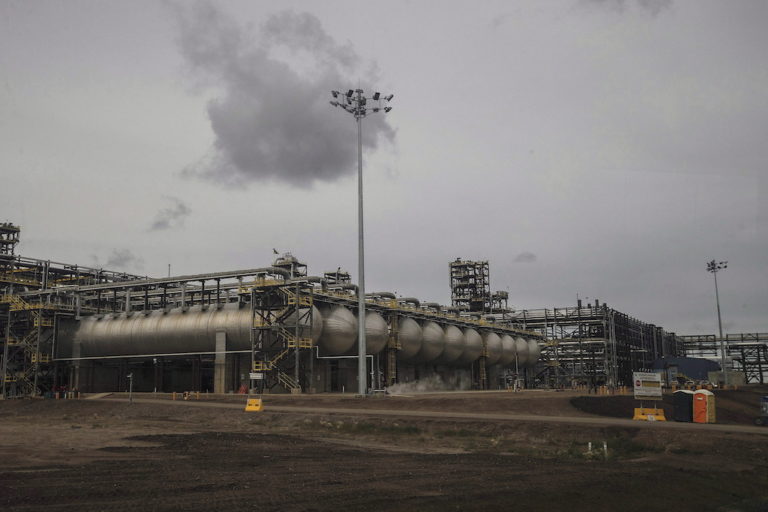
CALGARY — Energy companies and industry lobbyists are urging Ottawa to start backstopping loans to Indigenous communities, a financial arrangement they say could help First Nations secure equity positions in projects worth billions, from wind farms to hydrogen plants.
Skip to content


News
Energy companies urge Ottawa to backstop Indigenous loans amid concerns over project delays
First Nations organization estimates $60B in project equity possible in the natural resources sector alone
Enoch Cree Nation Chief Bill Morin and other dignitaries at a groundbreaking ceremony at the Trans Mountain stockpile site in Edmonton in July 2018. Photo: The Canadian Press/Jason Franson
CALGARY — Energy companies and industry lobbyists are urging Ottawa to start backstopping loans to Indigenous communities, a financial arrangement they say could help First Nations secure equity positions in projects worth billions, from wind farms to hydrogen plants.
In submissions to Finance Canada ahead of next year’s federal budget, companies and organizations including pipeline giant TC Energy, wind and solar developer EDF Renewables and the Canadian Renewable Energy Association say the government should introduce a national loan guarantee program to help crucial net-zero energy projects gain public support while also giving Indigenous people meaningful equity positions in those developments.
Talking Points
- Energy companies are calling on Ottawa to backstop loans to First Nations groups
- They say such a policy could help First Nations secure equity stakes in projects, and comes amid wider concerns over permitting delays on major developments
Under such a program, the federal government would loan money to First Nations for them to invest in major energy and infrastructure projects, then assume any financial obligations should the nation default on its debt.
The First Nations Major Projects Coalition (FNMPC), a Vancouver-based organization that works with Indigenous communities on large-scale developments, estimates that First Nations in Canada could acquire equity stakes in natural resource projects worth up to $60 billion over the next 10 years. (The calculation is based on what it estimates are a total 470 proposed projects in the pipeline valued at $525 billion.)
Niilo Edwards, CEO of the FNMPC, said government guarantees provide Indigenous groups with loans at manageable interest rates they otherwise couldn’t attain. That in turn lets First Nations chiefs invest in projects that, if successful, provide long-term capital that can be ploughed back into communities.
“They are looking to improve their economic self-determination and ultimately the standard of living for their nations,” he said in an interview.
Related Articles

First Nations in Canada have already successfully taken equity stakes in many projects, particularly in Alberta and Ontario. Last year, Calgary pipeline company Enbridge signed an agreement with 23 First Nations and Métis communities that gave them an 11.57 per cent stake in seven pipelines worth an estimated $1.12 billion at the time. In 2017, the Fort McKay First Nation and Mikisew Cree First Nation acquired a 49 per cent stake in one of Suncor Energy’s oil storage farms. Hydro One, Ontario’s public grid operator, offers First Nations a 50 per cent equity stake in all new transmission line projects over $100 million.
Still, Indigenous reactions to major project developments on their lands have been mixed, and opposition to such developments is sometimes charged, heightening tensions in First Nations’ already fraught relations with the Canadian government.
Manitoba’s Sagkeeng First Nation has filed for a court-ordered review of a $453-million hydroelectric power line in the province, while the Pessamit Innu band in Quebec have opposed power lines over concerns that dams built on their traditional lands have decimated salmon populations. Fossil-fuel projects have been met with particular scorn: the Wet’suwet’en First Nation mounted a long campaign against TC Energy’s Coastal GasLink pipeline in western B.C., which prompted protesters in Ontario and Quebec to blockade railways in a show of solidarity.
There are wider concerns within Canada’s energy sector about its ability to secure permission for major projects, including those that will help reach net-zero emissions targets. Oilsands companies are together building a $16.5-billion carbon capture hub that has been met with hesitancy by one First Nation, while local opposition groups more broadly have rallied against everything from wind farms to hydroelectric lines.
The FNMPC, for its part, believes that a loan guarantee program ought to be granted to companies operating in any industry, including the natural resources sector, so that First Nations can choose which projects they want to support themselves.
“A loan guarantee program in our view, and our members’ view, needs to be sector agnostic,” Edwards said. “It needs to empower Indigenous nations to self-determine which projects are right for them or not. And I don’t think it’s the government’s business to put parameters around that and pick and choose the financing support that they’ll offer to Indigenous nations.”
Ian Anderson, the former CEO of Trans Mountain, said loan guarantees could play a role in retaining Canada’s duty to Indigenous peoples. Trans Mountain is nearly tripling the capacity of an existing 300,000-barrel-per-day oil pipeline leading from Edmonton to Vancouver. The Crown corporation and the pipeline’s previous owner, Kinder Morgan, have consulted with over 133 First Nations communities and organizations along the proposed route.
“In order to execute on [treaties] between nations and this country, one of the problems to solve for is financial capacity, and the ability to participate in things like Trans Mountain,” he said. “And one of the ways to solve for that is to backstop loans for projects that are economically worthwhile.”
Ottawa has said it will sell equity stake in Trans Mountain to First Nations along with the necessary financial banking (the federal government purchased the pipeline in 2018 from its previous private sector owner after it threatened to shelve the project). Costs to build the pipeline have ballooned from $7.4 billion in 2017 to $30.9 billion in 2023 due to permitting delays.
Billy Morin, chief of the Enoch Cree Nation west of Edmonton, said that aside from the revenues and jobs that equity positions in projects create, loan guarantees also give First Nations communities a healthy sense of responsibility that helps them break away from decades of dependence on government programs or other assistance. Enoch was one of several Indigenous groups that partnered with Trans Mountain on the pipeline expansion.
“The attitude of ownership, I tell my people, is the attitude of responsibility,” Morin said at a Calgary energy conference in September. “You want to own something, you’re responsible for it now. You’re liable and you have to step up to the plate. And so if we’re talking about energy projects, it’s not enough for us to be on the sidelines.”



Loading...
Thanks for sharing!
You have shared 5 articles this month and reached the maximum amount of shares available.
CloseThis account has reached its share limit.
If you would like to purchase a sharing license please contact The Logic support at [email protected].
CloseGift the full article!
You have gifted 0 article(s) this month and have 5 remaining.
Recipients will be able to read the full text of the article after submitting their email address. They will not have access to other articles or subscriber benefits.
Photo: The Canadian Press/Jason Franson
Most Popular This Week


In-depth, agenda-setting reporting
Great journalism delivered straight to your inbox.
News
Takeovers are shifting control of Canadian firms abroad, survey shows
Briefing
Brookfield joins investors group backing Nvidia’s US$500B AI financing push
Polar raises US$215M for second Canadian risk-transfer fund
Francisco Partners agrees to buy Moneris from BMO, RBC for $2B
Best business newsletter in Canada
Get up to speed in minutes with insights and analysis on the most important stories of the day, every weekday.
Exclusive events
See the bigger picture with reporters and industry experts in subscriber-exclusive events.
Membership in The Logic Council
Membership provides access to our popular Slack channel, participation in subscriber surveys and invitations to exclusive events with our journalists and special guests.